When you use GPS in your car for driving directions, the GPS only provides one direction at a time. GPS tells you what to do now and what to do next. Your car can only go one direction at a time. Humans aren’t any different. When you coach people, you are their GPS, supporting them in achieving a desired goal efficiently.
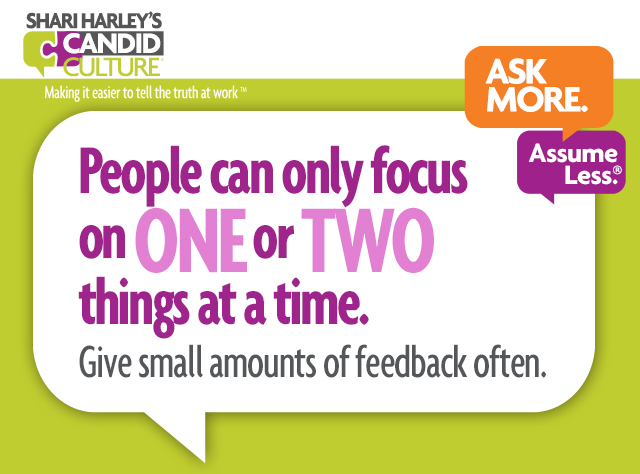
Coach and give feedback like your GPS. Give one or two pieces of feedback at a time. Then give the person time to make changes and improve before giving more feedback.
What I hear every day that makes me shudder:
Manager: “One of my employees has been making a lot of mistakes. He seems disengaged (p.s. “disengaged” is Cap’n Crunch, vague and thus not real feedback). I’m not sure what’s happening.”
Me: “When are performance appraisals?” Manager: “In six weeks.”
Most people hoard feedback. We wait for the right time, aka when we’re comfortable. That time will never come. The right time to give feedback is when something happens or shortly thereafter. Practice the 24-hour guideline and the one-week rule. Wait 24 hours to give feedback if you’re angry, but not longer than a week. Give feedback when you’re not upset, but soon after the event occurs, so people remember what you’re talking about.
Feedback is hard on the ego. The more feedback we receive in one conversation, the harder it is to hear. People need to feel successful. Receiving too much feedback at one time makes us feel we can’t be successful, so why bother. Pick the biggest and most impactful behaviors. Wait. And then give more feedback.
When it comes to feedback, keep this mantra in your head – recency, frequency. Recency, frequency. Short, weekly, feedback conversations – five minutes long – are better than sixty-minute feedback conversation once a month or quarter. You’ll see more behavior change and protect team member’s ego. Shorter and more frequent is better.
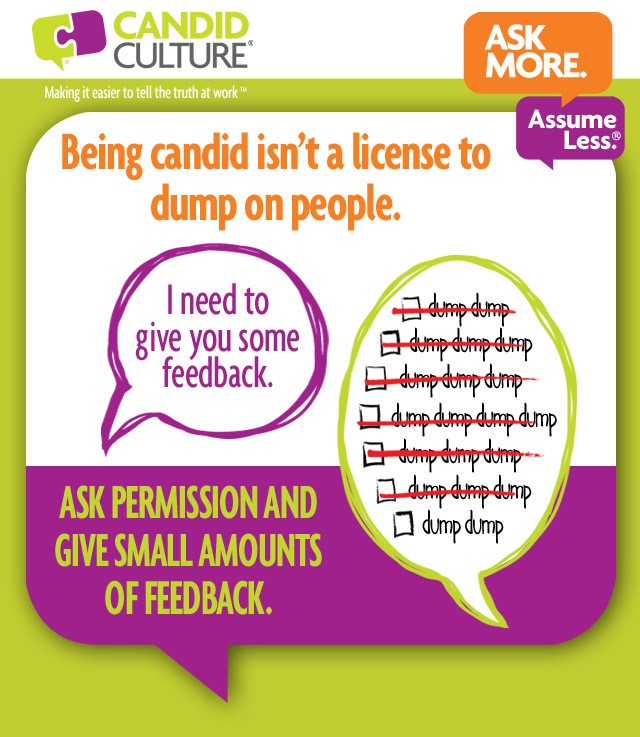
People leave feedback training armed with new skills and
they unfortunately sometimes use those skills as a weapon. It goes something
like this, “I need to have a candid conversation with you.” And then the person
proceeds to dump, dump, dump. This couldn’t be more wrong, wrong, wrong.
When you give someone negative feedback you are essentially telling him that he did something wrong. And who likes to be wrong? The ego gets bruised and people often start to question themselves. This normal reaction doesn’t mean you shouldn’t give feedback, you just need to do it judiciously.
Ask yourself these four questions when deciding whether
or not to give someone feedback:
Do I have the relationship to provide feedback?
Does the recipient trust me and my motives?
Do I have permission to give feedback? If the recipient
doesn’t work for you, you need permission to give feedback.
Is this something the person can do something about?
If it’s not a change the recipient can make, keep your thoughts to yourself.
Is the feedback helpful? Ultimately the purpose
of all feedback is to be helpful.
Let’s say you’re on the receiving end of too much feedback.
What should you do? It’s ok to say “no
thank you” to feedback. Here’s what you could say:
“Thank you for taking the time to bring this to my
attention. I really appreciate it. You’ve given me a lot of feedback today. I’d
like something to focus on that I can impact right now. What’s the most
important thing I should do?” You’ve validated the other person and
demonstrated openness and interest. You’ve also set some boundaries and
expectations of what you will and won’t do.
“Thank you for taking the time to share your requests about…
We won’t be making any changes to that and here’s why.” It’s ok not to act on
all feedback, simply tell people why you won’t.
“I appreciate your concern. I’m not looking for feedback on
that right now.” Can you say that to someone? Yes. Should you? Sometimes. To
your boss – no. To someone who offers unsolicited advice that’s outside of
their lane, yes. They’ll get the message.
People can only act on and digest small amounts of feedback
at a time. Be judicious and assess your motives. The purpose of feedback is to
be helpful, when the feedback is requested and when you have the relationship
to give it.
If you receive too much feedback or unsolicited feedback, it’s
ok to decline. You’re not the 7-11, aka you’re not always open.
Sign Up
Career tips you won't get elsewhere. Sign up to get a free tip card.