Performance appraisals are, for many, the most dreaded day of the year. Most employees anticipate the meeting, wondering what their manager will say. In addition to hearing about the situations your manager, and others in your organization, observed throughout the year, why not tell your manager what you’d like to know?
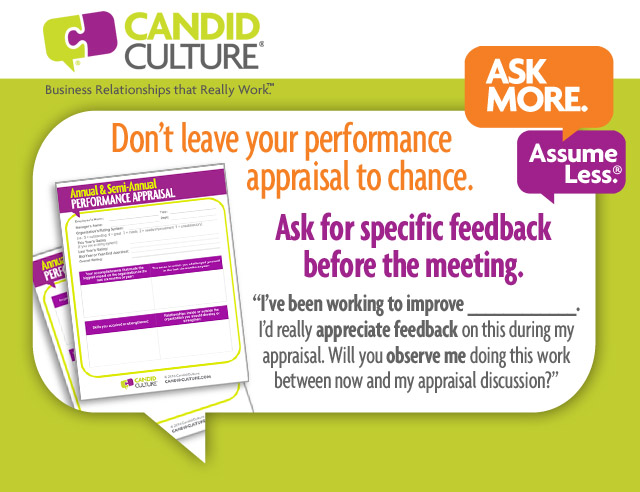
It’s perfectly appropriate to tell your manager you’d like feedback about a specific aspect of your performance or about a certain project or piece of work. And the time to ask for this feedback is at least one month BEFORE your appraisal meeting.
If you ask for feedback during the meeting, you’re likely to catch your boss off guard. Managers don’t typically follow employees around or call into every meeting in which employees participate. As a result, your boss may not have an answer to your question. They are likely not thinking about the specific input you want.
Most people don’t like to be caught off guard or feel they can’t answer a question. Asking for feedback in the moment, that your boss can’t address, may embarrass your manager. Don’t put managers on the spot. Set your boss and yourself up for success by asking for specific feedback BEFORE meetings, and give your manager a chance to observe you doing that kind of work.
Ask a vague question, get a vague answer. Ask a specific question, get a specific answer. If you want specific feedback, let your manager know and give her time to observe you doing the actions you’re asking about BEFORE the feedback conversation.
If you want to know how you manage telling internal or external clients “no”, give your boss a chance to see or hear you do this. If you want feedback on how you built relationships with peers virtually this year, give your boss a chance to observe that behavior or time to ask your peers for input.
Here’s how asking for specific feedback might sound: “My annual performance appraisal is in June. I am, of course, interested in everything you have to say. I’d also like feedback on how I lead large meetings. I’m leading two meetings between now and my appraisal. If you have the availability to call into either one and listen to how I elicit participation while maintaining control of the meeting, I’d really appreciate it. I’ll send you the call-in information.”
When you tell your manager the specific feedback you want to hear and give her an opportunity to observe you doing that work, you demonstrate seriousness about getting feedback and that you respect your manager’s time. You’re also likely to get more useful, specific feedback.
The practice of asking for specific feedback before one-on-one meetings and giving your manager time to observe you doing that work, is something I recommend doing all year, not just when preparing for performance appraisals. Feedback should be delivered as work is produced. The annual review should be just that, a review of conversations that happened during the year.
Remember, you get what you ask for. Ask a vague question, get a vague answer.
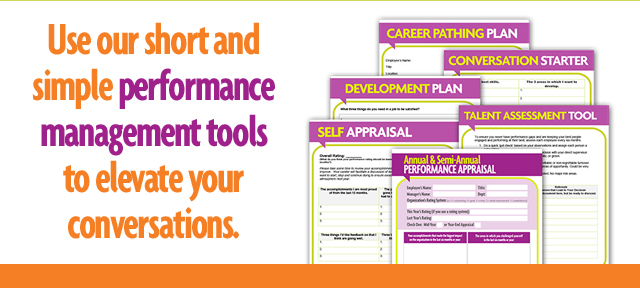
No one (I know) enjoys writing, delivering, or receiving performance feedback. It’s time consuming to write, challenging to deliver, and can be difficult to hear. Unfortunately, most performance management systems – goal setting forms, performance appraisal templates, and online templates – don’t make the process easier, they make it harder. Short and simple is best.
Earlier in my career, when I started managing leadership development for a mutual fund company, I inherited a 12-page performance appraisal form with 80 competencies. One of the business leaders I supported told me, “I’m not asking my people to use this form. If you can give me something that’s one page, I’ll have my managers use it.” That conversation sent me on a mission to make all performance management forms one or two pages. And really, why shouldn’t they be? People can only focus on leveraging and changing a few things at a time. Why give more feedback than that at any given time?
If you’re chasing people to use your performance management tools and templates, you’re using the wrong forms. In my experience, when people find something easy to use and valuable, they’ll use it. If something is difficult to use or doesn’t seem to add value, people drag their heels.
Here are a few ideas for making your performance management process easier:
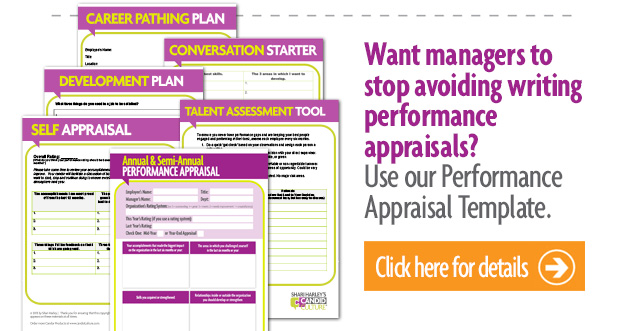
Make your forms and templates simple. No performance management tool should be more than two pages. In a performance appraisal – quarterly, annual, or otherwise – identify up to three things the person did well and a max of three things they can either do more, better, or differently. Anything more is overwhelming and a set up for disappointment, frustration, and overwhelm.
If you have additional areas for the person to work on, meet again in 90-days and assess how the person has done with the three pieces of feedback already provided. If they have made significant progress on the things they were already working on, add a few new things to work on. If significant progress hasn’t been made on the existing feedback, wait to add more.
I know your existing performance management templates may not allow for what I’m suggesting. If you’re working with a template that requires more input, write up to three clear, succinct, and actionable bullets in each required area and not more. Bullets are better than paragraphs. Be specific. “Great job” is not feedback. Neither is, “needs improvement.” Give a specific example or two. No example, no feedback.
Resist the urge to write paragraphs of vague feedback or to accept that type of feedback in a self-appraisal. Paragraphs of feedback take too long to write and often say little. I’d suggest spending less time writing performance feedback and instead spend the time observing performance, asking others for input on the person’s performance, and writing three succinct, specific bullets that describe an action taken or outcome produced. Specific feedback is meaningful, useful, and received with less defensiveness.
Click below to see our suite of one and two-page performance management templates.
Most people would rather get a root canal than participate in an annual performance appraisal.
The reasons performance appraisals are so difficult is simple:
Most managers don’t deliver timely and balanced (positive and negative) feedback throughout the year.
Many employees don’t ask for regular feedback.
Too much information is delivered during the annual employee performance appraisal.
And as crazy as it sounds, managers and employees haven’t agreed to give and receive regular and candid feedback.
Performance appraisals don’t have to be the worst day of the year.
Here are four steps to ensure performance appraisals are useful and positive:
Managers and employees must agree to give and receive balanced, candid feedback. Don’t assume the agreement to speak honestly is implicit, make it explicit.
Managers, be honest and courageous. Don’t rate an employee a five who is really a three. You don’t do anyone any favors. Employees want to know how they’re really doing, no matter how much the feedback may sting.
Managers, focus on three things the employee did well and three things to do more of next year. Any more input is overwhelming.
Managers, schedule a second conversation a week after the employee performance appraisal, so employees can think about and process what you’ve said and discuss further, if necessary.
The key to being able to speak candidly during an employee performance appraisal is as simple as agreeing that you will do so and then being receptive to whatever is said. And don’t make feedback conversations a one-time event. If you do a rigorous workout after not exercising for a long time, you often can’t move the next day. Feedback conversations aren’t any different. They require practice for both the manager and employee to be comfortable.
Sign Up
Career tips you won't get elsewhere. Sign up to get a free tip card.