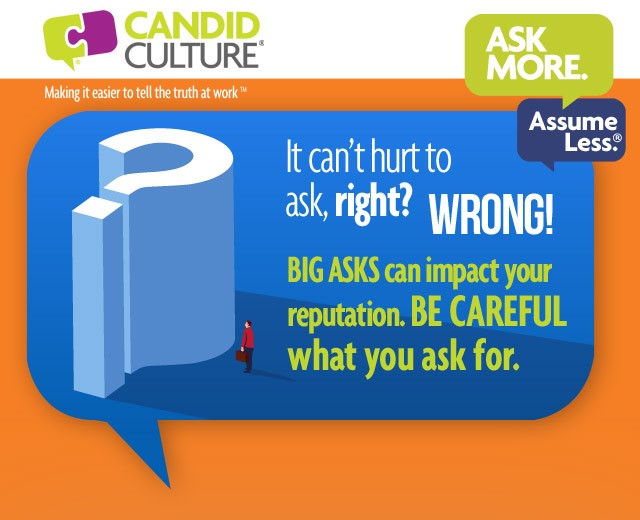
I recently interviewed a candidate who asked for a lot of ‘stuff’ during the interview process. She wanted compensation, perks, accommodations, and benefits that were way outside the norm. I’m assuming she was employing the adage we’ve all heard, that “it can’t hurt to ask.” Unfortunately, it can hurt to ask.
When forging new relationships, we watch (judge) people. We’re trying to figure out who they are and how they are. Are they the person they claimed to be during the interview process? Are they trustworthy? Did I make the right decision in bringing this person into my team, organization, and life?
Requests always make an impression. When we’re building new relationships, requests make an even bigger impression. Candidates who said the commute wouldn’t be an issue, but complain about it two weeks into the job, cause managers to doubt their hiring decision. Coworkers who consistently ask for extensions to deadlines, appear unreliable.
People watch us and silently judge, making assessments about our commitment, reliability and even character. Don’t make people question you. Make reasonable asks.
Five ways to make reasonable requests:
Vet your requests with people who know your company, manager, and/or industry, before making them. A reasonable request in one organization, might not be reasonable in another.
If something is important to you, ask for it during the interview process or at the onset of new projects and relationships. Don’t wait. Waiting to ask for things until after you’ve started a job can damage your relationships and reputation. Managers don’t like bait and switch, even when it’s unintended.
Once you’ve received an emphatic “no”, accept it. I worked with someone who asked for something during the interview process. I said “no” and explained why. He asked again after being hired. This annoyed me and made me feel like he didn’t listen.
If you think a change should be made in your organization, propose a solution. Offer to be the person who drives the process, if appropriate. Pursue the change over a period of months. Ask up to three times for changes to be made. If nothing changes over a period of months, ask the leader you’ve been working with if you should stop asking. The change may not be a priority, and over asking can make you look like a pest who doesn’t understand the organization’s priorities.
If you aren’t sure that what you’re asking for is reasonable, say so. Tell the person what you want and to please tell you if it isn’t a reasonable request.
Ask for feedback on your requests. If you’ve seen me speak, you know I’m a proponent of telling people, “If I do anything that damages our working relationship or makes you question me, I hope you’ll tell me. I promise I’ll take your feedback graciously and say, “thank you.”
Ask for what you want, within reason, be upfront when relationships begin, and build your relationships rather than break them.
Posted under Career Management on October 6, 2025 by Shari Harley. 0 Comments
You might be lucky enough to have a manager who helps you advance your career, but you might not. Either way, you deserve to have the career you want, and ultimately, it’s your job to advance your career.
Advance Your Career Step One: Learn about different areas of your organization and become clear on what you want to learn and what areas of the business you want exposure to. You won’t know what to ask for from your manager if you don’t know what your organization does and the opportunities that are available.
Advance Your Career Step Two: Get to know the leaders and employees in other departments. Find out what they do on a daily basis, the initiatives they’re working on, and their short and long-term goals.
If you’re working virtually or in a hybrid environment, you may be wondering how to learn more about your organization and build relationships from a distance. How do you meet with people you never see? Anything you can do in-person, you can do over the phone or via video. It’s nice to be able to walk into someone’s office and ask a question or connect with someone in the hallway or a breakroom, but it isn’t essential.
Reach out to people in the organization you already know. You can make these connections via email or phone. I recommend phone. Tell people you want to learn more about the organization’s objectives and different departments. Ask who they can connect you with. Networking and building new business relationships virtually takes more upfront work than walking into someone’s office, but it can be done. Ask people to make virtual connections for you and then follow up on those connections within one business day.
Remember the job search advice you were given early in your career, to have informational interviews with people doing the work you wanted to do? Getting to know your current organization better is similar. Ask for informational meetings within your organization. And then communicate with the people you’re connected with in the way THEY like to communicate. Tell a person you’ve been connected with that you’d appreciate 15 minutes of their time and ask how they’d like to meet – via phone or video? Then schedule a short meeting via their preferred medium. When the 15-minutes is up, tell the person, you’re watching the time and you respect their time. Ask if they’d like to end or continue the conversation. And then honor their request. If you’d like to meet again, ask for another meeting. If there are next steps, make those steps clear and follow up via email, if it’s appropriate.
Advance Your Career Step Three: Ask your manager, your peers, and other organizational leaders who you need a good working relationship with and who can influence your next career opportunity.
You never know who talks to whom and who can influence your future opportunities. Department heads talk to other department heads. Don’t assume who can or can’t influence your next opportunity or lack thereof.
Advance Your Career Step Four: Tell people who can influence your career what you want to do. Don’t assume people know what you want to do in the future. In fact, assume others have no idea about the work you want to do and the things you want to learn. Tell people, “I’m really interested in learning more about ___________. I’d like exposure to __________ part of our organization.”
Your career is your responsibility. Don’t wait for your manager make your career happen. Take matters into your own hands. Follow the steps above and get more of what you want at work.
Posted under Career Management on September 7, 2025 by Shari Harley. 2 Comments
Every day I’m annoyed that I’m not perfect. I want to be a combination of Mary Poppins, Super Woman, and Kate Middleton, but I’m not. I’m a business owner, working mom, who just yelled at my son, on his birthday, and ate a large piece of birthday cake with a lot of green icing and sprinkles, despite that I “don’t eat sugar”.
Some days are going to be bad. On those bad days, it’s easy to feel like we’re messing things up and that we are indeed a mess. Instead, give yourself a break. The thing to know and remember, in the moment, is that you’re a human being, doing the best you can.
Here is a list of five ways to give yourself a break and as a result, do your best work.
Set realistic deadlines so you’re not constantly running against time, and overestimate how long everything will take to do.
Before agreeing to a new commitment, ask yourself, “Do I really want to do this?” Try not to commit yourself to things you know, at your core, you don’t want to do. You’ll just resent that commitment when it rolls around and aren’t likely to do your best work.
Turn off the alerts on your phone and laptop when you’re working. You’ll be more focused and get more work done.
Take a day off. Your company offers vacation time for a reason. People do better work when they take time to relax and rejuvenate.
Say “thank you” more and “I’m sorry” less. “Thank you for letting me know” is more empowering than “I’m sorry I missed that.” I’m guilty of apologizing for everything, so much so that one of my employees and I play a game that whoever says she’s sorry first has to throw a dollar in a communal collection pot. Whatever you put attention on will improve.
Some of these things are business focused, some are personal. You bring yourself – your whole self – to work. It’s why you’re good at what you do. People want to work with real people. And real people over commit, make mistakes, and spend too much time on social media at 11:30 pm. Give yourself a break.
Who have you fired lately? The person who cuts your hair or lawn? A doctor, accountant, or restaurant where you had a bad experience? Did you call any of those providers and tell them why you were replacing them? My hunch is no. There’s little incentive to do so. Why risk their defensiveness? It’s easier to just replace them. And the same is true for you.
There’s little incentive for the people you work with to tell you when you frustrate them. The perceived cost seems too high. The people you work (and live) with have experienced others’ defensive responses to negative feedback (which is no fun) and they don’t want to experience your reaction. As a result, when you disappoint or frustrate others, it’s easier to say nothing than tell you the truth.
The tendency for others to tell you things are fine when they’re not, will prevent you from managing your career and relationships. People will go missing and you’ll be passed over for professional opportunities and never know why.
To make it more likely that people will tell you when you disappoint or frustrate them, make it easy to tell you the truth.
Here are seven practices for receiving feedback:
Receiving Feedback Practice #1: When you begin new relationships, tell people you want their feedback.
Receiving Feedback Practice #2: Promise that no matter what people say, you’ll respond with “thank you.” This is very hard to do.
Receiving Feedback Practice #3: Tell people you already have relationships with, that if you haven’t said it in the past, you really want their feedback and promise to respond graciously with “thank you.”
Receiving Feedback Practice #4: Ask people who matter to you for feedback regularly.
Receiving Feedback Practice #5: Resist the urge to get defensive.
Receiving Feedback Practice #6: Catch yourself when you start to become defensive and apologize. Say something like, “I’m getting defensive. I’m sorry. Tell me again. I’ll do a better job of listening.”
Receiving Feedback Practice #7: Take a break from conversations during which you find yourself responding defensively. Say something like, “I’m not responding as well as I’d like. How about we take a break? Give me a few minutes (hours or days) and I’ll come back to you to talk more. I really want to hear what you have to say.”
The aforementioned list provides recommendations for asking for and receiving feedback you want, not feedback you don’t. You are not a dumping ground. Don’t ask for feedback you don’t want. And when you do ask for feedback, qualify what type of feedback you’re looking for. Telling people “I want your feedback” doesn’t mean they’re welcome to say whatever they want.
The purpose of asking for feedback and making it safe to tell the truth is to give you more control over your career and relationships. It’s ok to be passed over for opportunities and relationships, but it’s unhelpful not to know why.
When something ‘bad’ happens, my nine-year-old is quick to ask who is at fault, hoping, of course, it’s not him. I’m trying to get him to use the word accountability instead, and to understand that if he has some accountability, he has some control over what happens. If he has no accountability, he has no control. A tough concept for a nine-year-old.
Stuff happens. People won’t give you what you need to complete projects. Things will break. When breakdowns happen, I always ask myself, “What could I have done to prevent this situation?” or “What did I do to help create this situation?”
It may sound odd that I always look at myself when breakdowns occur, even when it’s someone else who didn’t do their job. It’s just easier. When I can identify something I could have done to make a situation go differently, I feel more in control – aka better.
I’m the person who gets off a highway jammed with traffic. The alternative route may end up taking longer, but at least I’m moving. I feel like I’m doing something and thus have more control. Taking responsibility for what happens to you is similar. When you’re accountable for what happens, you can do something to improve your situation. When someone else is accountable, you’re at the mercy of other people and have very little control.
There are, of course, exceptions to the practice that “we’re accountable.” Terrible and unfair acts of violence, crime, and illness happen to people, about which they have no control. But in general, in our day-to-day lives, there is typically something we did to contribute to a bad situation or something we can do to improve it.
Here are four practices for improving difficult situations even when you didn’t create the mess alone.
Ask more questions. If you’re not clear as to what someone is expecting from you, ask. Even if their instructions aren’t clear, it is you who will likely be held accountable later.
Tell people what you think they’re expecting and what you’re planning to do, to ensure everyone’s expectations are aligned. This beats doing weeks’ worth of work, only to discover what you created isn’t what someone else had it mind.
Ask for specific feedback as projects progress. Don’t wait until the end of a project to find out how you performed.
Admit when you make a mistake or when you wish you had done something differently. Don’t wait for someone to tell you. Saying, “I’m sorry. How can I make this right with you?” goes a long way.
These are really delegation practices — reverse delegation. Help people express their expectations of you clearly, so you can be successful.
I am always asking the questions, “What could I have done differently? What did I do to contribute to this situation, what can I do now to make this situation better?” I encourage you to do the same, even when someone else drops the ball. You can’t control others, but you can control you. And your happiness and success is your responsibility.
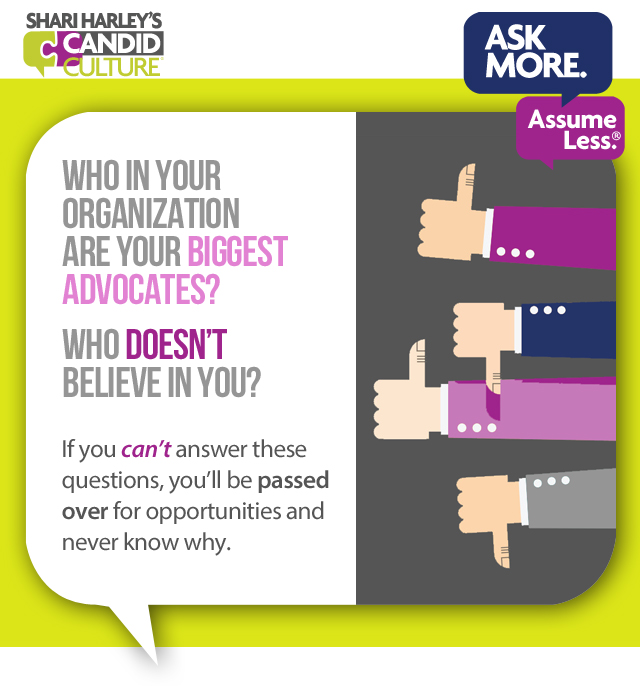
You will be passed over for jobs, projects, and opportunities, and never know why. Being passed over isn’t necessarily a bad thing, not knowing why you were passed over is problematic. If you don’t know why you’re being passed over, how can you be prepared next time?
Organizations are political. People talk. You’ve undoubtedly already experienced this.
If you want to manage your professional reputation, one thing you must know is who talks about you and what they say. How decisions get made in organizations isn’t always obvious. There are the obvious channels of decision making, like your boss and your boss’s boss. But there are also the people who talk to your boss and boss’s boss and have an opinion about you, who you may not be aware of.
Everyone in an organization has people they trust, who they listen to and confide in. Who those trusted people are isn’t always obvious. When you’re being considered for a new position or project, the decision makers will invariably ask others for their opinion. Knowing who does and doesn’t support you in a future role is essential to managing your professional reputation and career.
I don’t want you to be nervous, paranoid, or suspicious at work. I do want you to be savvy, smart, and aware.
It’s not difficult to find out who can impact your professional reputation at work, you just need to ask the people who know. Start with your manager. Your manager likely knows and will tell you, if you ask.
To ensure you know who can impact your professional reputation, tell your manager:
“I really enjoy working here. I enjoy the people, the work and our industry. I’m committed to growing my career with this organization.”
Who in the organization should I have a good relationship with?
Who/what departments should I be working closely with?
Who impacts my professional reputation and the opportunities I have?
What skills do I have that the organization values most?
What contributions have I made that the organization values most?
What mistakes have I made from which I need to recover?
Your manager doesn’t walk around thinking about the answers to these questions. If you want thoughtful answers, set a time to meet with your manager. Tell your manager the purpose of the meeting – to get feedback on your professional reputation so you can adeptly manage your career – and send the questions in advance, giving your manager time to prepare for the meeting. You will get more thoughtful and complete answers if your manager has two weeks to think about the questions and ask others for input.
Don’t be caught off guard by a less-than-stellar professional reputation. Take control of your reputation and career. Ask more. Assume less.
There was way too much guessing at work before most people began working from home. Without visual cues, figuring out how to work with people is even harder. You may find yourself thinking, “I’m going to miss this deadline. I wonder what the consequences will be?” Or perhaps, “They said they wanted input on this project. I wonder if they really meant that, and how much feedback is ok to provide?” Or maybe, “They asked for a proposal. Are they expecting something elaborate, or will a one-pager do?”
We often don’t know what others are expecting from us, so we guess. The problem with guessing is that we may do more work than we actually need to, and not in the way the other person wants it. Even worse, when we don’t work according to others’ expectations, they aren’t likely to tell us. Instead, they tell others and make decisions about us that aren’t positive.
I’m a fan of asking lots and lots of questions, preferably at the beginning of anything new. Anticipate all that can happen, get in front of breakdowns, and set clear expectations by asking questions. The people who participate in virtual and in-person training with me get an entire box of questions to ask. And the homework is to go ask more questions of the people they work most closely with. Asking questions will always be easier than recovering from violated and often unstated expectations.
If you want fewer breakdowns and frustrations at work, ask the following questions of the people you work with:
What do you want to do, on this project, and what do you want me to do?
What does a good job look like?
What will be different in the organization when this project is finished?
How would I frustrate you and not even know it?
How often do you want to receive updates from me?
Do you want to receive all the details or just big picture information?
Do you want to receive the information in bullet form or paragraphs?
It’s never too late to ask questions like these. It’s ideal to ask the question at the beginning of a piece of work. But asking in the middle or even towards the end is fine too. People will appreciate that you asked, whenever you ask.
You receive a meeting request for August 5th. Your calendar is open, so you accept the request. You get asked to visit an out-of-state client on August 12th. Your calendar is open, so you say yes. You’re asked to make a presentation in place of a team member who is out of town, on August 14th. You want to be a team player, so you say yes. And soon what was a relatively slow month is booked with meetings, travel, and other commitments. Mid-month you’re tired, over-extended, and resentful. You want to be a good team member and a responsive professional. How do you do both without feeling tired and resentful?
One of the best pieces of advice I heard many years ago was to decide how to handle something before the situation presents itself. For example, if you’re trying to lose weight and you’re going to an event that will have an amazing buffet, decide what you will and won’t eat before you arrive. Choosing not to eat the desserts will be much easier if you’ve made that decision before the event rather than when you’re standing in front of temptation. Managing commitments and schedules can work the same way.
Before having a child, I worked 80 hours a week and traveled up to six days a week. And I loved every second of it. After having my son, I realized that I didn’t want to keep that kind of schedule anymore. I needed to cut back. So, I created clear and specific boundaries for myself. I decided how many days a month I would travel, by what time I needed to arrive home from each trip so I could see my son before he went to sleep, and how many speaking engagements I would commit to each month. When I receive speaking requests, I honor my pre-established boundaries. If I am already on the road the maximum number of days I told myself I would travel, I ask if the client can do a different month or if I can speak virtually. If the answer is no, I turn the work down.
I rarely deviate from my established boundaries. And when speaking requests come in, the decision-making isn’t a struggle. I don’t have to decide if accepting a request will be too much. I’ve already made the hard decisions about the schedule I will keep. So, each incoming request either fits into my already-decided-schedule or it doesn’t.
I work for myself. I have latitude to make decisions about my schedule that I might not if I still had a regular, corporate job. So how do you make and share decisions when you’re not your own boss?
Decide what you want your schedule to look like. How many hours do you want to work a week? What time would you like to start and stop working on most days? How much travel are you willing and able to do? How many meetings can you attend a day and still get your work done, so you’re not working each evening or weekend?
Then communicate your desired schedule to the person you work for. Tell your manager how much travel you would like to do and the hours you would like to work. Then negotiate. You may not be able to maintain the schedule you want all the time, but you certainly won’t if you don’t make your desires known.
The time to tell your manager that you want to reduce your travel is before you’re asked to take a trip, not after. But it’s never too late. If you find yourself too busy or on the road too much, you can always have a conversation and renegotiate.
Too often people sit at their laptops doing their minimal best while begrudging their boss, organization, or current job, hoping that something better will come along. Or people silently do good work and think that someday someone will notice, and they’ll get the role and recognition they deserve.
If you want to advance your career, you must know how to ask for more responsibility at work.
You may be rolling your eyes thinking, “More? I can’t do more. I already work evenings and weekends. I sleep with my phone and haven’t taken a vacation in two years, and you want me to do more?!?!” Actually, I want you to stop sleeping with your phone and go on vacation. But that’s a post for a different day.
When I say do more, I don’t mean to do anything anyone asks nor anything your organization needs. Offer to take on more work that is aligned with what you want to do AND is important to the leaders of your organization.
Before starting Candid Culture, I had a corporate job, leading an operations unit. Four years into my tenure with the company, one of my peers left, and his role wasn’t refilled. I felt his department was important to our organization’s success, so I offered to run his department, in addition to my own.
My new department was a change agent’s dream. I outlined a strategic plan and long and short-term goals. I re-wrote job descriptions and org charts. But six months into taking on the department, I couldn’t get one change approved. I was confused and frustrated.
I had initially been hired to turn another department around, and I’d been very successful at getting changes approved. Yet this time, I could get nothing approved. After six months of banging my head against a wall, I finally ‘got it.’ The owners of the company didn’t see the department as valuable, thus they weren’t willing to invest in it. Hence why the job sat vacant, until I offered to do it.
I’m embarrassed at how long it took me to see that the only person committed to my new department was me. When my colleague’s senior-level job wasn’t refilled and there was no hiring freeze, I should have known the department wasn’t seen as important.
If you want to know what’s important in your organization, look at where the money is being spent. What departments and/or leaders are getting resources?
When I say ask for more, I mean be strategic about what you ask for.
Ask yourself these questions:
What do I want to do?
Where in the organization are there opportunities to do that kind of work – that is important to the organization’s leaders?
Who will support me in doing this work? Who won’t?
How to ask for more responsibility at work. Tell your boss and/or department leader:
I really enjoy working here. I enjoy the people, the work and our industry.
I’m committed to growing my career with this organization.
I’m interested in learning more about ________________________.
I’d love to run ___________________________.
I think we have some opportunities to make improvements in _____________________.
How could I get some exposure to ____________________.
A project is starting in ______________. I’d love to be on the team. What are your thoughts about that? Would you be comfortable supporting my participation? If yes, how can we make it happen? If not, what would you need from me in order to support it?
The work you take on does not need to be high level. Everyone in an organization does grunt work. Just be sure that whatever you offer to do is seen as integral to the future of the organization. You’re not likely to get what you don’t ask for.
We’ve all heard the expression, “It doesn’t hurt to ask.” But what if it can and does?
A past, full-time nanny told me she was planning to attend a party the night I had an overnight work trip planned. She told me I need to find alternative care for my son while I was out of town. I had made an agreement with the nanny when I hired her. She could take any day off during the year, except when I was traveling for work. And I would provide months of notice when I scheduled a work trip. Her request to attend a mid-week, party when I was traveling was incredibly stressful (for me) and made me question her judgment and her commitment to the job.
While it’s true that you won’t get what you don’t ask for, it’s also true that requests form others’ impressions of us. Some asks may create the impression that we’re difficult to work with. Other requests may create the impression that we’re out of touch or entitled. Be brave in what you ask for but also be judicious and aware of how requests may impact others.
So, what shouldn’t you ask for at work? What’s appropriate in one environment may not be ok in another.
Here are a few do’s and don’ts to follow when making requests:
Don’t ask for anything that requires your boss to break the rules or treat you differently from other employees. This may seem obvious, but I’ve been asked for things that I couldn’t legally provide. A candidate asked me to write them a monthly check towards their personal health insurance plan versus participating in our company-sponsored health insurance plan. It’s an innocent request but put me in a very awkward position and I said no.
Consider how your requests impact other people. Will your request for time off create challenges for your teammates?
Don’t ask for or take time off during the busiest times of the year. Ask your boss what those busy times are and then plan accordingly.
Don’t ask for exceptions unless you’re desperate – being paid in advance to cover unforeseen personal expenses, taking time off you haven’t earned, and using company resources for personal use. All of these may seem acceptable in the moment, but if they make your boss bend or break the rules, they’ll likely make you look bad too.
Be brave. Be bold. And be careful what you ask for. Your reputation is more important than a request that feels important right now but will be insignificant by next year.