Running effective meetings is hard. It takes courage. Who wants to tell their boss, peers, and customers to put away their phones, stop side talking, and speak more succinctly? No one. But if you run meetings and don’t manage ‘bad’ meeting behavior, you look bad and you won’t get the results you want.
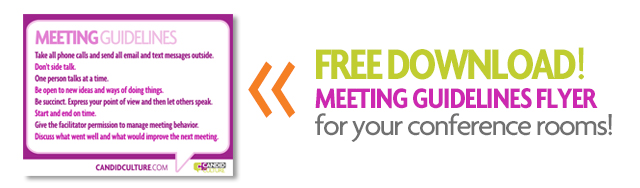
Meeting facilitators, work with the meeting participants to set expectations everyone agrees to follow. Standard meeting guidelines include not side talking, putting away or silencing electronics, tabling tangents, not interrupting others, speaking succinctly, etc. You can set any behavior guidelines you like as long as the meeting participants agree to those expectations. Ask meeting participants what behavior guidelines they want to follow. The more control you give people, the more buy in you’ll get. Remind people of the guidelines at the beginning of every meeting and then hold people accountable.
Possibly even more frustrating than running a meeting in which participants break all the ‘rules’, is participating in inefficient meetings when you aren’t the facilitator. It’s difficult to sit through a poorly run meeting feeling there isn’t anything you can do to make it better.
Luckily, there are things you can do to improve the meetings you don’t run. None of my suggestions will be comfortable. But think of all the time you’ll save.
Conversation one – running effective meetings: If you want to impact the meetings you attend, approach the facilitator(s), empathize about what a challenging meeting it is to run, tell the person you want to be supportive, and ask if they want to discuss some different ways to manage the meeting. That conversation could sound something like, “Wednesday’s staff meeting is tough to run. Would you be interested in talking through some different ways to manage participant behavior? I have some ideas and would be happy to discuss. I’d like to be helpful.”
Conversation two – running effective meetings: If you want to be more direct, you could say something like, “Can we talk about Wednesday’s staff meeting? It can’t be an easy meeting to run. Key decision makers are missing meetings, and a few people tend to take over the conversation and take us off track. Can I make a few suggestions that might help? What do you think of working with the group to set some expectations people agree follow and then holding people to those agreements? We can share the facilitation responsibilities by assigning jobs during the meeting – back up facilitator, note taker, timekeeper, etc. – so all of the responsibility doesn’t fall to you. What do you think?”
The person running the meetings knows they’re not going well. They just don’t know what to do about it. Offer support. Don’t judge. Be helpful and possibly they’ll be receptive.
The key to running an effective meeting is to set clear expectations people agree to follow, review those expectations at the beginning of every meeting, and speak up when the expectations are violated. All of these things take courage. But meeting participants will be grateful to you for being strong.

Meetings go long; attendees stealthily text under the table like no one can see them; one person talks the whole time, while everyone else rolls their eyes. All the while, the facilitator does nothing.
Sound familiar?
The amount of time wasted in unproductive meetings and the degree of frustration meeting participants feel is astronomical.
The solution is simple but may not feel easy.
Set clear meeting expectations at the beginning of EVERY meeting and hold people accountable when they violate the guidelines.
Most meeting facilitators don’t set expectations at the beginning of meetings. Instead, facilitators expect attendees to follow the unstated, assumed guidelines. And when the meeting facilitator’s boss, peers, or customers are on their phone, it’s too hard to say something, so facilitators ignore the behavior, hoping it will stop without intervention.
The key to getting what you want in meetings (and in life) is to ask, which for the most part, we don’t. We assume people will do things as we do.
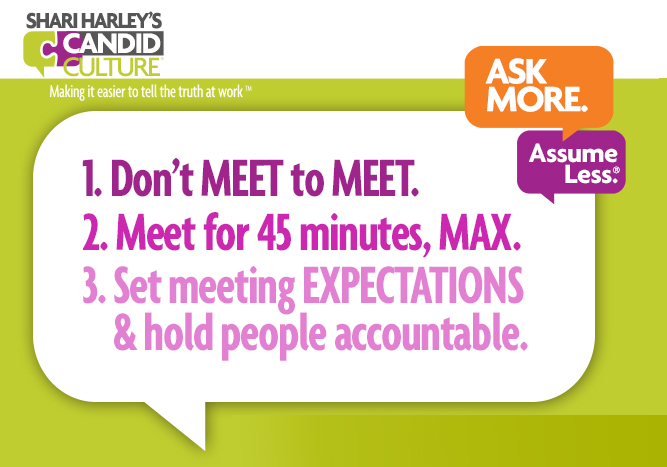
Tips for Running an Effective Meeting:
1. Set meeting expectations at your next meeting.
2. Write the expectations on a flip chart or in the chat and hang them up/post them in the chat at the beginning of every meeting.
3. Review the meeting expectations every time you meet, even with groups who meet weekly.
4. Ask meeting participants’ permission to manage meeting behavior. Your role as the meeting facilitator gives you the right to address bad meeting behavior. Asking for permission and letting people know you will say something if you see their phone etc., makes it easier to speak up.
5. Tell participants they are expected to hold themselves and each other accountable.
6. Then hold people accountable for following the meeting expectations. If you ask people not to side talk, address side talking when you hear it. If you ask people not to be on their laptops or phones, ask people to put them away. If one person talks too long, interrupt them. You will have no credibility if you set expectations but don’t hold people accountable.
The reason facilitators don’t hold people accountable is that they feel uncomfortable. It’s hard to tell your peers, boss, and coworkers to be more succinct. It’s almost impossible if you don’t set expectations about meeting behavior and set the expectation that you will say something when the meeting expectations are violated. The simple act of setting meeting expectations and asking people’s permission to manage to those expectations makes managing ‘bad’ meeting behavior easier. Not easy, but easier.
You may be thinking, “I don’t run these meetings. I’m an innocent victim.”
As a meeting participant, it is frustrating to go to poorly run meetings. But it’s also your role to speak up when you see things going poorly. Talk with the meeting facilitator.
The conversation could go something like this:
Express empathy: “That Wednesday team meeting is tough. I wouldn’t want to run it.”
Ask permission to give feedback: “I’d like to help. I’ve got a few observations and suggestions. Is it ok if I share them?”
Give feedback: “I’ve noticed that several people have been missing the meeting and others are on their phones and laptops during meetings. This definitely limits what we can get done and must be frustrating to you. What are your thoughts?”
Make a suggestion: “What do you think of setting meeting expectations at the next meeting and then telling people you’re going to hold them accountable?”
Offer help: “You’re not alone in this meeting. I’d be happy to tee up this discussion and explain why we need to set meeting expectations. What do you think?”
The facilitator knows the meetings aren’t going well. She just doesn’t know what to do. Offer to help. Don’t judge. She might be more receptive than you think. And you can stop suffering through poorly run meetings.