
Call Shari 303-863-0948 or Email Us

Posts Tagged ‘how to work with a control freak’

Manage Control Freaks – Give More Data

Frustrated by a control freak, micromanager, or a high-need-to-know type? Controlling behavior stems from a need that isn’t being met. Identify the need, meet it, and your life gets easier.

If someone wants more updates, information, or involvement than you’re comfortable with, the person has a need that isn’t being met. When you meet the need, the person will likely back off.

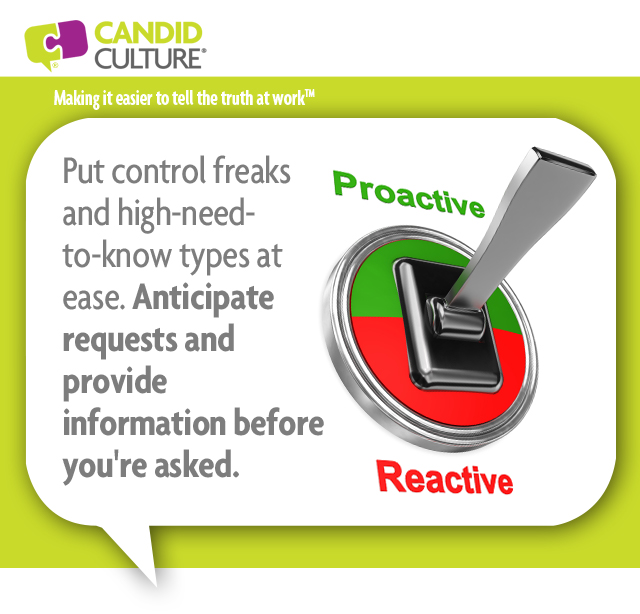
I ask the people who work for me to not make me ask for anything twice. Meaning, if I ask for an update the week before a speaking engagement, anticipate that I’ll want that information for all engagements. Confirm by asking me and then provide the data without being asked for all future engagements. Getting the information regularly without having to ask builds trust and credibility.
Here are six tips for working with control freaks:

1. If you don’t know, ask:

  • The person’s work-related goals. What are they working on this quarter and year?
  • What the person is concerned about at work? What are they worried about?
  • How do they like to communicate – in-person, email, phone, video, voicemail, or text?
  • How often do they want information, in what format, and with how much detail?

2. When you first begin working with someone, provide more information than you think you need to, and then confirm the person wants that information in the future.

3. If you’re asked for information, ask if they want the same type of information in the future. Then provide the information before you’re asked.

4. If someone is overly involved in your work and you feel you have no freedom, state your observation, and ask for information. That could sound like, “I’ve noticed you’ve been involved with the major decisions with this project. I’m used to working with less oversight. Do you have a concern about my approach?” Then you negotiate. Everything is a negotiation.

5. The approach in number four will likely put the other person on the defensive. A less confrontational approach is to discuss and agree upon levels of involvement and supervision when projects begin. That could sound something like, “What kind of involvement do you want to have in this project? What parts of the project do you want to do? What parts do you want me to do? What kind of updates would you like, how often, and with how much detail?” It’s always easier to prevent a problem than to fix one.

6. Lastly, don’t take anything personally. Oversight and involvement may be a reflection of how someone feels about your performance, but it might not. When in doubt, ask.  


Build Others’ Confidence by Saying Less

One of the hardest things I ever did was to hire someone to care for my infant son. “Here is the person most important to me in the world. Keep him alive.” I had no idea how difficult it would be to trust a relative stranger so implicitly. And as a result, let’s just say I was not the easiest parent to work for.

My son is now nine. While this was a long time ago, I’m still embarrassed to admit that I wrote sixteen-pages of instructions on how to take care of my kid. And I gave that ‘booklet’ to a nanny with much more childcare experience than I had. When I heard my son crying, I would tell myself not to walk into the room and check on him, knowing it undermined the nanny, but I did it anyway. When the nanny sent me an update of when my son last ate, I replied telling her when he should eat again, even though I knew she already knew that. Yes, I really did these things.

Each time I over instructed, monitored, and advised, I regretted it. I knew micromanaging our nanny made me difficult to work with, which is not how I wanted to be.

build confidence

Many people attend training on how to manage others. I’d suggest we also look at how we manage ourselves. How does working with you make people feel? Do your questions, requests, and interactions make people feel more self-confident and valued, or do people feel questioned and undermined? Do you pick your battles? Do you give just enough direction but not so much as to squelch the other person’s ideas, initiative, and spirit, especially when the stakes are high?

As you know, I’m evaluating how I do these things too. We are always a work in progress.

Here are four ways to build confidence in the people you work with:

Build Confidence 1: Ask people for their ideas and implement those ideas whenever possible. And if you aren’t open to others’ ideas, don’t ask for them. It’s better not to ask for ideas than to ask when you’re really not interested.

Build Confidence 2: Ask for and be open to others’ feedback. People will be more receptive to your feedback when you’re receptive to theirs.

Build Confidence 3: Say “thank you” regularly and mean it. Give specific examples about what you’re thankful for.

Build Confidence 4: Admit when you’re wrong. Strong people admit mistakes, weak people don’t.

People can work with you, around you, and against you. Earn loyalty and respect by respecting others’ talents and knowing when to take a step back.

build confidence

Sign Up

Career tips
you won't get
elsewhere. Sign up
to get a free
tip card.
MENU

Shari Harley