My last boss, before I started Candid Culture 18 years ago, was the best boss I ever had. He always had my back. He was knowledgeable about the business and happy to share his knowledge. He trusted me and gave me a lot of latitude. And I confused that positive relationship with that of a confidante.
I felt comfortable with my boss, so I complained about my internal customers to him. I thought he was a safe person to do that with. I was wrong. He eventually told me he had no way to determine that I didn’t vent with everyone. My naïve decision to vent to my boss was a point of reference about my professionalism and not a good one.
A manager’s job is to help employees eliminate obstacles, ensure employees have the resources they need to be successful, and to be a coach. A manager’s job is also to evaluate their employees.
Managers only have so many points of reference to evaluate their employees’ performance. If employees tend to vent with their boss how internal customers are difficult to work with, the manager doesn’t know that that employees don’t do this with everyone. It’s a point of reference that makes an impression.
It would have been fine to tell my boss I was struggling to work with an internal customer and ask for suggestions for how to work better with the person. It would have been fine to say I was frustrated or discouraged and was in need of support. It’s ok to share problems and breakdowns and leverage your boss to find solutions and to get help. Asking your boss to help you solve a problem you haven’t been able to solve yourself is expected. Using your boss as a therapist is not.
I don’t want you to be paranoid, to feel that you have to watch every word that comes out of your mouth, and that you always have to be on your guard. Just know the role people in organizations play. Leaders and managers have to determine who is successful in their current role and who is a good fit for future roles, so be mindful of how you show up and to whom.
We all know impressions are formed quickly and are hard to change. If someone sees you once a week, one a month, once a quarter, what are they seeing? People only know what we show them and what others tell them. Let your boss see the poised professional you are. Let your friends and family see the rest.
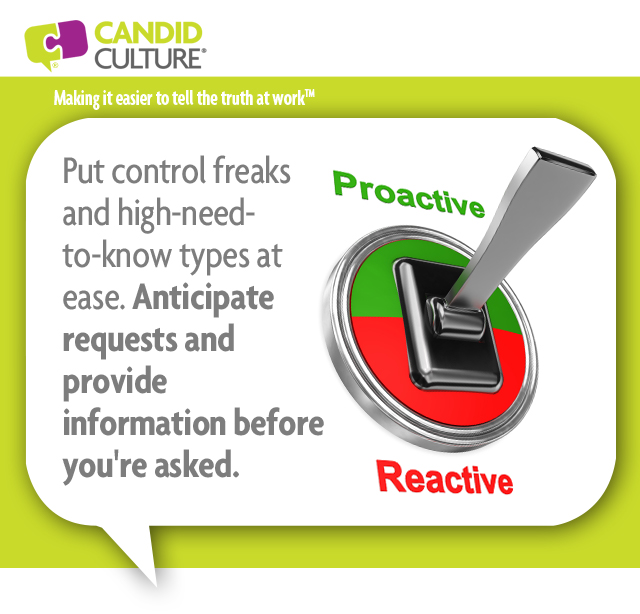
Frustrated by a control freak, micromanager, or a high-need-to-know type? Controlling behavior stems from a need that isn’t being met. Identify the need, meet it, and your life gets easier.
If someone wants more updates, information, or involvement than you’re comfortable with, the person has a need that isn’t being met. When you meet the need, the person will likely back off.
I ask the people who work for me to not make me ask for anything twice. Meaning, if I ask for an update the week before a speaking engagement, anticipate that I’ll want that information for all engagements. Confirm by asking me and then provide the data without being asked for all future engagements. Getting the information regularly without having to ask builds trust and credibility.
Here are six tips for working with control freaks:
1. If you don’t know, ask:
The person’s work-related goals. What are they working on this quarter and year?
What the person is concerned about at work? What are they worried about?
How do they like to communicate – in-person, email, phone, video, voicemail, or text?
How often do they want information, in what format, and with how much detail?
2. When you first begin working with someone, provide more information than you think you need to, and then confirm the person wants that information in the future.
3. If you’re asked for information, ask if they want the same type of information in the future. Then provide the information before you’re asked.
4. If someone is overly involved in your work and you feel you have no freedom, state your observation, and ask for information. That could sound like, “I’ve noticed you’ve been involved with the major decisions with this project. I’m used to working with less oversight. Do you have a concern about my approach?” Then you negotiate. Everything is a negotiation.
5. The approach in number four will likely put the other person on the defensive. A less confrontational approach is to discuss and agree upon levels of involvement and supervision when projects begin. That could sound something like, “What kind of involvement do you want to have in this project? What parts of the project do you want to do? What parts do you want me to do? What kind of updates would you like, how often, and with how much detail?” It’s always easier to prevent a problem than to fix one.
6. Lastly, don’t take anything personally. Oversight and involvement may be a reflection of how someone feels about your performance, but it might not. When in doubt, ask.
Sign Up
Career tips you won't get elsewhere. Sign up to get a free tip card.