Eighteen years ago, I quit my corporate job to start Candid Culture. I had almost no business relationships or contacts outside of my corporate job. Thinking I should network, I registered to attend the Society for Human Resource Management (SHRM) National Conference in Las Vegas. It’s the largest HR conference in the world – approximately 27,000 people attend. I flew to Las Vegas to attend the conference, but I was so terrified about my new undertaking, I spent three days in bed, ordering bad room service, paralyzed by fear. I barely left my hotel room and attended almost none of the conference.
A few years ago, I spoke at that same conference – the SHRM National Conference – also in Las Vegas, to an audience of 750 people. In two weeks, I’m speaking at the SHRM Talent Conference in Dallas. Will I see you there?
Things have come full circle.
When something feels big and I’m not sure what to do, I do nothing. And my hunch is, I’m not alone. The key to getting through anything large, scary, or intimidating is to start. Any action will do. The key is simply taking action.
Here are five actions you and your manager can take to make taking action more likely:
Action #1: What often stands in the way of taking action is that we aren’t sure what to do. Perhaps we aren’t sure we can do the task at hand. Or we can’t see what the end result should look like. Or the project feels so big that even thinking about starting is tiring. Ask questions and ask for help.
Most managers could strengthen their delegation skills. When assigning a project, managers often ask, “Do you have any questions?” This is an ineffective question because few people want to admit to having questions. Or managers ask, “What do you need from me?” when most people have no idea what they need.
Don’t be afraid to ask questions until you’re clear about what a good job looks like.
Action #2: Managers, ask better questions. Rather than asking if employees have questions, ask, “What’s your plan? What are you going to do first? What are you doing to do next?” These delegation questions will tell you what employees know and don’t know. Asking, “Do you have any questions” or “does this make sense” tells you nothing.
Action #3: Do one small thing, anything, towards achieving the goal. And do it now. Don’t wait until the right time. The right time is now.
Action #4: Managers, delegate projects with multiple, short deadlines. Set direct reports up for success by helping employees break projects into multiple, small deliverables. Ask to review work as it’s completed versus when the entire project is due.
Action #5: Give yourself small windows of time to work on a project. If you give yourself 60 uninterrupted minutes to work, you’re likely to invest that time. If you dedicate a day, you’re likely to get distracted and fill the time with other things.
Trust that you can do what’s in front of you. Someone wouldn’t have asked you to do something if they’d didn’t have confidence that you could do it. And if this is a goal you set for yourself, and it’s something you really want, deep down, you know you’re capable of doing it.
If you’re overwhelmed or don’t believe you can do something, call someone who has more faith in you than you have in yourself. Let that person fill you with confidence until you can generate it for yourself. When I started Candid Culture, I was filled with fear and quite honestly, was convinced I was going to fail. But my friends and past coworkers believed I could do it. And their confidence carried me until I could generate my own.
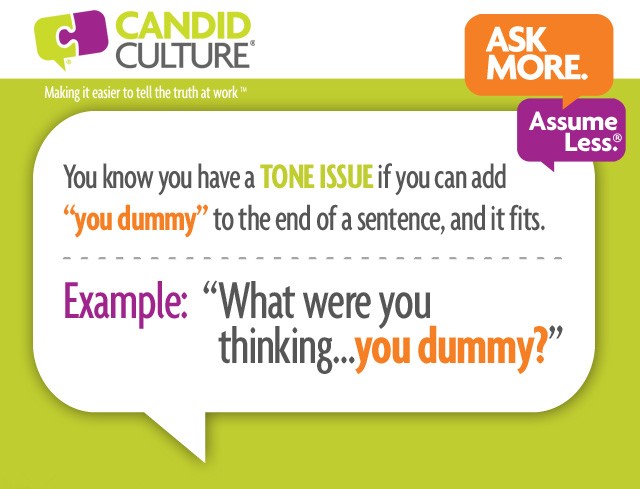
You know when someone gives you ‘the tone’, similar to when people roll their eyes at you? When you get ‘the tone’ you’re being told that the other person is exasperated.
Tone of voice is one of the hardest things to coach because we don’t hear ourselves. People who give people ‘the tone’ rarely know they’re doing it.
One of the best ways I know to effectively coach tone of voice is to ask tone givers to record themselves during meetings and calls, then listen to the recording together and ask what they heard and how they would have interpretated the communication had it been directed at them. Finally, ask if their tone would pass The Grandma Test. Ask, “If your grandmother called and someone spoke to her that way, how would you feel?” No one wants to speak unkindly to their grandma. You can also read emails out loud, adding the tone you ‘heard’, and ask the sender how they would have interpreted the message.
When given the tone, most people feel judged. And when people feel judged, conversations are constrained.
The way to avoid giving ‘the tone’ is to come from a place of curiosity. When you ask the question, “What were you thinking when you approached the customer that way,” you can sound curious or judgmental. Being judgmental evokes defensiveness, which shuts conversations down. Being curious creates discussion.
Consider asking questions like these to invite discussion:
“Tell me more about… Help me understand… What are your thoughts about…. What’s the history behind….”
Any of these questions will lead to a good discussion, if you manage your tone.
If you want to get information or influence someone, ask questions and engage the person in a dialogue. We often try to persuade people by giving them information. This rarely works. Instead of overloading people with data, ask questions that evoke discussion. Through discussion, you might get to a different place. And if not, you’ll at least have learned why the other person thinks as they do, and you will have shared your point of view in a way that is inviting versus off-putting.
It’s easy to give people ‘the tone’ when we’re tired and frustrated. Try to avoid difficult conversations when you’re tired or stressed. Wait to have important conversations until you know you can manage yourself and your tone.
When you use GPS in your car for driving directions, the GPS only provides one direction at a time. GPS tells you what to do now and what to do next. Your car can only go one direction at a time. Humans aren’t any different. When you coach people, you are their GPS, supporting them in achieving a desired goal efficiently.
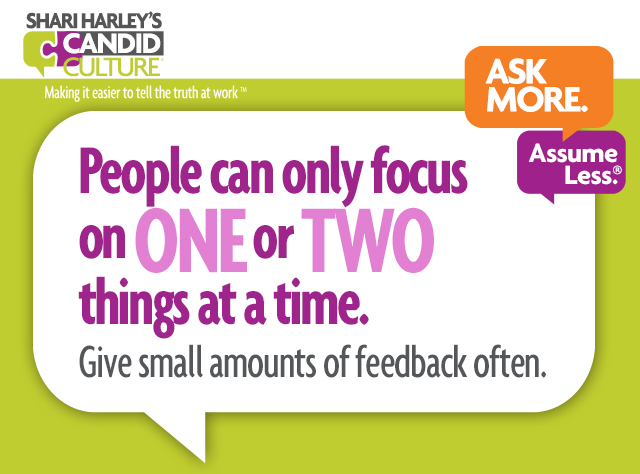
Coach and give feedback like your GPS. Give one or two pieces of feedback at a time. Then give the person time to make changes and improve before giving more feedback.
What I hear every day that makes me shudder:
Manager: “One of my employees has been making a lot of mistakes. He seems disengaged (p.s. “disengaged” is Cap’n Crunch, vague and thus not real feedback). I’m not sure what’s happening.”
Me: “When are performance appraisals?” Manager: “In six weeks.”
Most people hoard feedback. We wait for the right time, aka when we’re comfortable. That time will never come. The right time to give feedback is when something happens or shortly thereafter. Practice the 24-hour guideline and the one-week rule. Wait 24 hours to give feedback if you’re angry, but not longer than a week. Give feedback when you’re not upset, but soon after the event occurs, so people remember what you’re talking about.
Feedback is hard on the ego. The more feedback we receive in one conversation, the harder it is to hear. People need to feel successful. Receiving too much feedback at one time makes us feel we can’t be successful, so why bother. Pick the biggest and most impactful behaviors. Wait. And then give more feedback.
When it comes to feedback, keep this mantra in your head – recency, frequency. Recency, frequency. Short, weekly, feedback conversations – five minutes long – are better than sixty-minute feedback conversation once a month or quarter. You’ll see more behavior change and protect team member’s ego. Shorter and more frequent is better.
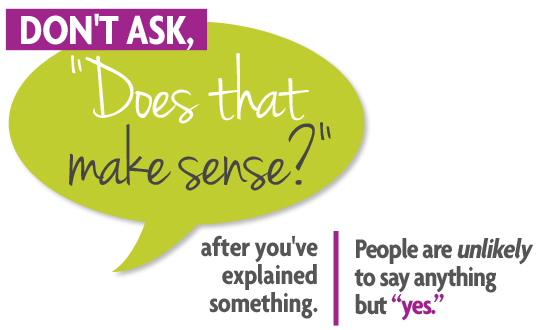
I’m taking golf lessons, which should frighten anyone within 100 feet. Every time the instructor explains something new, he asks me, “Does that make sense?” “Does that make sense” is a common clarifying question that many people ask, but it’s not a good question for two reasons.
Reason number one: If an explanation doesn’t make sense to me, I’m the idiot for not “getting it.” The question implies that the instructor was clear, I just “didn’t get it.”
Reason number two: The question doesn’t force me to speak, thus the person asking the question doesn’t get any information. “Does that make sense” is like asking a shopper in a store, “Can I help you?” We all know the right answer to that question is, “No, I’m just looking.” This is a similar to when someone asks, “Are there any questions?” The right answer is “no.” And when people say “no,” the person who asked the question often says, “good,” affirming people for not asking questions and making it less likely that questions will be asked in the future.
The purpose of asking questions is to get information. The problem with asking, “Does that make sense?” or “Do you have any questions?” is that the typical answers teach us nothing.
The golf instructor should be asking me:
What did you learn today?
What are you planning to do as a result of what we’ve covered?
What techniques did I demonstrate? Let me see how that form looks.
What questions do you have for me?
If he asks me the clarifying questions above, he will know what I am likely to do on the golf course.
Here are some clarifying questions that will force people to talk and won’t make them feel stupid for asking questions. Instead of asking, “Does that make sense,” consider asking:
“I want to make sure I gave clear instructions. Will you tell me what I’m asking you to do?” You could also phrase the questions like this, “Just so I know how I landed, what do you think I’m asking/expecting you to do?” or “What does a good job look like?” or “What should this look like when it’s complete?”
** These questions may sound condescending and like micromanaging in writing, but the questions can be asked in a supportive and non-judgmental manner. If you’re worried that the questions will make you appear as controlling or micromanaging, just say that. “I want to be sure you’re set up for success. If any of my questions feel condescending, please tell me. That isn’t my intention.”
I was talking with one of my clients a few months ago. She was very upset because she told one of her employees what to do and he didn’t do it. Frustrated, she said, “He knew what to do, and he didn’t do it.” I asked her, “How do you know that he knew what to do?” She replied, “I told him what to do and when I asked if he had any questions, he said no.”
Her situation is a common one. The right answer to “Do you have any questions” is “no.” And we’re surprised when we swing by the person’s desk two weeks later to get a status update on the project, and they haven’t started working on it yet.
Here are some additional examples of clarifying and delegation questions. These questions will force people to speak, providing a clearer sense of what people know and are likely to do.
What questions do you have?
What are you planning to do first? If the person answers this question appropriately, ask what they are planning to do next. If they don’t answer the question appropriately, step in and give more direction.
Provided you trust that the person knows what to do, give a tight deadline and ask to review the person’s work in a few days. Give people some freedom, but not enough to waste a lot of time and go down a fruitless path. Delegation is something at which most managers can improve. More effective delegation will lead to fewer missed deadlines and frustrations in the workplace.
The fear of saying what we think and asking for what we want at work is prevalent across organizations. We want more money, but don’t know how to ask for it. We want to advance our careers but are concerned about the impression we’ll make if we ask for more. Many employees assume they won’t get their needs met and choose to leave their jobs, either physically or emotionally, rather than make requests.
How to Retain Good Employees:
The key to keeping your best employees engaged and doing their best work, is to ask more questions and make it safe to tell the truth.
Managers:
Do you know why your employees chose your organization and what would make them leave?
Do you know your employees’ best and worst boss?
The answers to these questions tells managers what employees need from the organization, job, and from the manager/employee working relationship.
Team members:
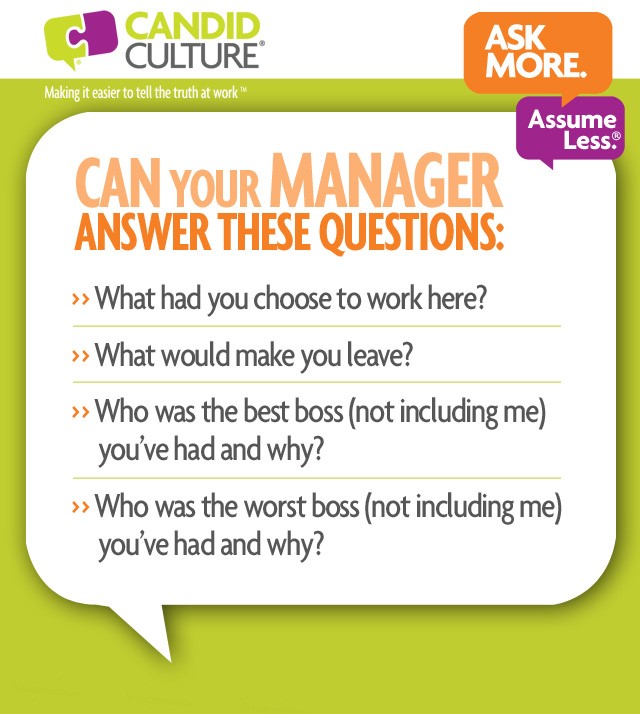
Can your manager answer these questions – that I call Candor Questions – about you? For most people, the answer is no. Most managers don’t ask these questions. And most employees are not comfortable giving this information, especially if the manager hasn’t asked for it.
It’s easy to mistake my book, How to Say Anything to Anyone, as a book about giving feedback. It’s not. It takes me nine chapters to get to feedback. The first eight chapters of the book are about how to create relationships in which you can tell the truth without fear. You can read all the feedback books you want and take numerous training classes on coaching, managing people, giving feedback, and managing conflict, and you’ll still be hesitant to speak up, because a formula for giving feedback is not what you’re missing. What’s missing is being given permission and knowing it’s safe to tell the truth.
Managers, here’s how to retain good employees:
Tell your employees, “I appreciate you choosing to work here. I want this to be the best career move you’ve made, and I want to be the best boss you’ve had. I don’t want to have to guess what’s important to you. I’d like to ask you some questions to get to know you and your career goals better. Please tell me anything you’re comfortable saying. And if you’re not comfortable answering a question, just know that I’m interested and I care. And if, at any point, you’re comfortable telling me, I’d like to know.”
Then ask the Candor Questions during job interviews, one-on-one, and team meetings. We’re always learning how to work with people, so continue asking questions throughout your relationships. These conversations are not one-time events.
If you work for someone who isn’t asking you these questions, offer the information. You could say:
“I wanted to tell you why I chose this organization and job, and what keeps me here. I also want to tell you the things I really need to be happy and do my best work. Is it ok if I share?”
Your manager will be caught off guard, but it is likely that they will also be grateful. It’s much easier to manage people when you know what they need and why. Most managers want this information, it just may not occur to them to ask.
If the language above makes you uncomfortable, you can always blame me. You could say:
“I read this blog and the author suggested I tell you what brought me to this organization and what I really need to be happy here and do my best work. She said I’d be easier to manage if you had that information. Is it ok if I share?”
Yes, this might feel a little awkward at first, but the conversation will flow, and both you and your manager will learn a great deal about each other.
The ability to tell the truth starts with asking questions, giving people permission to speak candidly, and listening to the answers.
I’m taking golf lessons, which should frighten anyone within 100 feet. Every time the instructor explains something new, he asks me, “Does that make sense?” “Does that make sense” is a common clarifying question that many people ask, but it’s not a good question for two reasons.
Reason number one: If an explanation doesn’t make sense to me, I’m the idiot for not “getting it.” It’s not that the instructor hasn’t been clear, I just “didn’t get it.”
Reason number two: The question doesn’t force me to speak, thus the person asking the question doesn’t get any information. “Does that make sense” is like asking a shopper in a store, “Can I help you?” We all know the right answer to that question is, “No, I’m just looking.” This is a similar to when someone asks, “Are there any questions?” The right answer is “no.” And when people say “no,” the person who asked the question often says, “good,” affirming people for not asking questions and making it less likely that questions will be asked in the future.
The golf instructor should be asking me:
What did you learn today?
What are you planning to do as a result of what we’ve covered?
What techniques did I demonstrate?
Let me see how that form looks.
What questions do you have for me?
If he asks me the clarifying questions above, he will know what I am likely to do on the golf course.
Here are some clarifying questions that will force people to talk and won’t make them feel stupid for asking questions. Instead of asking, “Does that make sense,” consider asking:
“I want to make sure I gave clear instructions. Will you tell me what I’m asking you to do?” You could also phrase the questions like this, “Just so I know how I landed, what do you think I’m asking/expecting you to do?”
** This may sound condescending and like micromanaging in writing, but the question can be asked in a supportive and non-judgmental manner.
I was talking with one of my clients a few months ago. She was very upset because she told one of her employees what to do and he didn’t do it. Frustrated, she said, “He knew what to do, and he didn’t do it.” I asked her, “How do you know that he knew what to do?” She replied, “I told him what to do and when I asked if he had any questions, he said no.”
Her situation is a common one. The right answer to “Do you have any questions” is “no.” And we’re surprised when we swing by the person’s desk two weeks later to get a status update on the project, and he hasn’t started working on it yet.
Here are some additional examples of clarifying and delegation questions. These questions will force people to speak, providing a clearer sense of what people know and are likely to do.
What questions do you have?
What are you planning to do first? If the person answers this question appropriately, ask what they are planning to do next. If they don’t answer the question appropriately, step in and give more direction.
Provided you trust that the person knows what to do, give a tight deadline and ask to review the person’s work in a few days. Give people some freedom, but not enough to waste a lot of time and go down a fruitless path. Delegation is something at which most managers can improve. More effective delegation will lead to fewer missed deadlines and frustrations in the workplace.
Sign Up
Career tips you won't get elsewhere. Sign up to get a free tip card.