Every time I ignore the red flags I see when interviewing a candidate, or when I feel an employee is struggling, or a project is off track, I pay the price. Every single time.
You interview a candidate who has had three jobs in the last year. You think, “Maybe this one will work out.” No, it won’t. Move on. You haven’t gotten an update from a project team in over a month. You think, “This group is typically reliable. Things are probably fine.” Check in. Even the most diligent employees need accountability and attention.
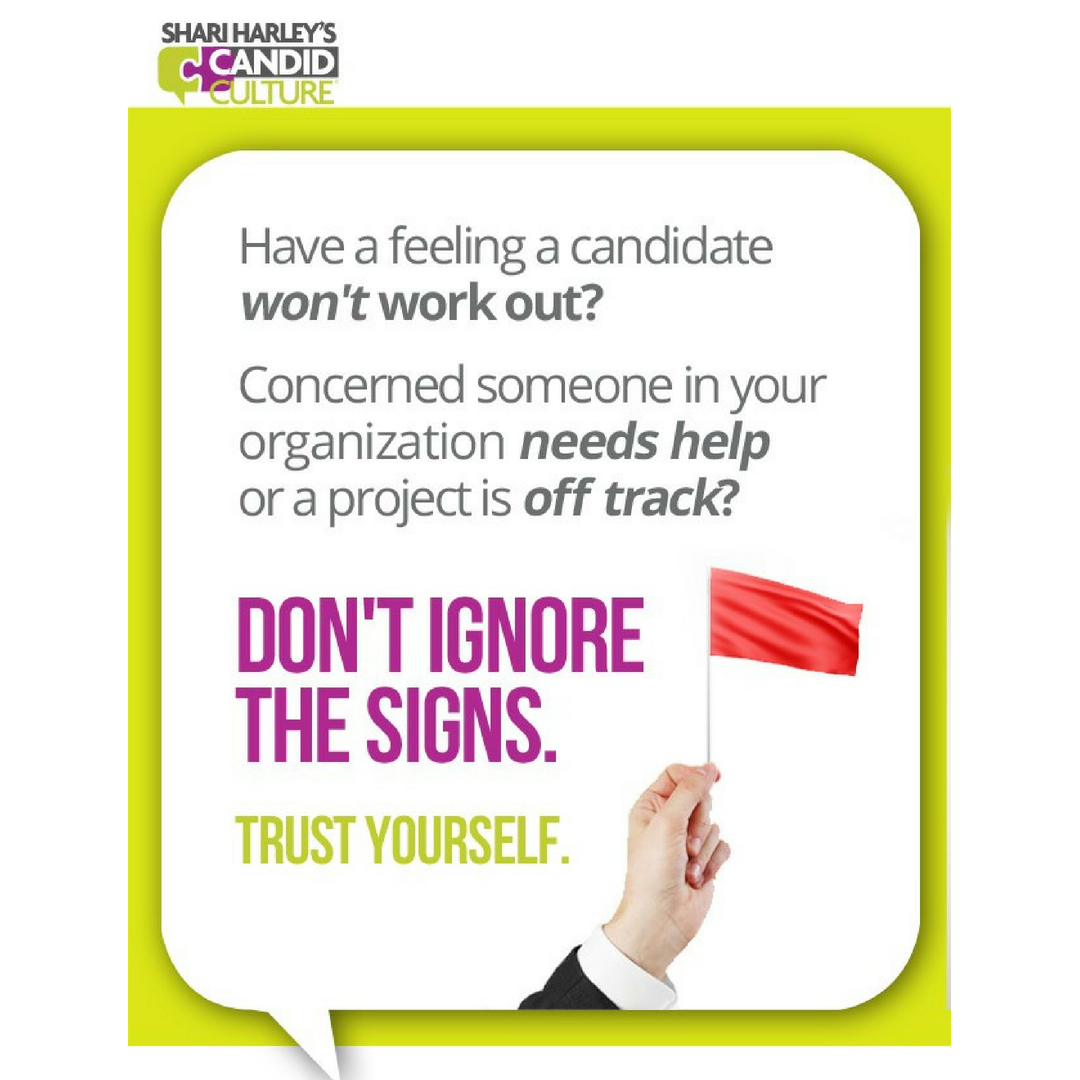
They call them red flags for a reason. If you suspect a problem, there likely is one. Don’t just wait and ‘see how things go.’ Make a hard decision, get more information, or get involved. Wait and see is often a recipe for disaster.
Sometimes we don’t get involved because we don’t have the time or want to focus on other things. Other times we just don’t trust or listen to our gut.
Trust yourself.
Here are six steps you can take to help listen to yourself and ensure you don’t overlook or ignore red flags:
1. Become very clear about your desired outcome. Decide what you want.
2. Eliminate distractions. Get quiet, aka, still your mind.
3. Think about the situation at hand. Weigh the facts and your options.
4. Decide without belaboring.
5. Act on your decision.
6. Don’t look back. Your initial decision is usually the right one.
Trusting and listening to ourselves can be hard. Perhaps it’s the fear of making a mistake or being wrong. Chances are you’re right, so pay attention to the red flags, trust yourself, and listen to your gut.
There is one job interview question recruiters and hiring managers must ask. And the answer should be a deal-breaker.
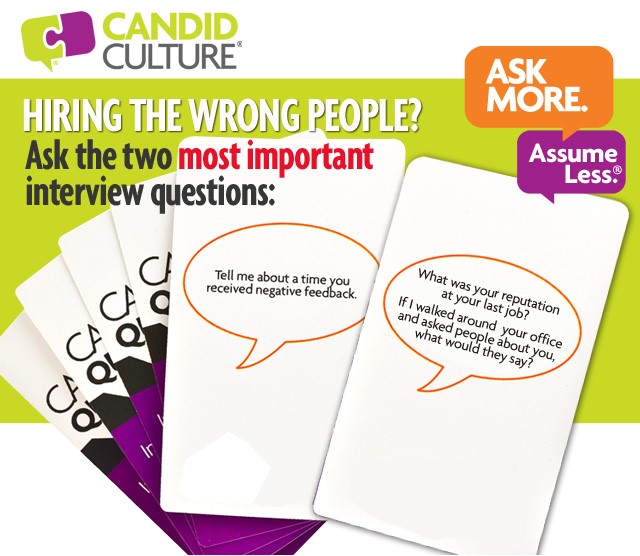
The most important job interview question for any role in every organization: Tell me about a time you received negative feedback.
This is NOT the same question as tell me about a weakness. Or tell me about a time you made a mistake at work. Those are also important job interview questions to ask. But they’re not the most important question.
Let’s assume everyone you interview is age sixteen and older. Unless your candidates live in a cave, never speaking to anyone, it’s not possible to arrive at age 16 without having received negative feedback. The feedback can come from a friend, teacher, or parent. It doesn’t need to be work-related.
The point of the question is to discover whether the candidate is open to feedback. People who are not open to feedback are extraordinarily difficult to work with. They aren’t coachable. Any type of feedback they receive will result in resistance and defensiveness.
Employees who aren’t open to feedback won’t change or improve their behavior, regardless of how effective a manager is. Instead of listening to feedback and taking corrective action, employees who are not open to feedback will tell managers why they are wrong.
Everyone you interview has received negative feedback at some point. The question is whether or not candidates were receptive to the feedback. People who aren’t open to feedback won’t be able to answer your question.
If candidates can’t tell you about a time they received negative feedback, ask a follow-up question. Your job as the interviewer is to give candidates every possible opportunity to be successful. If you don’t get the answer you’re looking for, ask the interview question in two different ways, until you’re certain the candidate can’t or won’t answer the question.
If candidates can’t tell you about a time they received negative feedback, ask what their reputation is at their current job or was at a previous job. Candidates probably won’t be able to answer this question either. Most people don’t know their reputation at work.
Even if a candidate doesn’t know with certainty their reputation at work, the answer they provide will give you a sense of how self-aware they are. People who are self-aware are more open to feedback and are easier to coach and manage than people who are not self-aware.
I eliminate candidates who demonstrate they aren’t open to feedback, whether I’m hiring for Candid Culture or for one of my clients. I don’t care how credentialed or experienced the candidate is. If candidates aren’t receptive to feedback, they don’t get a job offer.
Sign Up
Career tips you won't get elsewhere. Sign up to get a free tip card.