Performance appraisals are, for many, the most dreaded day of the year. Most employees anticipate the meeting, wondering what their manager will say. In addition to hearing about the situations your manager, and others in your organization, observed throughout the year, why not tell your manager what you’d like to know?
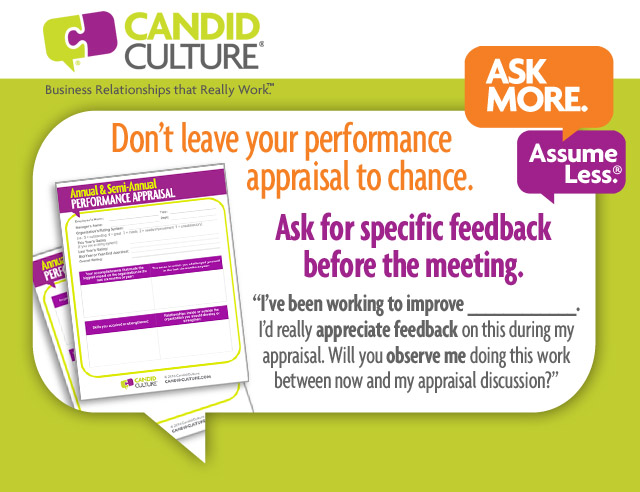
It’s perfectly appropriate to tell your manager you’d like feedback about a specific aspect of your performance or about a certain project or piece of work. And the time to ask for this feedback is at least one month BEFORE your appraisal meeting.
If you ask for feedback during the meeting, you’re likely to catch your boss off guard. Managers don’t typically follow employees around or call into every meeting in which employees participate. As a result, your boss may not have an answer to your question. They are likely not thinking about the specific input you want.
Most people don’t like to be caught off guard or feel they can’t answer a question. Asking for feedback in the moment, that your boss can’t address, may embarrass your manager. Don’t put managers on the spot. Set your boss and yourself up for success by asking for specific feedback BEFORE meetings, and give your manager a chance to observe you doing that kind of work.
Ask a vague question, get a vague answer. Ask a specific question, get a specific answer. If you want specific feedback, let your manager know and give her time to observe you doing the actions you’re asking about BEFORE the feedback conversation.
If you want to know how you manage telling internal or external clients “no”, give your boss a chance to see or hear you do this. If you want feedback on how you built relationships with peers virtually this year, give your boss a chance to observe that behavior or time to ask your peers for input.
Here’s how asking for specific feedback might sound: “My annual performance appraisal is in June. I am, of course, interested in everything you have to say. I’d also like feedback on how I lead large meetings. I’m leading two meetings between now and my appraisal. If you have the availability to call into either one and listen to how I elicit participation while maintaining control of the meeting, I’d really appreciate it. I’ll send you the call-in information.”
When you tell your manager the specific feedback you want to hear and give her an opportunity to observe you doing that work, you demonstrate seriousness about getting feedback and that you respect your manager’s time. You’re also likely to get more useful, specific feedback.
The practice of asking for specific feedback before one-on-one meetings and giving your manager time to observe you doing that work, is something I recommend doing all year, not just when preparing for performance appraisals. Feedback should be delivered as work is produced. The annual review should be just that, a review of conversations that happened during the year.
Remember, you get what you ask for. Ask a vague question, get a vague answer.
Last week I had lunch with a client. When I returned from lunch I saw a friend who told me I had something stuck in my teeth. I was embarrassed and wondered why my client hadn’t told me.
It’s quite possible he hadn’t noticed. In fact, knowing this guy and how much work I’ve done with his firm on being candid, it’s probable he hadn’t noticed. But we all know people who notice and say nothing. We could walk around all day with toilet paper on our shoe, lipstick on our teeth, or our fly down, and the people around us won’t tell us.
If you read my blog weekly, you already know that people have been trained not to tell you the truth.
But I think there is more preventing people from telling us the truth. Complete this sentence: “If you have nothing nice to say, _________________________________. Who told you that? Your mother!!!
I do think there’s something to this. We’re raised to believe that it’s not nice to say something to another person that isn’t positive. And in the past, when we did speak up, it’s likely the other person got defensive. So it’s no wonder that we don’t readily give people bad news.
Here are five tips for getting feedback from the people around you:
Establish a core team of people who will always tell you the truth. These can be friends, coworkers, clients, vendors, your boss, etc.
Give people permission, to be honest with you. “Let’s make a deal. I always want you to tell me the truth. If I have something stuck in my teeth, or I’m inappropriately dressed for a meeting, or I’m doing something that damages my reputation, I want you to tell me.”
Make it easy to tell you the truth. “I promise no matter what you tell me and how hard it is to hear, I will say thank you. I won’t get defensive. And if I do, I’ll apologize and try to do better next time.”
Offer to do the same for them. “And if you want me to do the same thing for you, I’m happy to do it.”
Periodically check in with people and ask for feedback. “A few months ago I asked you to tell me anything I said, did, or wore that got in the way of my success. Is there anything you’ve seen that you want to tell me?”
Every time you ask for feedback and take it graciously, you train the person to give you more feedback. On the contrary, every time you get defensive, you make it hard for people to give you feedback, making it likely they won’t do it again.
If you don’t want to walk around looking silly all day, create a safe environment where co-workers can tell the truth.
Many businesses are struggling to overcome negative and permanent online reviews on yelp, trip advisor, Glassdoor, etc. And they’re wondering why customers and employees go online vs. giving feedback directly. The answer is simple.
Giving feedback online is easy. Giving feedback directly is harder, for many reasons. No one wants to be the person who complains. Feedback is likely to be received with a defensive at worst and explanatory at best response, and who really wants to deal with that? And we fear we’ll get “in trouble” for giving feedback, etc. etc. etc. I could go on and on.
If you want your customers and employees to give you feedback directly instead of blasting you online when they’re unhappy, make it easy to give you feedback, regularly.
Here are four ways to help prevent negative online reviews and improve the data you get from customers and employees:
Ask customers and employees for feedback regularly. Don’t wait until the end of the year or after a service has been provided to ask for feedback. Ask for feedback during the customer’s experience. Ask employees for feedback every 90-days. Marriott hotels is masterful at this. Hotel guests don’t get onto the hotel’s free Wi-Fi until answering one question about their hotel stay. If guest feedback has a negative component, a manager will call you immediately. Such smart business.
If you’re going to send online surveys, keep them short. Never ask a customer more than five questions, and two is better. Ask a version of, “What are you appreciating about your experience? What could we change on your behalf?” What else do you need to know? Too many businesses send exhaustive and exhausting surveys to customers after a service has been provided. It’s rude and unrealistic to expect customers to complete 30+ survey questions. Keep it short. You’ll see better response rates.
Call 10% (or fewer if you have thousands of employees and customers) and ask for feedback. It’s such a rare occurrence to receive a phone call asking for feedback, it’s an immediate loyalty and relationship builder.
Don’t request a positive score on a survey. Sending a survey and asking for certain response type is a turnoff. Uber drivers who ask me to rate them a five never get that rating. The best way to get an awesome rating is to be awesome.
Ask for feedback early and often, and make it easy to give. P.S. And no anonymous surveys – a topic for another day.
Last week I had lunch with a client. When I returned from the lunch I saw a friend who told me I had something stuck in my teeth. I was embarrassed and wondered why my client hadn’t told me.
It’s quite possible he hadn’t noticed. In fact, knowing this guy and how much work I’ve done with his firm on being candid, it’s probable he hadn’t noticed. But we all know people who notice and say nothing. We could walk around all day with toilet paper on our shoe, lipstick on our teeth, or our fly down, and the people around us won’t tell us.
If you read my blog weekly, you already know that people have been trained not to tell you the truth.
But I think there is more preventing people from telling us the truth. Complete this sentence: “If you have nothing nice to say, _________________________________. Who told you that? Your mother!!!
I do think there’s something to this. We’re raised to believe that it isn’t nice to say something to another person that isn’t positive. And in the past, when we did speak up, it’s likely the other person got defensive. So it’s no wonder that we don’t readily give people bad news.
Here are five tips for getting feedback from the people around you:
Establish a core team of people who will always tell you the truth. These can be friends, coworkers, clients, vendors, you boss, etc.
Give people permission to be honest with you. “Let’s make a deal. I always want you to tell me the truth. If I have something stuck in my teeth, or I’m inappropriately dressed for a meeting, or I’m doing something that damages my reputation, I want you to tell me.”
Make it easy to tell you the truth. “I promise no matter what you tell me and how hard it is to hear, I will say thank you. I won’t get defensive. And if I do, I’ll apologize and try to do better next time.”
Offer to do the same for them. “And if you want me to do the same thing for you, I’m happy to do it.”
Periodically check in with people and ask for feedback. “A few months ago I asked you to tell me anything I said, did, or wore that got in the way of my success. Is there anything you’ve seen that you want to tell me?”
Every time you ask for feedback and take it graciously, you train the person to give you more feedback. On the contrary, every time you get defensive, you make it hard for people to give you feedback, making it likely they won’t do it again.
If you don’t want to walk around looking silly all day, make it safe to tell you the truth.
Sign Up
Career tips you won't get elsewhere. Sign up to get a free tip card.