Every time I work with a new organization, at least one employee pulls me aside and tells me about the organization’s “list”. Employees who speak up and say things the leadership team disagree with, get put on the “list”. And employees who make the “list” disappear from the organization. Mind you, no one has ever seen this “list”, but employees everywhere are convinced it exists. And this is a challenge for leaders.
Even leaders who do all the right things regarding asking for and being open to all kinds of input are up against the belief that it isn’t safe to tell the truth at work. It may not even be true. There may be no consequences whatsoever for speaking up, but the perception of the negative consequence is what matters. And this perception is powerful and pervasive across organizations.
Disagreement is hard. But silence and the fear of speaking up is dangerous. Organizations full of yes people don’t innovate. They don’t solve problems or find new ways to save costs. They don’t grow, develop, or change. Hearing the truth takes courage and persistence. Put your ego aside and ask – again and again and again.
So, what is to be done? How do leaders get the truth when employees are afraid, disbelieving and perhaps cynical?
Below are seven practices for leaders and managers to get more truth in their organization:
Put your ego aside. It hurts when people disagree with our beliefs or approach, and we’ll be fine. Let curiosity rather than your ego run the show.
Ask for input. Ask again and again and again. Employees may eventually believe that you really want their input.
Ask for input in different ways – in-person roundtable discussions, email, surveys, and informal, regular debriefs. Give people with different communication styles and levels of comfort different ways to express themselves.
Ensure there are no negative consequences for speaking up. You can coach employees on how they spoke up and make suggestions for diplomacy but reward the courage it took to speak up.
Reward people publicly who risk by sharing challenging information. You get more of what you reward. Do you have a company award for people who innovate and speak up?
Share what you learn after gathering data. Give more information than you think you need to and do it in a timely way. Sitting on information creates suspicion and cynicism.
Tell employees the ideas you’re accepting and those you’re rejecting, and why. It’s ok not to accept and act on all feedback. But close the loop and explain the rationale for decisions.
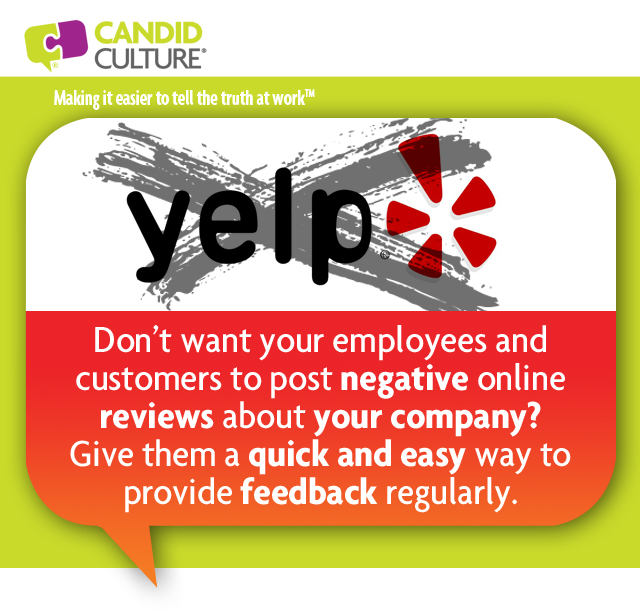
Many businesses are struggling to overcome negative and permanent online reviews on Yelp, Google, TripAdvisor, Glassdoor, etc. And they’re wondering why customers and employees go online vs. giving feedback directly. The answer is simple.
Giving feedback online is easy. Giving feedback directly is harder, for many reasons. No one wants to be the person who complains. Feedback is likely to be received with a defensive at worst and explanatory at best response, and who really wants to deal with that? At work we fear we’ll get “in trouble” for giving feedback, etc. etc. I could go on and on.
Customers go to Yelp and Google when they either don’t have an alternative or after they have provided direct feedback and didn’t feel heard. Provide customers an easy method of giving feedback and they won’t need to go to Yelp. This is true for your employees too.
If you want your customers and employees to give you feedback directly instead of blasting you online when they’re unhappy, make it easy to give you feedback, regularly.
Here are four ways to help prevent negative online reviews and improve the data you get from customers and employees:
Ask customers and employees for feedback regularly. Don’t wait until the end of the year or after a service has been provided to ask for feedback. Ask for feedback during the customer’s experience. Ask employees for feedback every 90-days.
If you’re going to send online surveys, keep them short. Never ask a customer more than five questions, and two is better. Ask a version of, “What are you appreciating about your experience? What could we change on your behalf?” What else do you need to know? Too many businesses send exhaustive and exhausting surveys to customers after a service has been provided. It’s unrealistic to expect customers to complete 30+ survey questions. Keep it short. You’ll see better response rates.
Call 10% (or fewer if you have thousands of employees and customers) and ask for feedback. It’s such a rare occurrence to receive a phone call asking for feedback, it’s an immediate loyalty and relationship builder.
Don’t request a positive score on a survey. Sending a survey and asking for a certain response type is a turnoff. Uber drivers who ask me to rate them a five never get that rating. The best way to get an awesome rating is to be awesome.
Ask for feedback early and often, and make it easy to give. P.S. And no anonymous surveys – a topic for another day.
Lots of organizations send out employee engagement surveys with the desire of improving employee engagement and retention; unfortunately, they often damage both in the process.
There are a few employee engagement survey pitfalls that luckily are easy to avoid.
Here are three practices to follow when sending out employee engagement surveys:
Shorter is better. I hate to say this, but no one wants to fill out an employee engagement survey. It’s time consuming, employees doubt the survey will yield results, and they worry that their feedback isn’t really confidential.
Make your employee engagement survey easy to fill out by making it short. And by short, I mean 25 questions or fewer. You’ll get a better response rate to a 25-question survey than a 65-question one.
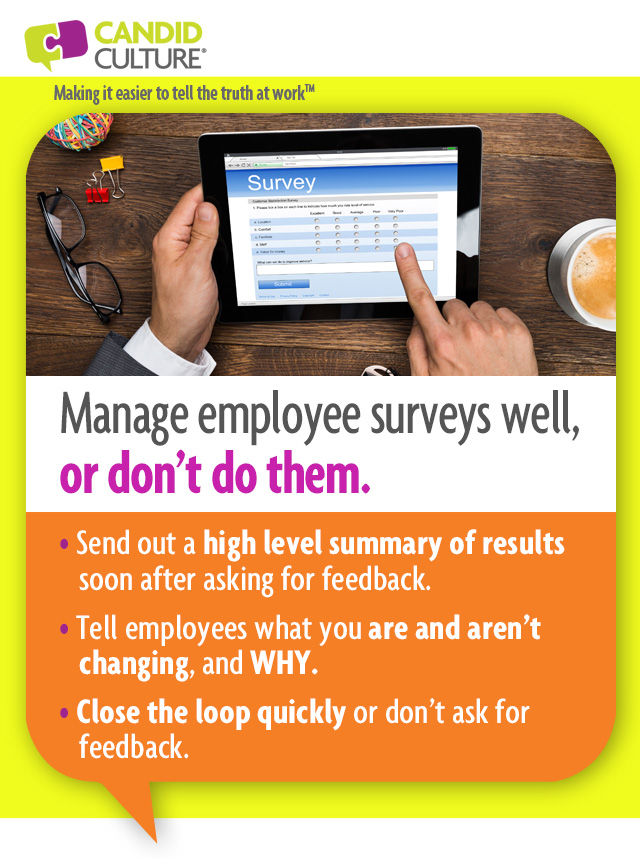
Provide employees with survey results quickly. Most organizations ask for too much information. Leaders are overwhelmed by the volume of survey information, so they spend months and months reviewing it, while employees comment on yet another employee survey with no communication.
Send out a succinct communication sharing the top few learnings – the good and the not-so-good — within a few weeks of sending out the survey. You don’t need to take action at the same time. Simply keep employees in the loop by communicating a quick summary of what you learned. If you wait too long to share the feedback, it often never gets communicated. And the next time you send out a survey, employees will remember the absence of information and be hesitant to fill it out.
Within 90-days, tell employees what you will and won’t be changing, based on the survey feedback, and tell them why. Employees don’t need or expect all of their input to be utilized. Closing the loop with clear communication about what you are and aren’t changing, and why, is often sufficient.
Lots of organizations send out employee engagement surveys with the desire of improving employee engagement and retention; unfortunately, they often damage both in the process.
There are a few employee engagement survey pitfalls that luckily are easy to avoid.
Here are three practices to follow when sending out employee engagement surveys:
Shorter is better. I hate to say this, but no one wants to fill out your employee engagement survey. It’s time consuming, employees doubt the survey will yield results, and employees worry that their feedback isn’t really confidential.
Make your employee engagement survey easy to fill out by making it short. And by short, I mean 10 questions or fewer. You’ll get a better response rate to a 10-question survey than a 65-question one.
Provide employees with survey results quickly. Most organizations ask for too much information. Leaders are overwhelmed by the survey information, so they spend months and months reviewing it, while employees comment on yet another employee survey with no communication.
Send out a succinct communication sharing the top few learnings – the good and the not-so-good — within a few weeks of sending out the survey. You don’t need to take action at the same time. Simply keep employees in the loop by communicating a quick summary of what you learned. If you wait too long to share the feedback, it often never gets communicated. And the next time you send out a survey, employees will remember the absence of information and be hesitant to fill it out.
Within 90-days, tell employees what you will and won’t be changing, based on the survey feedback, and tell them why. Employees don’t need or expect all of their input to be utilized. Closing the loop with clear communication about what you are and aren’t changing, and why, is often sufficient.
Many businesses are struggling to overcome negative and permanent online reviews on yelp, trip advisor, Glassdoor, etc. And they’re wondering why customers and employees go online vs. giving feedback directly. The answer is simple.
Giving feedback online is easy. Giving feedback directly is harder, for many reasons. No one wants to be the person who complains. Feedback is likely to be received with a defensive at worst and explanatory at best response, and who really wants to deal with that? And we fear we’ll get “in trouble” for giving feedback, etc. etc. etc. I could go on and on.
If you want your customers and employees to give you feedback directly instead of blasting you online when they’re unhappy, make it easy to give you feedback, regularly.
Here are four ways to help prevent negative online reviews and improve the data you get from customers and employees:
Ask customers and employees for feedback regularly. Don’t wait until the end of the year or after a service has been provided to ask for feedback. Ask for feedback during the customer’s experience. Ask employees for feedback every 90-days. Marriott hotels is masterful at this. Hotel guests don’t get onto the hotel’s free Wi-Fi until answering one question about their hotel stay. If guest feedback has a negative component, a manager will call you immediately. Such smart business.
If you’re going to send online surveys, keep them short. Never ask a customer more than five questions, and two is better. Ask a version of, “What are you appreciating about your experience? What could we change on your behalf?” What else do you need to know? Too many businesses send exhaustive and exhausting surveys to customers after a service has been provided. It’s rude and unrealistic to expect customers to complete 30+ survey questions. Keep it short. You’ll see better response rates.
Call 10% (or fewer if you have thousands of employees and customers) and ask for feedback. It’s such a rare occurrence to receive a phone call asking for feedback, it’s an immediate loyalty and relationship builder.
Don’t request a positive score on a survey. Sending a survey and asking for certain response type is a turnoff. Uber drivers who ask me to rate them a five never get that rating. The best way to get an awesome rating is to be awesome.
Ask for feedback early and often, and make it easy to give. P.S. And no anonymous surveys – a topic for another day.
Lots of organizations send out employee engagement surveys with the desire of improving employee engagement and retention; unfortunately they often damage both in the process.
There are a few employee engagement survey pitfalls that are luckily easy to avoid.
Here are three practices to follow when sending out employee engagement surveys:
Shorter is better. I hate to say this, but no one wants to fill out your employee engagement survey. It’s time consuming, employees doubt the survey will yield results, and employees worry that their feedback isn’t really confidential.
Make your employee engagement survey easy to fill out by making it short. And by short, I mean 10 questions or fewer. You’ll get a better response rate to a 10-question survey than a 65-question one. And do you really need more information than the answers to ten well-written questions?
Provide employees with survey results quickly. Most organizations ask for too much information. Leaders are overwhelmed by the survey information, so they spend months and months reviewing it, while employees comment on yet another employee survey with no communication.
Send out a communication sharing the top few learnings – the good and the not-so-good — within a few weeks of sending out the survey. You don’t need to take action at the same time. Simply keep employees in the loop by communicating a quick summary of what you learned. If you wait too long to share the feedback, it often never gets communicated. And the next time you send out a survey, employees will remember the absence of information and be hesitant to fill it out.
Within 90-days, tell employees what you will and won’t be changing, based on the survey feedback, and tell them why. Employees don’t need or expect all of their input to be utilized. Closing the loop with clear communication about what you are and aren’t changing, and why, is often sufficient.
All of that being said, I’m going to recommend you send out fewer surveys. Employee engagement surveys are a good way to quickly collect lots of information. Engagement surveys are not a good way of building trust and relationships with employees, which is what leads to employee engagement and retention. Employees don’t feel closer to an organization’s leadership team after filling out an employee engagement survey. Trust isn’t built. Instead of sending out so many surveys, I’d suggest cutting the number in half and have leaders and managers hold roundtable discussions with groups of 6-8 employees a few times a year instead. Roundtable discussions achieve several goals at once—they give leaders visibility, which builds trust, they help leaders build rapport and relationships, and gather the same data that a written survey provides.
When leaders participate in our Be a Best Place to Work program, we teach the five things leaders need to do to engage and retain employees. Holding roundtable discussions and asking these questions is a key recommendation of the training. Sending out written surveys is not. Engage and retain employees by talking with employees. Ask employees for their input. Listen. And watch your employee engagement survey scores sky rocket.
Lots of organizations send out employee engagement surveys with the desire of improving employee engagement and retention; unfortunately they often damage both in the process.
There are a few employee engagement survey pitfalls that are luckily easy to avoid.
Here are three practices to follow when sending out employee engagement surveys:
Shorter is better. I hate to say this, but no one wants to fill out your employee engagement survey. It’s time consuming, employees doubt the survey will yield results, and employees worry that their feedback isn’t really confidential.
Make your employee engagement survey easy to fill out by making it short. And by short, I mean 10 questions or fewer. You’ll get a better response rate to a 10-question survey than a 65-question one. And do you really need more information than the answers to ten well-written questions?
Provide employees with survey results quickly. Most organizations ask for too much information. Leaders are overwhelmed by the survey information, so they spend months and months reviewing it, while employees comment on yet another employee survey with no communication.
Send out a communication sharing the top few learnings – the good and the not-so-good — within a few weeks of sending out the survey. You don’t need to take action at the same time. Simply keep employees in the loop by communicating a quick summary of what you learned. If you wait too long to share the feedback, it often never gets communicated. And the next time you send out a survey, employees will remember the absence of information and be hesitant to fill it out.
Within 90-days, tell employees what you will and won’t be changing, based on the survey feedback, and tell them why. Employees don’t need or expect all of their input to be utilized. Closing the loop with clear communication about what you are and aren’t changing, and why, is often sufficient.
All of that being said, I’m going to recommend you send out fewer surveys. Employee engagement surveys are a good way to quickly collect lots of information. Engagement surveys are not a good way of building trust and relationships with employees, which is what leads to employee engagement and retention. Employees don’t feel closer to an organization’s leadership team after filling out an employee engagement survey. Trust isn’t built. Instead of sending out so many surveys, I’d suggest cutting the number in half and have leaders and managers hold roundtable discussions with groups of 6-8 employees a few times a year instead. Roundtable discussions achieve several goals at once—they give leaders visibility, which builds trust, they help leaders build rapport and relationships, and gather the same data that a written survey provides.
When leaders participate in our Be a Best Place to Work program, we teach the five things leaders need to do to engage and retain employees. Holding roundtable discussions and asking these questions is a key recommendation of the training. Sending out written surveys is not. Engage and retain employees by talking with employees. Ask employees for their input. Listen. And watch your employee engagement survey scores sky rocket.
Sign Up
Career tips you won't get elsewhere. Sign up to get a free tip card.