Someone asks if you can (fill in the blank). You look at your calendar. That hour is open. You say, “yes.” You forgot that hour was designed for something you’ve been meaning to do, for yourself. You’re angry for forgetting. You promise to do better tomorrow.
The next day… repeat.
A way out of tired-inducing-people-pleasing is to set boundaries and stick to them. And this is hard, for me.
Examples of boundaries: Putting an hour in your calendar during the day to exercise; blocking 30-minutes between meetings to work on projects; only scheduling 80% of your workday to allow for last-minute requests and emergencies. Putting a boundary in place doesn’t mean saying no. Boundaries create the conditions that tell us, without struggle, when to say yes.
Before I had my son, I traveled for work constantly. Some weeks I was on the road for six consecutive days, in three different states. And I loved every second of it. Audience + microphone = happiness. When I had a child, I knew that schedule wasn’t going to work. So, I set boundaries. I decided how many nights per week I would travel and the time I needed to arrive home from each trip. And I didn’t violate those boundaries for 8 years. If a piece of work would require me to violate my travel boundaries, I said no without struggle, no matter how much I wanted to do that piece of work. The boundaries made the decisions easy. There was no deliberating or debating.
I’ll admit, I’m not as effective as setting boundaries in other areas of my life. Last week, I had a yoga class on my calendar. When I learned a repair person was able to be at my house during that hour, the yoga class was quickly deleted from my calendar. Yesterday, I asked my son what he wanted for breakfast, before flag football. He wanted scrambled eggs and a smoothie. I made both, knowing there wasn’t time. We were late for flag football. What was missing in both situations? Boundaries.
How does this apply to work? The key to preventing tired, burnt-out employees is to make it safe to speak up. Burnout is a systemic issue, not a personal one. Burnout at work comes from too much to do, over time. One way out is to make it safe to tell the truth at work.
For the most part, no one wants to admit to their boss that they are overextended or overwhelmed. Doing so feels like failure, and who wants to admit failure? If you want employees who are energized versus exhausted, focus on making it safe to tell the truth at work.
Five ways to make it safe to tell the truth at work:
Leaders and managers share their own strategies for managing time and priorities.
Ask your employees and coworkers meaningful questions. “How’s it going?” is not a meaningful question. Try: “What are your preferred working hours? What times a day would you prefer not to be contacted?”
Show appreciation when employees risk and say hard things.
Reward the truth. Make employees who are willing to say hard things a positive example.
Help employees problem solve to manage their time and priorities. Be ‘in it’ with them.
The good news about violating your own boundaries is you will get another chance to do it differently tomorrow. You can always reset a boundary. This time, tell the other people in your life about your boundaries. Tell your coworkers if you don’t do happy hours, 7:00 am Zoom calls, and back-to-back meetings, and tell them why. Then offer an alternative. Everything in life is a negotiation.
Who have you fired lately? The person who cuts your hair or lawn? A doctor, accountant, or restaurant where you had a bad experience? Did you call any of those providers and tell them why you were replacing them? My hunch is no. There’s little incentive to do so. Why risk their defensiveness? It’s easier to just replace them. And the same is true for you.
There’s little incentive for the people you work with to tell you when you frustrate them. The perceived cost seems too high. The people you work (and live) with have experienced others’ defensive responses to negative feedback (which is no fun) and they don’t want to experience your reaction. As a result, when you disappoint or frustrate others, it’s easier to say nothing than tell you the truth.
The tendency for others to tell you things are fine when they’re not, will prevent you from managing your career and relationships. People will go missing and you’ll be passed over for professional opportunities and never know why.
To make it more likely that people will tell you when you disappoint or frustrate them, make it easy to tell you the truth.
Here are seven practices for receiving feedback:
Receiving Feedback Practice #1: When you begin new relationships, tell people you want their feedback.
Receiving Feedback Practice #2: Promise that no matter what people say, you’ll respond with “thank you.” This is very hard to do.
Receiving Feedback Practice #3: Tell people you already have relationships with, that if you haven’t said it in the past, you really want their feedback and promise to respond graciously with “thank you.”
Receiving Feedback Practice #4: Ask people who matter to you for feedback regularly.
Receiving Feedback Practice #5: Resist the urge to get defensive.
Receiving Feedback Practice #6: Catch yourself when you start to become defensive and apologize. Say something like, “I’m getting defensive. I’m sorry. Tell me again. I’ll do a better job of listening.”
Receiving Feedback Practice #7: Take a break from conversations during which you find yourself responding defensively. Say something like, “I’m not responding as well as I’d like. How about we take a break? Give me a few minutes (hours or days) and I’ll come back to you to talk more. I really want to hear what you have to say.”
The aforementioned list provides recommendations for asking for and receiving feedback you want, not feedback you don’t. You are not a dumping ground. Don’t ask for feedback you don’t want. And when you do ask for feedback, qualify what type of feedback you’re looking for. Telling people “I want your feedback” doesn’t mean they’re welcome to say whatever they want.
The purpose of asking for feedback and making it safe to tell the truth is to give you more control over your career and relationships. It’s ok to be passed over for opportunities and relationships, but it’s unhelpful not to know why.
Several years ago I hired a vendor that wasn’t a good fit. Try as we might to work together, we didn’t communicate well. Everything was a struggle. After a frustrating few weeks, the owner of the business offered to refund my money and amicably part ways. His company had already done work on our behalf and I didn’t want to lose momentum. I turned him down. That was a mistake. When a small business owner, who needs your business (money), tells you to go elsewhere, listen. We parted ways a few months later in a much more costly and less amicable way.
You don’t want to work with people who don’t want to work with you. The same is true for friends and romantic relationships. Don’t chase people. If they don’t want you, move on. There are lots of other people who will see your value.
There are differing schools of thought on whether or not you should try to retain employees who quit. I’d be interested in seeing statistics on how long employees who quit but are then retained, stay with an organization and how well they perform. I’d let them go. Again, you don’t want people who don’t want you.
The challenge is that most people are afraid to speak up in organizations and relationships (of all kinds) when they’re unhappy. Unhappy employees typically quit versus make requests and give feedback.
The antidote is to create a culture in which employees, vendors, and customers openly make requests and talk about what is and isn’t working. Create a climate of candor in which feedback is exchanged regularly versus just during exit interviews, which is too late.
How to know when to cut bait with unhappy employees and vendors:
You’ve had several open discussions and can’t meet each others’ needs. If you don’t have a job the employee wants, that’s a good reason to part ways.
It’s not a good culture fit. You talk and talk but don’t communicate. Issues don’t get resolved. Frustration is the norm. This is also a good reason to end a working (or personal) relationship.
Five steps to create a more candid culture:
Discuss employees’, customers’, and vendors’ needs and requests at the beginning of working relationships. Agree upon what success and a good job looks like. Ask lots and lots of questions, and listen closely to the answers.
Ask for feedback regularly. Conduct a weekly plus/delta (a discussion of what is and isn’t working) during which all parties are invited and expected to speak freely. The more you have these discussions, the easier they will be and the more candid people will become.
Address challenges as they happen.
Discuss challenges that can’t be fixed.
If a relationship isn’t working, end it sooner rather than later. Be slow to hire and quick to fire.
There are lots of talented vendors and employees. Find employees and suppliers who are easy to work with (for you) and who can meet your needs, and vice versa. If you can’t meet each others’ needs or the relationship is a constant struggle, those are good reasons to move on. Don’t chase.
Every time I ignore the red flags I see when interviewing a candidate, or when I feel an employee is struggling, or a project is off track, I pay the price. Every single time.
You interview a candidate who has had three jobs in the last year. You think, “Maybe this one will work out.” No, it won’t. Move on. You haven’t gotten an update from a project team in over a month. You think, “This group is typically reliable. Things are probably fine.” Check in. Even the most diligent employees need accountability and attention.
They call them red flags for a reason. If you suspect a problem, there likely is one. Don’t just wait and ‘see how things go.’ Make a hard decision, get more information, or get involved. Wait and see is often a recipe for disaster.
Sometimes we don’t get involved because we don’t have the time or want to focus on other things. Other times we just don’t trust or listen to our gut.
Trust yourself.
Here are six steps you can take to help listen to yourself and ensure you don’t overlook or ignore red flags:
1. Become very clear about your desired outcome. Decide what you want.
2. Eliminate distractions. Get quiet, aka, still your mind.
3. Think about the situation at hand. Weigh the facts and your options.
4. Decide without belaboring.
5. Act on your decision.
6. Don’t look back. Your initial decision is usually the right one.
Trusting and listening to ourselves can be hard. Perhaps it’s the fear of making a mistake or being wrong. Chances are you’re right, so pay attention to the red flags, trust yourself, and listen to your gut.
Leaders with virtual and hybrid workforces are worried about losing their organization’s culture. Some organizations are calling employees back into the office to retain culture. Others are hosting in-person social events, retreats, and meetings to help employees reconnect and strengthen culture.
Getting together in person is nice but it isn’t always possible. And what happens when everyone goes home? Culture is built on a daily basis.
Organizational culture is an outcome of the decisions we make and how those decisions get made, how we treat people, and how we communicate and work together. If you want to strengthen your organization’s culture, do it every day.
To strengthen your culture, take small regular actions.
Start each meeting helping employees get to know each other better, from a work perspective.
Host town halls at least twice a year.
Host roundtable discussions between senior leaders and a diverse sample of your workforce.
Have leaders and managers leave employees a weekly voicemail. Share a recent success, challenge, or goal. Keep messages short and authentic. Set the tone for the week.
All of these actions can be done virtually or in a hybrid setting.
Give employees opportunities to talk to each other about the things that matter most at work. Do this regularly – at least a few times a year.
You don’t need to spend a lot of money to strengthen and retain your culture. Go small – regularly.
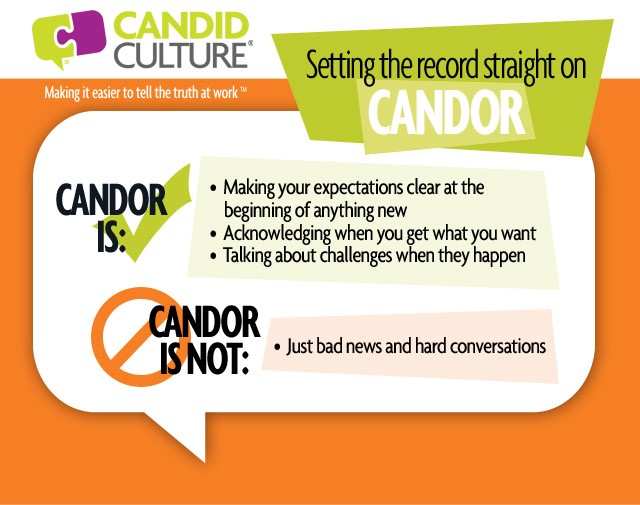
The word candor is not being used on a regular basis. Some people may not know what it means. And, in my experience, people who are familiar with the word often misinterpret candor to mean bad news. Most people expect bad news to come after the question, “Can I be candid with you?”
The definition of candor is, to be honest, truthful and forthright. We at Candid Culture define candor differently. The Candid Culture definition of candor: Telling people what you need before challenges occur. Anticipating everything that can take a project or relationship off track and talking about potential pitfalls before they happen.
Think about the projects and processes in your office – hiring someone new, sourcing a vendor, training people on new software. The potential breakdowns are predictable. You know the pitfalls that can happen when starting anything new because you’ve experienced them.
What if candor sounded like, “We want this project to be smooth. There are a couple of things that will make our work together go well and a few things that may delay the project and have it cost more than we budgeted. Let’s talk about what needs to happen for things to go smoothly, ways to prevent missed deadlines, and how we’re going to handle breakdowns when they happen.”
Some call a conversation like this setting expectations, others call it planning. In my world, these conversations are called candor –talking about what you need when projects begin, rather than letting the anticipatable train wreck happen.
Candor isn’t bad news. It’s telling people how to win with you vs. making them guess.
Examples of candor at work and at home:
“Here a few of my pet peeves… What are your pet peeves? I’ll do my best to avoid doing them.”
“What will frustrate you?”
“I turn off my cell phone alerts off after 9:00 pm, so feel free to text or call me anytime. I’ll respond to all messages in the morning.”
“I respond to text messages mostly quickly, then voicemail, then emails. If you don’t get a reply to an email within two or three days, don’t take it personally. Chances are I haven’t read the message. Feel free to follow up with a text or voicemail.”
“I work best by appointment. Drop by’s are hard because they interrupt my flow. Email or text me if you need something, and I’ll tell you when I can swing by. Does that work for you?”
For the most part, we treat people as we want to be treated. Other people aren’t us. They don’t do things as we do and don’t know what we want. Don’t make people guess how to work with you, what you need, and what you expect. Be candid and tell them! Then ask what the people you work and live with expect from you.
If you want to freak out the people you work with, tell them, “We need to talk.” If you really want to freak them out, say those four magical words on a Friday, or even better, the day before someone goes on vacation. “We need to talk” is rarely followed by, “and you’re awesome.” People know bad news is likely coming, and they’ll inevitably be on edge.
The antidote to asking for time to talk is to create opportunities to give feedback regularly.
There are many reasons giving feedback is hard. One of them is we wait too long. Something happens. We know we should address it, but we don’t want to. So, we wait to see if the behavior is really ‘a thing.’ Then it happens again. And now we know it’s ‘a thing.’ But we still don’t want to address it. Then the situation gets really bad, and now we have to say something. The conversation then takes 90 minutes, is painful, and everyone goes home unhappy.
Here are two keys to make giving feedback easier:
Giving feedback strategy one: Debrief everything. Do a quick plus/delta a regular basis to assess how things are going. Plus – what went well? Delta – what would we change if we could/what did we learn?
I recommend doing a quick debrief at the end of important meetings, hiring processes, projects, and when anything changes. Conduct a short debrief when you have staffing changes, gain or lose a client, launch or eliminate a product or service, etc. Change is an opportunity to evaluate how you work and to make adjustments.
When you debrief important events, you tell people that feedback is important and that it’s ok to be candid. Conducting regular debriefs also gives employees a chance to practice giving feedback, which is a hard skill. And like anything, the more we give feedback, the easier it becomes.
Conducting short, regular debriefs is one of the easiest ways to learn from the past and become a more candid culture.
Giving feedback strategy two: Schedule five to fifteen minutes each week to talk as a team and with direct reports. When you know you have time each week to talk with your manager, direct reports, and team members, you never have to ask for time to talk. Issues don’t build up or linger. Breakdowns and frustrations are discussed within of few days of their occurrence, and no one is worried that bad news is coming at their end of their vacation.
The key to being effective at giving feedback is to give feedback regularly. Short, frequent feedback conversations are much more effective than infrequent, long conversations that everyone dreads and leaves feeling exhausted and demoralized.
Debrief everything meaningful. Meet with people weekly. Ask for and give feedback as things happen, and watch your culture change.
A few years ago, I facilitated a company-wide training program for an 80-person organization. Early in the program, we were talking about career deal breakers and I asked someone in the group to share a deal breaker, so I knew that everyone was clear on what is and is not a true deal-breaker. An employee spoke up. She said, “I’ve been here six weeks. I’m overwhelmed and exhausted. If I don’t get some help soon, I’m leaving.” People in the room gasped audibly. And everyone surely thought the same thing – “She’s done. She’ll be gone by Friday.”
I ran into the organization’s CEO at the Denver airport two weeks later and we had dinner together. Over dinner, I asked if I could give him some advice. I said, “That woman who spoke up during the training did you a huge favor. You spent time and money to become a more candid organization; she gave you the opportunity to demonstrate whether or not you really mean it. Make sure nothing (bad) happens to her.”
It can be really hard when people disagree with us. Leaders institute a new practice, employees resist. Employees say they agree with a policy during a meeting but managers hear otherwise after the meeting.
It may feel easier to introduce a practice and ask employees to follow it without asking what they think. And sometimes it makes sense to do that. You don’t need to involve employees in every decision. But in an organization, it has to be safe to offer a counter-point-of-view. It must be safe to disagree.
Disagreement is hard. But silence and the fear of speaking up is dangerous. Organizations full of yes people don’t innovate. They don’t solve problems or find new ways to save costs. They don’t grow, develop, or change. Hearing the truth takes courage and persistence. Put your ego aside and ask – again and again and again.
Every time I work with a new organization, at least one employee pulls me aside and tells me about the organization’s “list”. Employees who speak up and say things the leadership team disagree with get put on the “list”. And employees who make the “list” disappear from the organization. Mind you, no one has ever seen this “list”, but employees everywhere are convinced it exists. And this is a challenge for leaders.
Even leaders who do all the right things regarding asking for and being open to all kinds of input are up against the belief that it isn’t safe to tell the truth at work. There may be no consequences whatsoever for speaking up, but the perception of the negative consequence is what matters. And this perception is powerful and pervasive across organizations.
So what is to be done? How do leaders get the truth when employees are afraid, disbelieving, and perhaps cynical?
Below are seven practices for leaders and managers to get more truth in their organization:
Put your ego aside. It hurts when people disagree with our beliefs or approach, and we’ll be fine. Let curiosity rather than your ego run the show.
Ask for input. Ask again and again and again. Employees may eventually believe that you really want their input.
Ask for input in different ways – in-person roundtable discussions, email, and surveys.
Ensure there are no negative consequences for speaking up. You can coach employees on how they spoke up and make suggestions for diplomacy, but reward the courage it took to speak up.
Share what you learn after gathering data. Don’t be a black hole. Give more information than you think you need to.
Tell employees the ideas you’re accepting and those you’re rejecting and why. It’s ok not to accept and act on all feedback. But close the loop and explain the rationale for decisions.
Be human. Admit failure, fear, worry, and wins. People trust leaders who are human, and humans have feelings and make mistakes. I’ll follow a humble leader further than a polished and seemingly perfect one.