Posts Tagged ‘avoid burnout’
Someone asks if you can (fill in the blank). You look at your calendar. That hour is open. You say, “yes.” You forgot that hour was designed for something you’ve been meaning to do, for yourself. You’re angry for forgetting. You promise to do better tomorrow.
The next day… repeat.
A way out of tired-inducing-people-pleasing is to set boundaries and stick to them. And this is hard, for me.
Examples of boundaries: Putting an hour in your calendar during the day to exercise; blocking 30-minutes between meetings to work on projects; only scheduling 80% of your workday to allow for last-minute requests and emergencies. Putting a boundary in place doesn’t mean saying no. Boundaries create the conditions that tell us, without struggle, when to say yes.
Before I had my son, I traveled for work constantly. Some weeks I was on the road for six consecutive days, in three different states. And I loved every second of it. Audience + microphone = happiness. When I had a child, I knew that schedule wasn’t going to work. So, I set boundaries. I decided how many nights per week I would travel and the time I needed to arrive home from each trip. And I didn’t violate those boundaries for 8 years. If a piece of work would require me to violate my travel boundaries, I said no without struggle, no matter how much I wanted to do that piece of work. The boundaries made the decisions easy. There was no deliberating or debating.
I’ll admit, I’m not as effective as setting boundaries in other areas of my life. Last week, I had a yoga class on my calendar. When I learned a repair person was able to be at my house during that hour, the yoga class was quickly deleted from my calendar. Yesterday, I asked my son what he wanted for breakfast, before flag football. He wanted scrambled eggs and a smoothie. I made both, knowing there wasn’t time. We were late for flag football. What was missing in both situations? Boundaries.
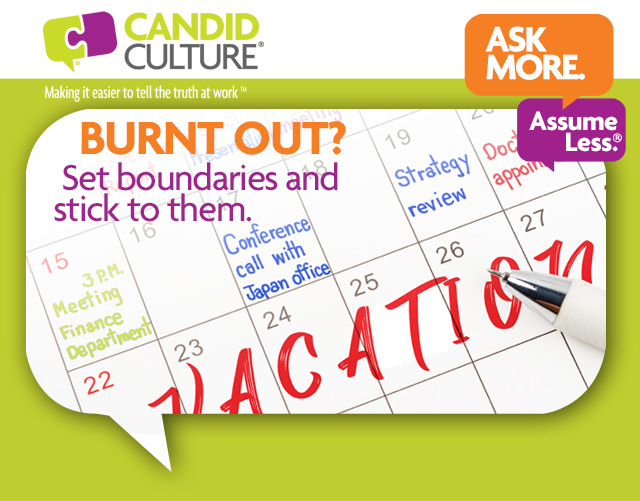
How does this apply to work? The key to preventing tired, burnt-out employees is to make it safe to speak up. Burnout is a systemic issue, not a personal one. Burnout at work comes from too much to do, over time. One way out is to make it safe to tell the truth at work.
For the most part, no one wants to admit to their boss that they are overextended or overwhelmed. Doing so feels like failure, and who wants to admit failure? If you want employees who are energized versus exhausted, focus on making it safe to tell the truth at work.
Five ways to make it safe to tell the truth at work:
- Leaders and managers share their own strategies for managing time and priorities.
- Ask your employees and coworkers meaningful questions. “How’s it going?” is not a meaningful question. Try: “What are your preferred working hours? What times a day would you prefer not to be contacted?”
- Show appreciation when employees risk and say hard things.
- Reward the truth. Make employees who are willing to say hard things a positive example.
- Help employees problem solve to manage their time and priorities. Be ‘in it’ with them.
The good news about violating your own boundaries is you will get another chance to do it differently tomorrow. You can always reset a boundary. This time, tell the other people in your life about your boundaries. Tell your coworkers if you don’t do happy hours, 7:00 am Zoom calls, and back-to-back meetings, and tell them why. Then offer an alternative. Everything in life is a negotiation.
I’m going to admit that I’m terrible at what I’m recommending today – taking time for yourself. Often my weekly blog is something I too am working on, and this week is no exception.
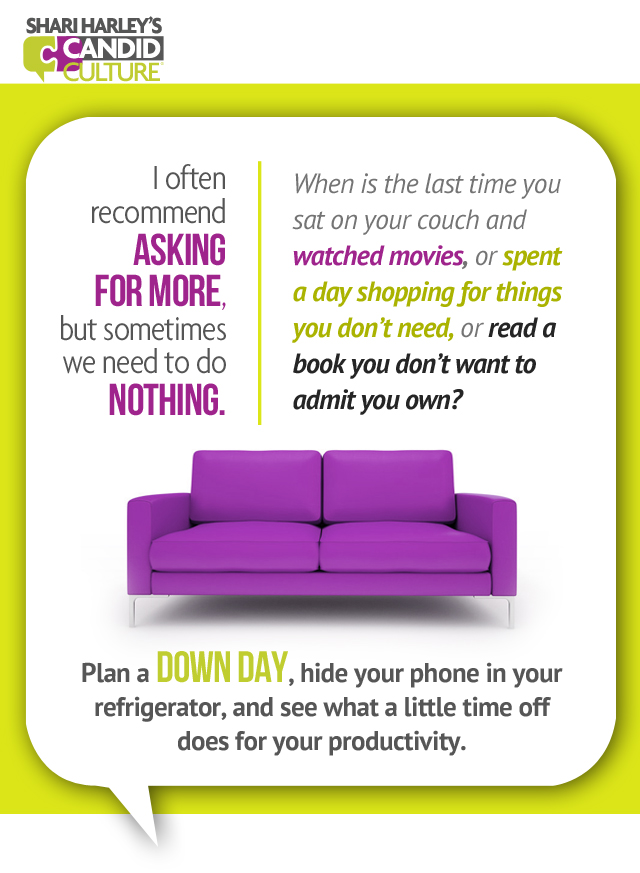
Many of you know that I have a small child and run a business. I work, travel, parent, and attempt to cook and keep my house clean. I’ll admit, I haven’t seen a gym or any form of real exercise since my son was born. I haven’t had lunch with a friend without my son in tow, haven’t seen a movie, and only talk to friends when I’m traveling.
The value of downtime and taking time for yourself is well documented. There is a lot written on the need to take breaks to recharge, rejuvenate, and avoid burn out. The question is how to do so without feeling like something else is getting short shrift.
Here are seven tips for taking time for yourself:
Taking time for yourself tip one: Give yourself permission after a really busy few days or week(s) to take a day and do nothing. If you’ve been on the road for four days or worked really long hours, plan to sleep in on the fifth day. Don’t schedule early morning meetings and a full day. Know that you won’t be productive on day five anyway, so you might as well plan to do very little, which is what you’re likely to do anyway.
Taking time for yourself tip two: Plan a day doing non-work-related things you really want to do. When is the last time you did something you really love to do, just because? You’re more likely to dedicate time off to doing something you love than just lying around. But, if a day of planned recreational activities feels like another ‘to do,’ you’re better off doing nothing and not feeling badly about it.
Taking time for yourself tip three: Plan time to see one or two friends a week. I’ll admit that I have to schedule phone calls to catch up with friends and schedule time to see people I care about. Yes, I admit, this seems wrong. But do whatever it takes. If you have to put lunch or a phone call with a friend in Outlook for it to happen, do it.
Taking time for yourself tip four: Don’t feel badly about taking time off. Many employees don’t take their allotted vacation time – for a variety of reasons. Just do what you need to feel rested and refreshed. Stop judging yourself.
Taking time for yourself tip five: If you take a day off or sleep late, don’t work until two in the morning the next day to compensate. Doing so defeats the purpose and will put you in a hole the next day.
Taking time for yourself tip six: Watch where your time goes when you’re ‘working.’ I know that I squander lots of time while I’m ‘working.’ I allow myself to get distracted reading emails as they come in, texting, and chatting in our office. You could work fewer hours if you reduced these distractions.
Taking time for yourself tip seven: Decide what you really want your life to be about and what’s really important to you. Do you want work to be your focus or do you want an equal balance of friendships, family, and community activities? You likely have what it is that you really want.
If what you really want is a career-centric life, then just admit that and don’t judge yourself for it. But do take enough time off that you are rested, productive, and don’t resent your work.
Posted under
Uncategorized on May 10, 2015 by Shari Harley. Comments
I’m going to admit that I’m terrible at what I’m recommending today – taking time for yourself. Often my weekly blog is something I too am working on, and this week is no exception.
Many of you know that I’m often in three to five states a week doing what I love most–working with all of you. When I get home, I often spend my evenings and weekends catching up.
While I feel I need to maintain this schedule to keep up, I’m aware that I can’t and don’t want to work all the time. So today’s blog is for all of us who don’t know how to turn it off and walk away from the laptop.
The value of downtime and taking time for yourself is well documented. There is a lot written on the need to take breaks to recharge, rejuvenate, and avoid burn out. The question is how to do so without feeling like something else is getting short shrift.
Here are seven tips for taking time for yourself:
Taking time for yourself tip one: Give yourself permission after a really busy few days or week(s) to take a day and do nothing. If you’ve been on the road for four days or worked really long hours, plan to sleep in on the fifth day. Don’t schedule early morning meetings and a full day. Know that you won’t be productive on day five anyway, so you might as well plan to do very little, which is what you’re likely to do anyway.
Taking time for yourself tip two: Plan a day doing non-work-related things you really want to do. When is the last time you did something you really love to do, just because? You’re more likely to dedicate time off to doing something you love than just lying around. But, if a day of planned recreational activities feels like another ‘to do,’ you’re better off doing nothing and not feeling badly about it.
Taking time for yourself tip three: Plan time to see one or two friends a week. I’ll admit that I have to schedule phone calls to catch up with friends and schedule time to see people I care about. Yes, I admit, this seems wrong. But do whatever it takes. If you have to put lunch or a phone call with a friend in Outlook for it to happen, do it.
Taking time for yourself tip four: Don’t feel badly about taking time off. I always feel guilty when I sleep until 11 am or do nothing until 3 pm on a Saturday. I still do it, but my enjoyment is diminished by my self-imposed judgment. Just do what you need to feel rested and refreshed. Stop judging yourself.
Taking time for yourself tip five: If you take a day off or sleep late, don’t work until two in the morning the next day to compensate. Doing so defeats the purpose and will put you in a hole the next day.
Taking time for yourself tip six: Watch where your time goes when you’re ‘working.’ I know that I squander lots of time while I’m ‘working.’ I allow myself to get distracted reading emails as they come in, texting, and chatting in our office. You could work fewer hours if you reduced these distractions.
Taking time for yourself tip seven: Decide what you really want your life to be about and what’s really important to you. Do you want work to be your focus or do you want an equal balance of friendships, family, and community activities? You likely have what it is that you really want.
If what you really want is a career-centric life, then just admit that and don’t judge yourself for it. But do take enough time off that you are rested, productive, and don’t resent your work.