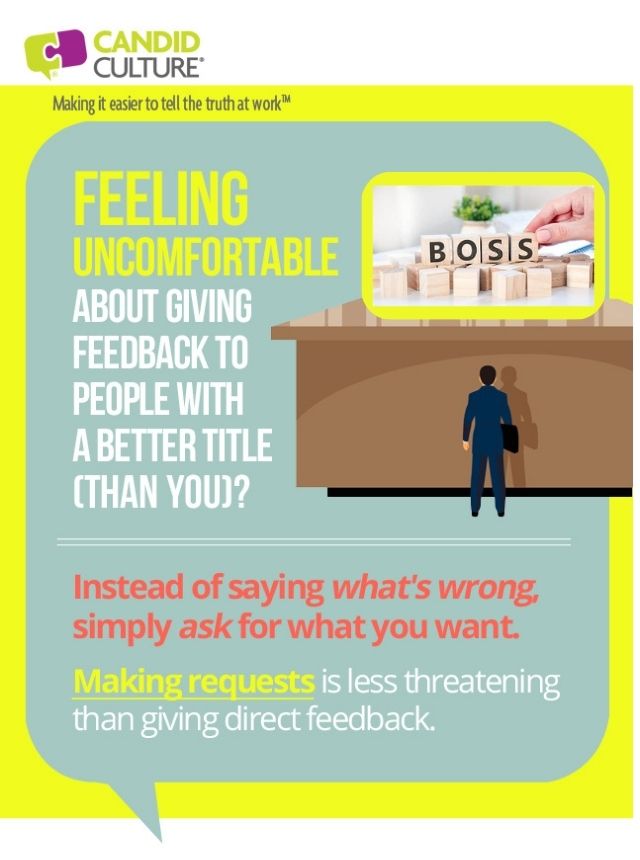
I’m often asked, “Can I give my boss or the people above me feedback? Is that really realistic?” Giving people ‘above’ you feedback has everything to do with the quality of your relationship and less to do with the person’s title. If your relationship is good and your boss is open to feedback, then yes, you can give them feedback. If your relationship isn’t that solid or your boss isn’t open to your feedback, practice managing up by asking for what you want instead of giving direct feedback.
No one likes to be criticized or told that they are wrong. When giving someone direct feedback, no matter how kind the delivery, you are telling someone, “You’re doing ______ wrong. Please do _____ instead.” Being that direct is challenging when you don’t have a trusting relationship or when people are highly defensive. You can achieve the same desired results by simply asking for what you want.
Asking for what you want is less judgmental than giving direct feedback and is a subtle way of telling someone they are not giving you what you need. And people who are paying attention will get that. They don’t need it spelled out.
Here are a few ways to practice managing up with your boss and other leaders in your organization:
Example One:
Giving Direct Feedback: “You don’t make time for me. I’m getting behind on projects because you don’t take the time to review my work.”
Managing Up by Asking: “How can we ensure you get to review my work each week, so I can finish the projects I’m working on?”
Example Two:
Giving Direct Feedback: “Every time we have a meeting scheduled, you cancel it.”
Managing Up by Asking: “If meetings get cancelled, is it ok if I reschedule them?
Example Three:
Giving Direct Feedback: “You’re a micromanager. I feel like I can’t make a move without your permission.”
Managing Up by Asking: “I’d like to manage ________ project. What do you need to feel comfortable with me doing that?”
Telling someone at any level they are doing something wrong, will likely evoke defensiveness. And being direct requires both courage and a good relationship. If you don’t have the relationship to be so direct, simply ask for what you want.
Time is the only thing in life you can’t get back. You can make friends and lose friends. You can make money and lose money. You can gain weight and lose weight. But you never ever get back your time.
So where is your time going? What are you doing that you know someone else should be doing? What are you doing out of obligation that is devoid of enjoyment? Where do you invest more time than you need to, requiring you to give short shrift to other priorities?
It may seem odd that a communications expert is writing about time management. I don’t speak or train on time management. But I do teach coaching and delegation, and effective managers and coaches know when to give something away.
Here are five time-management questions:
What are you doing at work that you know someone else could or should do?
If you invested a few hours training someone, what could you give up, creating room for something new?
What personal relationships do you invest time in because you think you’re supposed to?
Which family events are you attending out of obligation?
What do you give 110% percent to that 70% would be more than sufficient, leaving more of your time and energy for something more important?
You only have so much time and energy. Where are you going to put it – on the things that matter most or on distractions that seem important?
I’m not suggesting you skip every family event you don’t want to go to. But perhaps go for less time or skip every third event. I’m not advocating cutting corners or doing mediocre work. But sometimes we spend much more time on things than we need to, when investing less time would deliver the same result.
Here are a few examples of what I mean by 70% being more than enough:
You spend 25 hours on the formatting of a presentation when the content is what’s really important. You create gorgeous tables and graphs when five bullets were what the client really wanted.
You host a party and make hand painted table tents describing each food, when your guests will have a great time with typed descriptions or no descriptions at all.
You maintain friendships you know should have ended long ago because it seems like the right thing to do.
You avoid calling friends if you don’t have an hour to talk instead of calling and saying, I only have ten minutes but really want to talk with you.
Invest your time in what produces the greatest results and maximizes your enjoyment. Work hard, do great work, invest in your family and friends, and know when “no thank you” is the right answer.
When I led leadership development training for a large mutual fund company we offered a lot of training focused on helping people have hard conversations. Over time I realized that despite that I’d bought and offered the best training programs I could find, the training wasn’t helping. Managers didn’t give enough feedback, and when they did give feedback, employees were often left confused, wondering what they needed to do differently.
I decided that what was missing was the conversation before the crucial conversation. It wasn’t that managers didn’t know what they wanted to say; many managers felt they couldn’t say what they wanted to say. There wasn’t sufficient safety or permission for giving feedback, so managers said little or delivered messages that were so vague, employees were left wondering if there was a problem. This is how the idea for Candid Culture was born.
If you’re struggling with giving feedback, I doubt it’s the message that’s the challenge. The distinction between being able to tell the truth (as you see it) and saying nothing, is the quality of your relationship.
Think about the people – personal and professional – who can say anything to you. These are the people who can tell you the person you’re dating is wrong for you, that a piece of clothing is not flattering, or that you dropped the ball. You may not enjoy getting the feedback, but you’re able to hear what they have to say and take it in, because you know they care about you and have your best interests at heart. You trust their motives. When you trust people’s motives, they can say anything to you. When you don’t trust people’s motives, there is little they can say.
If you’re struggling to give feedback, evaluate your relationship by asking these questions:
Does this person trust me?
Does this person know that I have their back under any circumstances?
If the answer to either of the questions is no, it’s not giving feedback you’re struggling with, it’s the quality of your relationship. Work on building trust with this person and you’ll be able to say whatever you feel you need to say.
Here are four steps to building trusting relationships:
Ask questions to get to know people better than you know them now.
Tell people you want them to succeed and demonstrate that by being supportive of their efforts.
Set the expectation that you will give both positive and upgrade feedback as events happen, because you want the person to be successful.
When you deliver feedback, be extremely specific. Feedback that is specific will be received much better than vague feedback, which is typically judgmental.
When people know that you respect and support them, you have a great deal of freedom to speak up. When people don’t trust your motives, giving feedback is almost impossible. The recipient will become defensive and dismiss whatever you say, rationalizing that you don’t like them.
Worry less about giving feedback – for now. Instead, build trust. Get to know people better, then work on giving feedback.
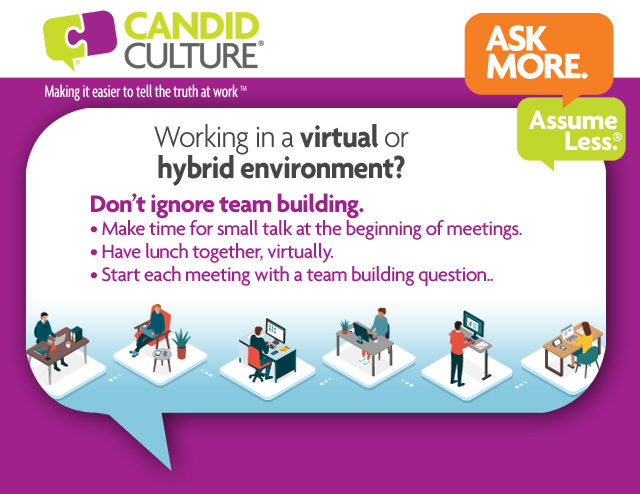
One of the most frequent questions I get is how to retain an organization’s culture and build teamwork when people work virtually. It’s easy to forget about team building when you’re working hybrid or think that team building can’t be done virtually, or decide to wait to do team building until your whole team can get together in person. My advice; don’t wait.
Often the most meaningful aspects of work are the people we work with and the relationships we build. When you leave a job, you leave your laptop and take your friendships. You can build team work virtually; you just need to make the time.
Spend the first few minutes of virtual or hybrid meetings on small talk, just like you would if you were gathering in a physical conference room.
Eat lunch together, virtually. Remember when people used to sit together in the office breakroom or cafeteria? Why not eat together via video? Team building doesn’t have to be elaborate. It can just be spending time together.
Humans need people contact and relationships. Connections with our coworkers make us feel connected to our organizations.
Small talk and group lunches create camaraderie, but they don’t teach people how to work together. In addition to social activities, give people a chance to talk about working style preferences. You don’t have to do personality assessments and long training programs to build teamwork. Just give people a chance to talk about how they like to work, on a regular basis.
Tell your team you want to help people get to know each other better, so work gets done more easily. Start each team meeting with one of the questions below, then move on to your meeting agenda. Do this all year.
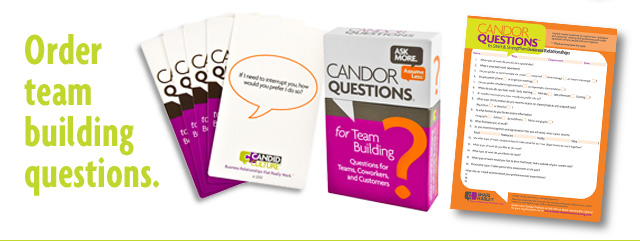
Here are a few team building questions you can use:
What are your pet peeves at work?
What time of day do you do your best work?
Do you leave your email, phone, or text alerts on at night? If I text you after hours, will you get a ping?
If I email you on weekends and evenings, do you think I expect a response? Would you prefer I send messages only during regular business hours?
What’s an area of our business you’d like to learn more about?
What’s something you’d like to learn to do that you don’t have a chance to do now?
Read a question to the group. Give everyone at the meeting the opportunity to answer the question about themselves. And remember, the meeting leader/facilitator speaks last. People will often follow the most senior person’s lead. You want people to answer authentically rather than providing what they think is the ‘right’ answer.
Team building doesn’t have to take a lot of time or money. Don’t wait until everyone is in the office or for a future retreat. Help coworkers spend time together formally and informally, getting to know each other better now.
Leaders and managers work hard to retain employees. Employees watch how their organization’s leaders and managers work, and often make career decisions based on the hours the most senior people keep.
Employees pay attention to how often managers and senior leaders take time off and whether or not leaders attend meetings and respond to emails while they’re on vacation. Employees observe the late nights that leaders and managers put in and the emails sent at 11:00 pm and on the weekends. I’ve heard lots of employees say, “If I need to work like my boss works to get ahead in this organization, I’m not interested.”
Managers, one of the keys to retaining employees is to communicate expectations. If you’re available while you’re on vacation, but don’t expect employees to do the same, set that expectation. If you send an email outside of regular business hours but don’t expect employees to respond until the next business day, tell them so. They don’t know. Many employees assume that if you email them at night, you expect a reply.
Microsoft has made these situations easy to avoid, with the ability to program emails to go out during regular business hours. And some people state in their email signatures, “I work outside of regular business hours, but don’t expect you to.”
Instead of allowing employees to make assumptions about what managers do and don’t expect, set clear expectations. Be overt and clear. When you hire employees, tell them, “I work most evenings and weekends, but don’t expect you to do so. And I work these hours because I enjoy it, not because I have to. If I email you outside of regular business hours, I am not expecting you to reply.” Retaining good employees begins during the interview process when initial expectations are set.
Managers, if you expect employees to check and respond to emails outside of regular business hours and to be available while on vacation, tell candidates during the interview process.
Employees, if your manager emails you outside of regular business hours and doesn’t tell you whether or not she expects you to reply, ask. Simply say, “I often receive emails outside of regular business hours. How will I know when you need me to reply?” Likewise, if you notice your manager emails you on vacation, you can say, “I typically hear from you when you’re on vacation. Are you expecting me to check in while I’m off?”
The need to ask questions and set expectations goes both ways. Don’t wait to be told. Ask.
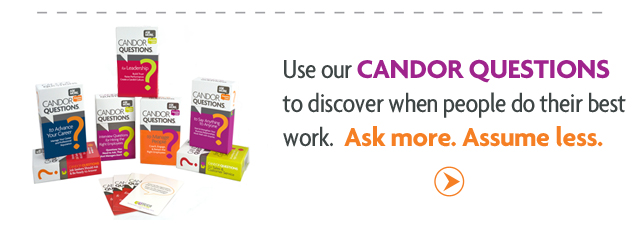
Managers and employees, ask these Candor Questions about working style preferences to aid in retaining employees:
How do you feel about being contacted outside of regular business hours?
If I need to reach you over a weekend or in the evening, what method is best?
Would you prefer I text you so you don’t have to check your email outside of business hours?
What time is too early and too late to call, text, and/or email?
Ask more. Assume less and make retaining employees easier.
Lots of people joined organizations virtually in the last few years and have never met their coworkers in person. Many people are working hybrid and may only see coworkers a few times a month, if at all. You may be wondering how you build relationships and your career when you don’t see the people you work with. Here is the short answer – talk to people. Pick up the phone. You don’t need to have video calls, if you don’t want to. You just need to talk to people.
People need human contact. We even need to connect with the people we don’t like – when we work with them. Text and email don’t replace talking to people.
We stopped talking to each other long before so many people began working from home. Email has been overused for years. We emailed the people we sat next to at work. We exchanged 20 emails on one topic rather than picking up the phone. We ask permission to call our friends to catch up. Texting a friend to ask, “Is it ok if I call you tomorrow morning?” is the norm. We exchange 50 texts to determine where and when to meet for lunch.
Maybe people think email and texting is easier, less intrusive, faster. Less intrusive, yes. Easier, sometimes. Faster, no.
Call the people you work with. Ask for the best time to call or schedule calls, depending on people’s preferences. Have the conversations you’d have if you ran into them in the hallway at work. Talk through the projects you’re working on. If you’re new to the organization, ask their role and how your role impacts theirs. Calls don’t have to be long. People just need contact. And while you’re on the phone, get questions answered in five minutes rather than with 25 emails.
Giving feedback upwards is hard. Giving feedback downward is hard. Giving feedback to peers can be the hardest of all. We work closely with our peers. They’re often our friends. And still, we need to be able to speak freely when our coworkers violate our expectations.
The key to being able to give peers feedback (to give anyone feedback) is to agree that doing so is not only acceptable but expected. Before agreeing to give and receive feedback, peers need to set clear expectations of how they’ll work together and treat each other.
Telling people how you want to work with them is always easier than asking someone to change their behavior. But it often just doesn’t occur to us to tell our peers what we want and need from them. We’re busy. They’re busy. And don’t they already know what courteous workplace behavior looks like? Return all emails within a day or two, tell people if you’re running behind on a project and will miss a deadline, and call into meetings on time from a quiet workspace. Aren’t all of these behaviors fairly obvious? Do I really need to tell people these are my expectations? Uh….yes, you do.
If you don’t want employees dumping these challenges on their managers, help employees talk to each other.
Here are seven steps to help people who work together set expectations and hold each other accountable:
Schedule a meeting during which people working together can discuss what they need from each other to be satisfied and productive. Then facilitate a discussion during which the group creates 5 – 7 behavior guidelines each person agrees to follow.
Put the list of agreed-upon behaviors in a shared folder. Leave the guidelines there indefinitely.
Give each person in the group permission to talk to individuals who violate the guidelines. This is very, very important. For the most part, employees won’t tell a peer they are missing deadlines, gossiping, or is distracted during meetings. People will suffer in silence and avoid the offender rather than speak up about the behaviors that frustrate them. Ask the group to grant each other permission to speak up when guidelines are violated. Giving each other permission to speak up will make future conversations possible – difficult but possible. Without permission and these agreed-upon behaviors in place, people will suffer in silence or talk about each other, not to each other.
Ask everyone in the workgroup to take feedback graciously, responding with “thank you for telling me,” rather than with defensiveness.
Two weeks after making the list of guidelines, get the group together on a call to review the list, and make any necessary changes to it. Discuss behaviors that were omitted, aren’t realistic, and are realistic but aren’t being followed.
Then follow up by facilitating a monthly conversation during which group members give honest feedback about which guidelines are being followed and which are not, and problem solve as a group. These conversations aren’t a chance to embarrass or call people out in front of a large group. If one person is violating a guideline, that conversation should happen individually. Group conversations keep the lines of communication open – which is essential to making working with others work.
You will need a strong facilitator for the group discussions. The facilitator must tease out people’s thoughts while making sure no one gets blasted in front of the group. Don’t let concerns, that you know exist, be brushed under the rug. Group members must openly and regularly discuss what is and isn’t working about their work environment, or frustrations will build, and unhappiness and dissension will ensue.
It’s not too late to put these practices in place, even with a group that has been working together for a long time. Just schedule the conversation and explain why you’re having it. People will be relieved and grateful.
How many times have you sent someone five emails and become frustrated when none were returned? Or you thought an employee was happy, only to be surprised when they quit? Or you needed to talk with someone but couldn’t get their attention, so you walked by their office throughout the day, wondering if it was ok to knock? Working with other people doesn’t have to be so hard.
Taking the time to ask team building questions is much faster than recovering from missteps with other people. Ask the questions at the beginning of anything new – when you hire a new employee, get a new customer, or start a new project. And keep asking the questions as you work with people.
I use the Candor Questions below, when I onboard a new team member at Candid Culture. The questions help the entire team get to know each other better and learn how to work together.
What will keep you working here and what would make you leave?
What’s the best way to get information to you – voicemail, text, or email?
What time is too early?
What time is too late?
Do you leave your email and/or text alerts on at night/when you go to sleep?
Would you prefer I send all emails and text messages during regular business hours?
What frustrates you at work?
What are your pet peeves?
What’s something you want to learn, skill or business wise, that you haven’t had a chance to do?
What’s something you wish I would start, stop, or continuing doing?
We move so fast at work and are so focused on completing goals, we often don’t take the time to really get to know the people we work with. I feel very strongly that asking the team building questions above will help people work better together. We’ll make fewer ‘mistakes’ with each other, and get more done with less stress and more ease. As William Ury said in his book, Getting to Yes, “Go slow to go fast.”
Asking questions about working style preferences and goals is an ongoing process, and it’s never too late. You can ask the team building questions during meetings or just slip them into your conversations. The process doesn’t have to be formal or time consuming. The point is simply, don’t guess what people need and are expecting from you, ask.
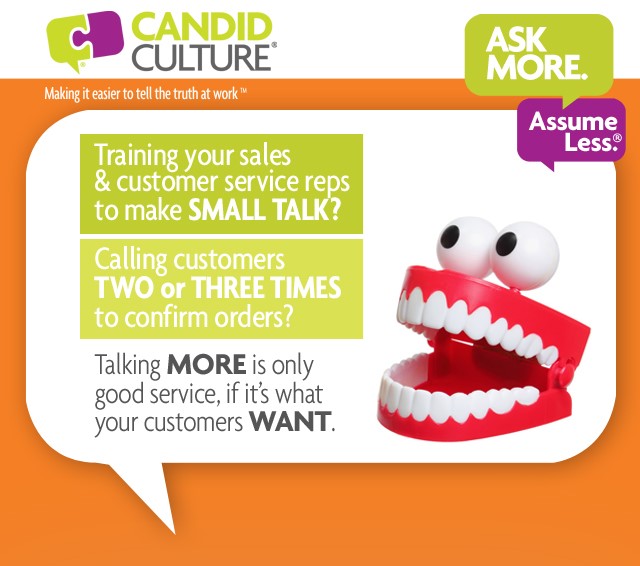
Many organizations think they’re improving customer service by training sales and customer representatives to make small talk — asking how a customer’s day, week, or trip is going. Asking questions and chatting with customers about personal matters is only good customer service if clients WANT to make small talk.
When room service delivers breakfast and the hotel guest is standing in a towel, he’s probably not interested in talking about whether his trip is for business or pleasure and whether or not he’ll have time for fun while he’s in town. Improving customer service will likely require the wait person to get in and out of his room quickly. When a ride-share driver talks with you when you want to work, his desire to chat probably isn’t improving customer service.
Sales and customer service representatives can also over communicate about business-related issues. Last weekend I ordered some equipment online. Shortly after placing the order, a customer service representative called me because I’d provided different billing and shipping addresses, and he wanted to be sure that someone wasn’t fraudulently using my card. Focused on improving customer service, he asked me to call back before they’d ship my item, which I needed Monday and paid $32 to have sent via overnight mail.
When I called back, I got voicemail and left a message. Then I spent the day wondering if the guy got my message and if my order would arrive on Monday. Then he left another voicemail saying that one of the items I ordered was out of stock but he thought they might have it in another color. He then called again to tell me that they did indeed have the item in a different color and asked me to call back. When I called back, I was told that my order had already shipped. Three unnecessary phone calls on a Saturday is not improving customer service.
You may be thinking this situation is an anomaly, but it happened to me again a few days later. I returned a pair of pants I bought online. I wrote a letter explaining for what item I wanted to exchange the pants. A customer service representative called to ask if I was sure about what I wanted and asked me to call back. When I returned the call, I was told that my order had already shipped.
I suspect companies think they’re improving customer service by asking how a customer’s day is going and by calling customers personally when questions arise. Perhaps I’m too busy, but having to call a vendor to tell them that I meant to order what I ordered and I really do have a separate billing and mailing address is not improving customer service. It’s time consuming and annoying.
I’m aware my preferences are not consistent with all buyers, and many customers appreciate calls from vendors and making small talk with wait staff, taxi drivers, and other service providers. But you won’t know what your customers want if you don’t ask them. Consider asking customers about their preferences when they buy something.
Here are a couple of questions you could ask, with the goal of improving customer service:
If we need to contact you, what method is best? Phone, email, or text message?
Ride-sharing drivers, massage therapists, dentists, etc. ask, “Would you like a silent ride/visit?”
What’s your definition of good customer service? Check all that apply.
Get it done fast and right the first time.
Get to know me. I’m happy to chat.
Get it done right and ask all the questions you’d like.
I’ll sacrifice pleasantries for speed.
Our customers don’t necessarily share our definition of good customer service. Small talk may suit some customers, while it alienates others. Read your customers’ body language and listen to their tone of voice. Do they look and sound like they want to chat with you? Do they happily provide you with detailed answers to small-talk related questions, or do they provide short answers and appear impatient? Listen, watch, and adjust your behavior accordingly. Or preferably, ask what customers are expecting from you when they buy. Ask more. Assume less.
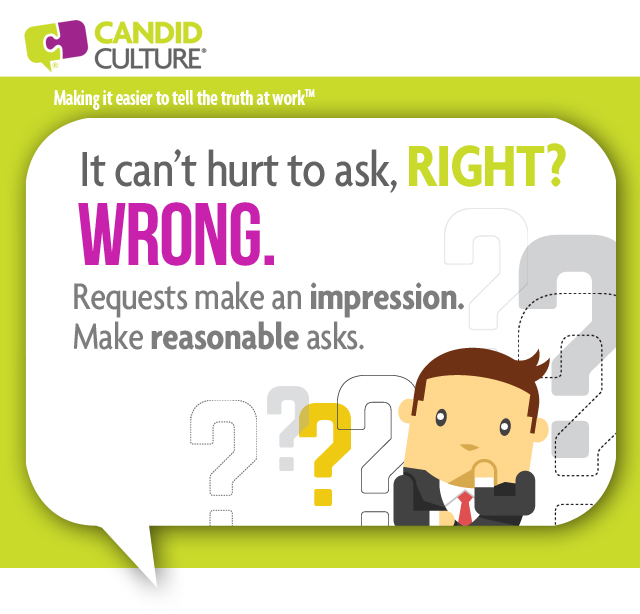
I recently interviewed a candidate who asked for a lot of ‘stuff’ during the interview process. She wanted compensation, perks, accommodations, and benefits that were way outside the norm. I’m assuming she was employing the adage we’ve all heard, that “it can’t hurt to ask.” Unfortunately, it can hurt to ask.
When forging new relationships, we watch (judge) people. We’re trying to figure out who they are and how they are. Are they the person they claimed to be during the interview process? Are they trustworthy? Did I make the right decision in bringing this person into my team, organization, and life?
Requests always make an impression. When we’re building new relationships, requests make an even bigger impression. Candidates who said the commute wouldn’t be an issue, but complain about it two weeks into the job, cause managers to doubt their hiring decision. Coworkers who consistently ask for extensions to deadlines, appear unreliable.
People watch us and silently judge, making assessments about our commitment, reliability and even character. Don’t make people question you. Make reasonable asks.
Five ways to make reasonable requests:
Vet your requests with people who know your company, manager, and/or industry, before making them. A reasonable request in one organization, might not be reasonable in another.
If something is important to you, ask for it during the interview process or at the onset of new projects and relationships. Don’t wait. Waiting to ask for things until after you’ve started a job can damage your relationships and reputation. Managers don’t like bait and switch, even when it’s unintended.
Once you’ve received an emphatic “no”, accept it. I worked with someone who asked for something during the interview process. I said “no” and explained why. He asked again after being hired. This annoyed me and made me feel like he didn’t listen.
If you aren’t sure that what you’re asking for is reasonable, say so. Tell the person what you want and to please tell you if it isn’t a reasonable request.
Ask for feedback on your requests. If you’ve seen me speak, you know I’m a proponent of telling people, “If I do anything that damages our working relationship or makes you question me, I hope you’ll tell me. I promise I’ll take your feedback graciously and say, “thank you.”
Ask for what you want, within reason, be upfront when relationships begin, and build your relationships rather than break them.