Managing People Archive
 A professional athlete would never get on the court, field, or ice without knowing the rules of the game. Athletes know every action that will result in points, penalties, and other positive and negative consequences. Yet many of us go to work without any idea of how we’re being held accountable and what a good job looks like.
In the next few weeks, way too many people will have a performance review during which they will receive feedback that’s a surprise.
Writing clear, specific, and measurable goals is the key to managing your own work performance and to not being caught off guard by performance appraisals. Writing goals may not be sexy or fun, but doing so is the key to taking control of your year.
Four tips for setting goals at work:
1. Setting goals at work: Don’t wait for your manager to suggest writing goals. Ask permission to draft 5 to 7 goals.
2. Setting goals at work: Discuss and finalize each goal with your manager, and ask that the goals be the criteria for your 2017 evaluation.
3. Setting goals at work: Write such specific goals, that at the end of the year, it’s very clear whether you did or didn’t produce the agreed-upon results. When goals are specific, performance appraisals write themselves.
4. Setting goals at work: As business priorities and objectives change, goals change as well. Review your goals with your manager quarterly and make changes as appropriate.
Here are questions to answer when writing goals:
- What results will you produce? What will be different in the organization at the end of the year? (X%) Assign each goal a percentage. Weight each goal by importance.
- What actions will you take? What will you do, and when will you do it?
- How will you know you’ve made progress or achieved your goal? What will be different as a result of your work? (This should be quantitative. Use numbers.)
Here is a completed sample goal:
Results to produce: Retain 90% of new customers. Weighting: 40%
Actions to take:
- Have a setting-expectation meeting with each new customer.
- Return all customer calls within 24-hours.
- Call 10% of customers quarterly, and ask for feedback.
Milestones and year-end results:
- Customer complaints will drop by 20%.
- Customer change orders will drop by 10%.
When what you need to do during the year is clearly articulated, you’ve set yourself up to win. You know exactly what you need to do to be successful. Early in my career, I worked for an organization that did goal setting well. Each employee wrote 5 to 7 goals that were weighted and extraordinarily specific. It was obvious, throughout the year, if employees were meeting performance standards. And at the end of the year, it was so clear whether or not employees had done what they needed to do, employees could write their own performance appraisal. That’s the power of goals. Well–written goals drive performance, empower employees, and remove the debate about results.
Not every goal or objective at work is numerical and clear cut, but many are. Write down what you need to do and what the desired outcome looks like, whenever possible, and you’ll feel more empowered and in control at work than you previously thought possible.

No one (I know) enjoys writing, delivering or receiving performance feedback. It’s time consuming to write, challenging to deliver, and can be difficult to hear. Unfortunately, most performance management systems – goal setting forms, performance appraisal templates and online templates – don’t make the process easier. Ins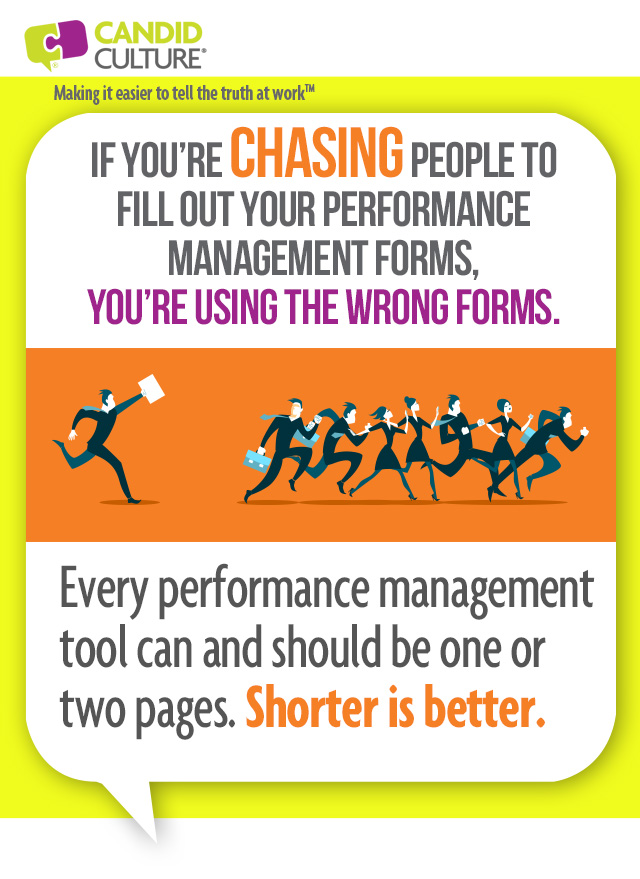 tead, they make it harder. Short and simple is best.
When I started managing leadership development for a large company, I inherited a 12-page performance appraisal form and what seemed like 89 competencies. One of the business leaders I supported told me, “I’m not asking my people to use this form. If you can give me something that’s one page, I’ll have my managers use it.” That conversation sent me on a mission to make all performance management forms one or two pages. And really, why shouldn’t they be? People can only focus on leveraging and changing a few things at a time. Why give more feedback than that at any given time?
If you’re chasing people to use your performance management tools and templates, you have the wrong forms. In my experience, when people find something easy to use and valuable, they’ll use it. If something is difficult to use or doesn’t seem to add value, people drag their heels.
Here are a few ideas for making your performance management process easier:
Make your forms and templates simple. No performance management tool should be more than two pages. In a performance appraisal – quarterly, annual, or otherwise – identify up to three things the person did well and a max of three things s/he can either do more, better, or differently next year. Anything more is overwhelming and a set up for disappointment, frustration, and overwhelm.
If you have additional areas for the person to work on, meet again in 90-days and assess how the person has done with the three pieces of feedback already provided. If s/he has made significant progress on the things they were already working on, add a few new things to work on. If significant progress hasn’t been made on the existing feedback, wait to add more.
I know your existing performance management templates may not allow for what I’m suggesting. If you’re working with a template that requires more input, write up to three clear, succinct, and actionable bullets in each required area and not more. Bullets are better than paragraphs. Be specific. “Great job” is not feedback. Neither is, “needs improvement.” Give a specific example or two. No example, no feedback.
Resist the urge to write paragraphs of vague feedback or to accept that type of feedback in a self-appraisal. Paragraphs of feedback take too long to write and often say little. I’d suggest spending less time writing performance feedback and instead spend the time observing performance, asking others for input on the person’s performance, and writing three succinct, specific bullets that describe an action taken or outcome produced. Specific feedback is meaningful, useful, and received with less defensiveness.
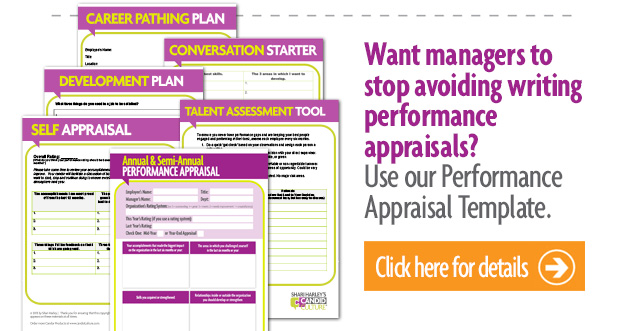
Click below to see our suite of one and two-page performance management templates. And watch for our upcoming webinar on how to write and deliver performance appraisals that are less painful, more useful, and quicker to write and deliver.
 Lots of organizations send out employee engagement surveys with the desire of improving employee engagement and retention; unfortunately they often damage both in the process.
There are a few employee engagement survey pitfalls that are luckily easy to avoid.
Here are three practices to follow when sending out employee engagement surveys:
- Shorter is better. I hate to say this, but no one wants to fill out your employee engagement survey. It’s time consuming, employees doubt the survey will yield results, and employees worry that their feedback isn’t really confidential.
Make your employee engagement survey easy to fill out by making it short. And by short, I mean 10 questions or fewer. You’ll get a better response rate to a 10-question survey than a 65-question one. And do you really need more information than the answers to ten well-written questions?
- Provide employees with survey results quickly. Most organizations ask for too much information. Leaders are overwhelmed by the survey information, so they spend months and months reviewing it, while employees comment on yet another employee survey with no communication.
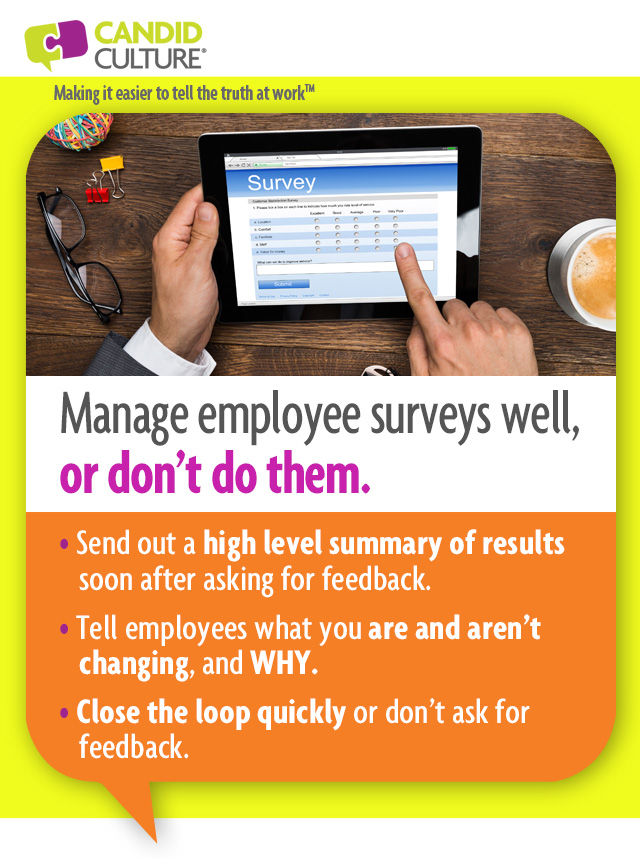
Send out a communication sharing the top few learnings – the good and the not-so-good — within a few weeks of sending out the survey. You don’t need to take action at the same time. Simply keep employees in the loop by communicating a quick summary of what you learned. If you wait too long to share the feedback, it often never gets communicated. And the next time you send out a survey, employees will remember the absence of information and be hesitant to fill it out.
- Within 90-days, tell employees what you will and won’t be changing, based on the survey feedback, and tell them why. Employees don’t need or expect all of their input to be utilized. Closing the loop with clear communication about what you are and aren’t changing, and why, is often sufficient.
All of that being said, I’m going to recommend you send out fewer surveys. Employee engagement surveys are a good way to quickly collect lots of information. Engagement surveys are not a good way of building trust and relationships with employees, which is what leads to employee engagement and retention. Employees don’t feel closer to an organization’s leadership team after filling out an employee engagement survey. Trust isn’t built. Instead of sending out so many surveys, I’d suggest cutting the number in half and have leaders and managers hold roundtable discussions with groups of 6-8 employees a few times a year instead. Roundtable discussions achieve several goals at once—they give leaders visibility, which builds trust, they help leaders build rapport and relationships, and gather the same data that a written survey provides.
When leaders participate in our Be a Best Place to Work program, we teach the five things leaders need to do to engage and retain employees. Holding roundtable discussions and asking these questions is a key recommendation of the training. Sending out written surveys is not. Engage and retain employees by talking with employees. Ask employees for their input. Listen. And watch your employee engagement survey scores sky rocket.


If you want to freak out the people you work with, tell them, “We need to talk.” If you really want to freak them out, say those four magic words on a Friday, or even better, the day before someone goes on vacation. “We need to talk” is rarely followed by, “and you’re awesome.” People know bad news is likely coming, and they’ll inevitably be on edge.
The antidote to asking for time to talk is to create opportunities to give feedback regularly.
There are many reasons giving feedback is hard. One of them is we wait too long. Something happens. We know we should address it, but we don’t want to. So we wait to see if the behavior is really ‘a thing.’ Then it happens again. And now we know it’s ‘a thing.’ But we still don’t want to address it. Then the situation gets really bad, and now we have to say something. The conversation then takes 90 minutes, is painful, and everyone goes home unhappy.
Here are two key to make giving feedback easier:
Giving feedback strategy one: Debrief everything. Do a quick plus/delta on a regular basis to assess how things are going. Plus – what went well? Delta – what would we change if we could/what did we learn?
I recommend doing a quick debrief at the end of important meetings, hiring processes, projects, and when anything changes. Conduct a short debrief when you have staffing changes, gain or lose a client, launch or eliminate a product or service, etc. Change is an opportunity to evaluate how you work and to make appropriate adjustments.
When you debrief important events, you tell people that feedback is important and that it’s ok to be candid. Conducting regular debriefs also gives employees a chance to practice giving feedback, which is a hard skill. And like anything, the more we give feedback, the easier it becomes.
Conducting short, regular debriefs is one of the easiest ways to learn from the past and become a more candid culture.
Giving feedback strategy two: Schedule five to fifteen minutes each week to talk as a team or with direct reports. When you know you have time each week to talk with your manager, direct reports, and/or team members, you never have to ask for time to talk. Issues don’t build up or linger. Breakdowns and frustrations are discussed within of few days of their occurrence, and no one is on edge that bad news is coming at their end of their vacation.
The key to being effective at giving feedback is to give feedback regularly. Short, frequent feedback conversations are much more effective than infrequent, long conversations that everyone dreads and leaves feeling exhausted and demoralized.
Debrief everything meaningful. Meet with people weekly. Ask for and give feedback as things happen, and watch your culture change.
When I had knee surgery a bunch of years ago, the surgeon told me, “I didn’t fix your knee. I altered it.” He was trying to set the expectation that my knee wouldn’t be perfect, it would be different.

Violated expectations are at the root of disappointment, frustration, and broken relationships. We think, “I expect you to do or be a certain way and you’re not, so I’m unhappy.” If you want to be more satisfied and less frustrated, change your expectations. I don’t mean lower your expectations. I really do mean change them.
I had a baby last year and had no idea how difficult it would be have someone I barely knew (our new nanny) take care of him. It was tortuous until I got the sage advice, “You’re not going to get everything you want. Pay attention to the big things and be ok with good enough.” That’s hard for me. I have high standards and I want things done a certain way (my way). But I also don’t want to do everything myself. So I find myself altering my expectations and being ok with good enough. And it’s very, very difficult.
You likely want each of your employees, coworkers, boss, clients, and vendors to do things a certain way. Sometimes they’ll meet those expectations and sometimes they won’t. Decide what you must have, communicate those expectations (repeatedly if necessary), and let the rest go.
Here are four steps for setting expectations at work:
Setting expectations step one: Consider everything you need or want from a person. Make a list, even if it’s just for you.
Setting expectations step two: Determine what that person is capable of providing. What’s realistic given who they are and the constraints they’re under (financial, time, skills, experience, etc.)?
Setting expectations step three: Reset your expectations, if necessary.
Setting expectations step four: Ask for what you want and be specific about your request. Telling someone, “This needs to get better,” will get you nothing. Telling someone, “I’d like to be included in each meeting that relates to this project and cc’d on all pertinent emails,” may just get you what you need.
As William Ury said in his book Getting to Yes, be hard on the problem and easy on the person. When you address violated expectations, simply share what you expected to have happen and what actually did happen. That could sound like, “I thought we agreed I would be invited to each meeting pertaining to this client. There was a meeting last week I wasn’t invited to. What happened?” Watch your tone of voice when asking this question. Be neutral and curious.
Changing your expectations will likely be a daily occurrence. People won’t necessarily do things your way or even in the way you hoped. Decide what you must have, and let the rest go. Just think of all the time and aggravation you’ll save.


There are two purposes of giving feedback and only two purposes – to encourage people to either replicate or change a behavior. Providing input for any other reason doesn’t actually qualify as feedback and only serves to damage relationships.
Sometimes we provide input because we’re frustrated or simply don’t like someone. Consider the purpose of your comments before you make them. If your intentions are pure – to help someone replicate or alter a behavior, then ask for permission and give feedback once given the green light. If you’re ‘just talking’ to talk or vent, say nothing.
Here are five criteria for when to give feedback and when to say nothing:
Giving feedback criteria one: You have the relationship to do so. You’ve built trust. The recipient will know your motives are pure – to add value and help.
Giving feedback criteria two: You’ve asked for permission to give feedback. Even if your title grants you the permission to give feedback, asking if the person is open to the feedback can increase receptivity.
Giving feedback criteria three: You’re not upset. Wait to give feedback until you’re calm, but don’t wait longer than a week (max two).
Giving feedback criteria four: Four months haven’t passed since the incident happened that you want to address. If the purpose of feedback is to encourage someone to replicate or change a behavior, the feedback needs to be given shortly after the event occurred. If you wait, the feedback is unhelpful and creates suspicion of other things you haven’t said.
Giving feedback criteria five: You have a specific example to provide. No example, no feedback. Feedback is supposed to be helpful. Telling someone they’re “doing a great job” is nice to hear but isn’t specific enough to be helpful or sincere. Likewise, telling someone their work isn’t “detailed oriented,” isn’t helpful without a specific example or two.
Evaluate your motives before you speak. Are you attempting to encourage someone to alter or replicate a behavior, or are you just sharing your unsolicited opinion? Give feedback for the right reasons, and retain your relationships.

I think Instacart is a brilliant idea. I make a grocery list online, someone else goes shopping for me, and drops my groceries on my porch. What a  great way to save time, unless I want a certain brand of canned tomatoes with no rosemary, and two green bananas and three that are almost ripe and one that is ripe right now. Meaning, if I want my groceries a certain way, I need to go shopping myself. No one else will pick precisely what I would. And delegating work and managing people is the same.
No one will do something just like you will. They might do it better or worse, but either way, work won’t be done just as you would do it. If you want something done precisely your way, you’re likely going to need to do it yourself.
There is little more demoralizing than working hard on a document and having your manager red line it with edits that aren’t wrong, they’re just not her way. This kind of feedback makes employees wonder why they bothered doing the work in the first place. Employees find themselves thinking and possibly saying, “If you’re going to change my work to be more your way, you should just do it yourself.”
This isn’t to say that if you have a vision for how work should be done that you shouldn’t delegate. Managers need to delegate work or they will be focused on the wrong things, exhausted, and resentful, and employees won’t grow, develop, and be properly utilized.
Managers need to set clear expectations, follow up to review work, provide regular feedback as the work is in process, and then expect and accept that completed projects won’t look just like what they would have done. Employees might produce great work, but it likely won’t be a mirror image of what the manager would have done herself.
If getting work that is slightly askew from what you would have done works for you, delegate the work. If work produced must be a certain way, you should likely do it yourself, or risk both you and your employees’ frustration.
Here are six steps on how to delegate, a skill I think most managers can strengthen:
How to delegate step one: Provide clear instructions to the person to whom you’re delegating. If you have an image of what something should look like, provide a sample document.
How to delegate step two: Ask the person to whom you delegated to tell you what you’re expecting. Don’t ask, “Do you have any questions?” The right answer to that question is, “No,” and gives you no insight about the person’s understanding of your expectations. Instead, ask, “So I know I’ve been clear, what am I asking you to do?” Or you could ask, “Based on what I’ve said, what do you think I’m looking for?” There are lots of ways to assess a person’s understanding. You simply need to get the person talking.
How to delegate step three: Don’t assume people know what to do. We have all left someone’s office with a new project thinking, “I have no idea where to start.” And then that project goes on the bottom of the pile.
Ask the person, “What are you going to do first?” If they give you an answer that tells you they know what to do, step back. They’ve earned some freedom. If they give you an answer that will not lead to the results you want, step in and offer help.
How to delegate step four: Ask to see work as the work is completed versus reviewing all of the work when the project is done. Giving a lot of upgrade feedback after work is completed is demoralizing to employees and wastes a lot of time. Tell employees, “I’d like to see your progress every Friday (or whatever interval is appropriate depending on the length and complexity of the project). This isn’t to micromanage you, it’s to ensure you don’t do a bunch of work that I will want changed. I don’t want you to waste your time.”
How to delegate step five: Give candid feedback when you review work. Don’t say something is fine if it’s not. Make changes while the work is in its early stages versus when it’s almost complete.
How to delegate step six: Resist the temptation to edit work or give feedback on work that is correct but wasn’t done your way. Remember, if you want something done your way, sometimes it makes sense to do it yourself.
When it makes sense to do something yourself: When you must have something a certain way and you’re the only person who can and will do it that way. If you’re ok with things not having the same words, formatting or flavor you’d put on them, delegate. If you need your bananas to look a certain way, go pick them up yourself. And both options are right answers. It’s ok to want what you want.


I had a colleague at my last job, prior to starting Candid Culture, who was a peer and a friend. We were at a similar level and would periodically sit in one of our offices, with the door closed, engaging in office gossip, talking about the bad decisions our company’s senior leaders made. One day I realized that these conversations were exhausting to me. They were negative and didn’t make me feel better. In fact, they made me feel worse.
Some people distinguish between office gossip and venting, asserting that venting is cathartic and makes people feel better. It doesn’t. Venting and office gossip are one in the same and both will make you tired and feel worse about your job and organization.
I’ll use an analogy I read in one of Deepak Chopra’s books. When you put a plant in the closet and don’t give it light or water, it withers and dies. When you put a plant in the sunlight and water it, it grows. And the same is true for people. Wherever you put your attention will get bigger and stronger. Whatever you deprive attention will become smaller.
In addition to draining you of energy and ensuring you focus on the things that frustrate you, office gossip kills organizations’ cultures. If employees can’t trust that their peers won’t talk about them when they’re not there, there is no trust in the organization. And this lack of trust feels terrible. It makes employees nervous and paranoid. A lack of trust sucks the enjoyment out of working because we feel we have to continuously watch our back.
Office gossip isn’t going anywhere. It’s a human phenomenon and is here to stay. But you can reduce office gossip.
Here are five steps to reduce the office gossip in your workplace:
Reducing gossip in the workplace step one: Address the gossip head on.
Tell your employees, “I’ve been hearing a lot of gossip, which is not good for our culture.”
Reducing gossip in the workplace step two: Hold regular town hall meetings, and give employees more information than you think you need to about initiatives, organizational changes, profitability, etc. Employees want to know how the organization is doing and what they can do to contribute. In the absence of knowledge, people make stuff up, not because they’re malicious, but because they have a need to know. Employees don’t have to fill in the gaps with office gossip when you inform them.
Reducing gossip in the workplace step three: Create a no-gossip-in-the-workplace policy.
Tell your employees, “We want people talking directly to each other, rather than about each other. As a result, we’re putting a no-gossip policy in place.”
Reducing gossip in the workplace step four: Draw attention to gossip.
Perhaps suggest, “Every time you hear gossip, wave two fingers in the air (or something else that’s equally visual).” This will draw attention to office gossip without calling anyone out.
Also, ask your peers and friends not to gossip with you. End conversations that contain gossip. This will be hard to do, but if everyone does it, it will become much easier.”
Reducing gossip in the workplace step five: Have an agreed-upon consequence for gossip.
Tell employees, “Every time we hear gossip in the workplace, the gossiper owes a dollar. Every quarter the gossipers will buy the office lunch from the office gossip jar.”
The keys to reducing office gossip are to draw attention to the gossip, have a consequence for gossiping, and over communicate so your employees don’t have to fill in the gaps themselves.
Venting and office gossip are the same. If you’re talking about someone else, unless you’re planning a conversation with a coworker or friend to address a challenge or problem, you’re gossiping. And talking about what frustrates you will only make you more frustrated.
My advice: Do something about the things you can impact and let the other stuff go. Talk about the things that matter to you. Resist the temptation to speak negatively about the people around you. And know that anyone who will gossip about someone to you, will also gossip about you.

Want to spend less time managing performance issues? Hire the right people. The right people make everything work. The wrong people drain your time, patience, and resources.
Instead of spending 60-90 minutes doing in-person interviews, which tell you little, give candidates a chance to experience the job, and see how they do. I used to conduct thorough, in-person interviews. I’d ask a lot of questions, and I still hired the wrong people. And as a result, we’ve changed our hiring practices at Candid Culture. We no longer do traditional, in-person interviews after phone screens. Instead, we watch candidates do parts of the job. Then we decide if we want to talk with them further.
Too many companies spend too much time interviewing candidates they won’t hire. You might have multiple employees interview a candidate. It’s not uncommon for candidates to meet six or seven people and spend an entire day interviewing. The ultimate decision maker(s) often interviews the person last, cuts the candidate, and thus wasted her employees’ and the candidate’s time. If you want your employees to be involved in the hiring process, have them interview only the candidates the decision maker(s) would be willing to hire. Why waste everyone’s time?
Here Are Seven Interviewing Techniques to Make Better Hiring Decisions:
Interviewing Techniques Number One: Consider hiring a recruiting firm to source and screen candidates. Reading 100 resumes is likely not how you want to spend your time.
Interviewing Techniques Number Two: If you choose not to outsource recruiting, create a few steps for candidates to follow when applying for a job with your company to weed out the people who aren’t serious. It’s better to see 20 resumes from serious candidates than 100 resumes from candidates who potentially aren’t really interested in your company.
Interviewing Techniques Number Three: If you’re sourcing and screening your own candidates, conduct thorough phone screens. Assess culture fit and candidates’ ability to do the job, and eliminate candidates who don’t meet your criteria.
Interviewing Techniques Number Four: Schedule in-person interviews with the candidates you’re interested in. Tell candidates they’ll be participating in a practical interview during which they’ll get to do parts of the job, so they can see if they’ll enjoy the work.
Interviewing Techniques Number Five: Have candidates do some of the work, observe them and/or the work they produce, and provide some positive and improvement feedback. If, after observing candidates do some work, you think they can do the job, and the candidate accepted your feedback without becoming defensive, conduct an in-person interview. If you don’t think they can do the job, end the interview.
During interviews, I screen for a candidate’s willingness to accept coaching and feedback. People who aren’t coachable or open to feedback are exhausting and difficult to work with.
Interviewing Techniques Number Six: If you’re interested in a candidate after both the practical and in-person interview, conduct detailed reference checks. Never, ever skip the reference check.
Interviewing Techniques Number Seven: Lastly, if you’re going to extend an offer, ask your finalists to spend a day or half a day job shadowing. Candidates and employers are on their best behavior during an interview and become more relaxed outside of the traditional interview. You want candidates to get a feeling for what it’s really like to work in your organization. Culture fit is the hardest thing for candidates and hiring managers to predict. Job shadowing helps.
Slow down your interviewing, be more thorough, and make better hiring decisions.
 Working in a matrix management structure often means being accountable to several people/having multiple bosses, and having lots of accountability without much authority – both challenging. The key to making a matrix management structure work is lots and lots of good communication.
It’s not uncommon for people working in a matrix management structure to be frustrated. People with dotted line employees or managers often say they’re unsure of who they really work for, who to go to with challenges and needs, and that they don’t have the authority to lead people or processes. All of these frustrations are avoidable and manageable.
If you work in a matrix management environment and are thus accountable to multiple people, take charge of the management structure by asking the questions:
- Who is my ultimate boss?
- Who has input on my performance feedback and review?
- Who writes my performance review?
- Who decides on raises and promotion opportunities?
- Who do I go to when I need help?
Request:
- Quarterly (at a minimum) joint meetings with all the managers you answer to
- That all the managers you’re accountable to provide input on your performance appraisal
- That all the managers your report to participate in your performance discussion(s)
Follow the same practices for people who dotted line report to you. If you’re accountable for someone’s results, but you’re not his/her direct supervisor, ask for quarterly meetings with the employees’ boss. Ask to participate in the appraisal process, and keep the lines of communication between you, the employee, and the direct supervisor transparent and open. Talk regularly. Agree on who sets expectations and gives feedback. Be sure you know your role and the direct supervisor’s role.
The key to making a matrix management structure work is:
- Everyone knows who does what and who has what authority
- Joint meetings happen regularly
- Expectations are clear
Ask more. Assume less.