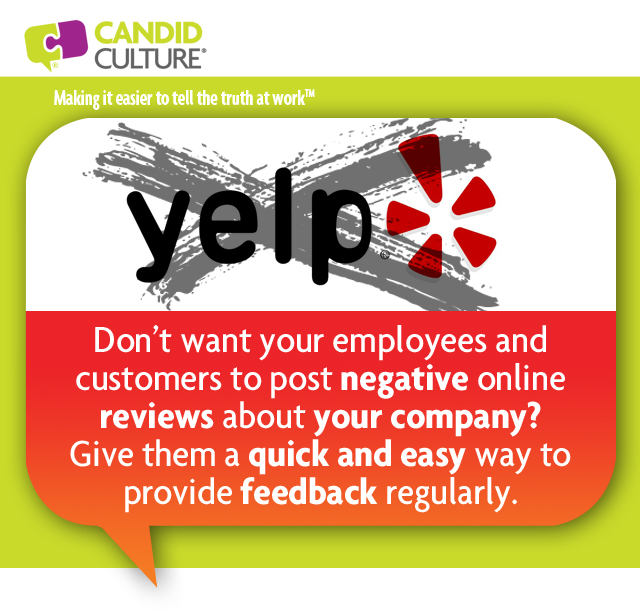
Many businesses are struggling to overcome negative and permanent online reviews on Yelp, Google, TripAdvisor, Glassdoor, etc. And they’re wondering why customers and employees go online vs. giving feedback directly. The answer is simple.
Giving feedback online is easy. Giving feedback directly is harder, for many reasons. No one wants to be the person who complains. Feedback is likely to be received with a defensive at worst and explanatory at best response, and who really wants to deal with that? At work we fear we’ll get “in trouble” for giving feedback, etc. etc. I could go on and on.
Customers go to Yelp and Google when they either don’t have an alternative or after they have provided direct feedback and didn’t feel heard. Provide customers an easy method of giving feedback and they won’t need to go to Yelp. This is true for your employees too.
If you want your customers and employees to give you feedback directly instead of blasting you online when they’re unhappy, make it easy to give you feedback, regularly.
Here are four ways to help prevent negative online reviews and improve the data you get from customers and employees:
Ask customers and employees for feedback regularly. Don’t wait until the end of the year or after a service has been provided to ask for feedback. Ask for feedback during the customer’s experience. Ask employees for feedback every 90-days.
If you’re going to send online surveys, keep them short. Never ask a customer more than five questions, and two is better. Ask a version of, “What are you appreciating about your experience? What could we change on your behalf?” What else do you need to know? Too many businesses send exhaustive and exhausting surveys to customers after a service has been provided. It’s unrealistic to expect customers to complete 30+ survey questions. Keep it short. You’ll see better response rates.
Call 10% (or fewer if you have thousands of employees and customers) and ask for feedback. It’s such a rare occurrence to receive a phone call asking for feedback, it’s an immediate loyalty and relationship builder.
Don’t request a positive score on a survey. Sending a survey and asking for a certain response type is a turnoff. Uber drivers who ask me to rate them a five never get that rating. The best way to get an awesome rating is to be awesome.
Ask for feedback early and often, and make it easy to give. P.S. And no anonymous surveys – a topic for another day.
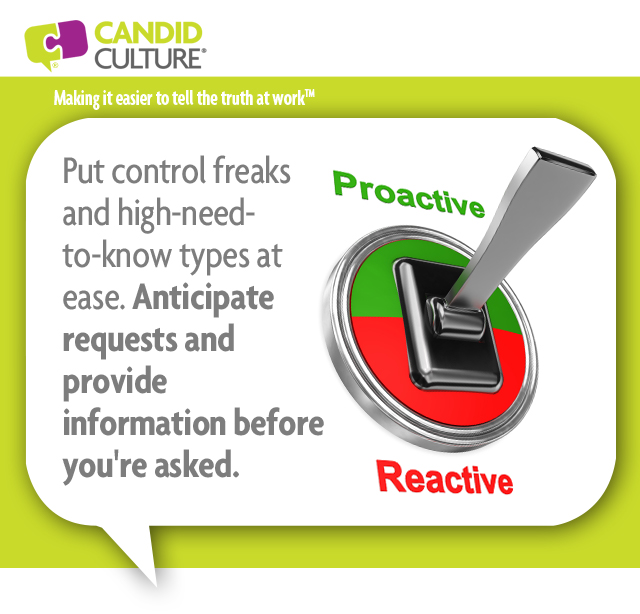
Frustrated by a control freak, micromanager, or a high-need-to-know type? Controlling behavior stems from a need that isn’t being met. Identify the need, meet it, and your life gets easier.
If someone wants more updates, information, or involvement than you’re comfortable with, the person has a need that isn’t being met. When you meet the need, the person will likely back off.
I ask the people who work for me to not make me ask for anything twice. Meaning, if I ask for an update the week before a speaking engagement, anticipate that I’ll want that information for all engagements. Confirm by asking me and then provide the data without being asked for all future engagements. Getting the information regularly without having to ask builds trust and credibility.
Here are six tips for working with control freaks:
1. If you don’t know, ask:
The person’s work-related goals. What are they working on this quarter and year?
What the person is concerned about at work? What are they worried about?
How do they like to communicate – in-person, email, phone, video, voicemail, or text?
How often do they want information, in what format, and with how much detail?
2. When you first begin working with someone, provide more information than you think you need to, and then confirm the person wants that information in the future.
3. If you’re asked for information, ask if they want the same type of information in the future. Then provide the information before you’re asked.
4. If someone is overly involved in your work and you feel you have no freedom, state your observation, and ask for information. That could sound like, “I’ve noticed you’ve been involved with the major decisions with this project. I’m used to working with less oversight. Do you have a concern about my approach?” Then you negotiate. Everything is a negotiation.
5. The approach in number four will likely put the other person on the defensive. A less confrontational approach is to discuss and agree upon levels of involvement and supervision when projects begin. That could sound something like, “What kind of involvement do you want to have in this project? What parts of the project do you want to do? What parts do you want me to do? What kind of updates would you like, how often, and with how much detail?” It’s always easier to prevent a problem than to fix one.
6. Lastly, don’t take anything personally. Oversight and involvement may be a reflection of how someone feels about your performance, but it might not. When in doubt, ask.
Last week I had lunch with people I worked with twenty-seven years ago. Twenty-seven years. I have long forgotten the projects we worked on, deadlines, and deliverables that were important at the time. What I do remember, are Jim and Siobhan. Some of my closest friends and the people most important to me in the world, are the people I’ve worked with.
It makes sense that we make friends at work – it’s where we spend a lot of time. And the people we work with make work fun or miserable. Building relationships and making friends at work are a couple of reasons virtual and hybrid work may feel challenging. I’ve never met Sarah who lives in California and codes our website, or Jessica, our attorney in Boston, and I rarely see Dana, who works for Candid Culture and lives in Arizona. But I feel connected to them, nevertheless. We email, text, and meet via video and phone.
There is a considerable amount of research citing the connection between having good business relationships and employee engagement, retention, and performance. When we feel we belong and have good relationships at work, we are happier and do better work. It makes perfect sense.
As I’m writing this, I’m thinking about my past coworkers who I traveled with for weeks on end, who also endured a CEO who made us practice and re-write presentations until 1:00 am for a meeting the next morning, and the coworkers I worked with at the World Trade Center. As much as I appreciated and cared about the people I worked with, I’m not sure how often I told them that they made my work world better.
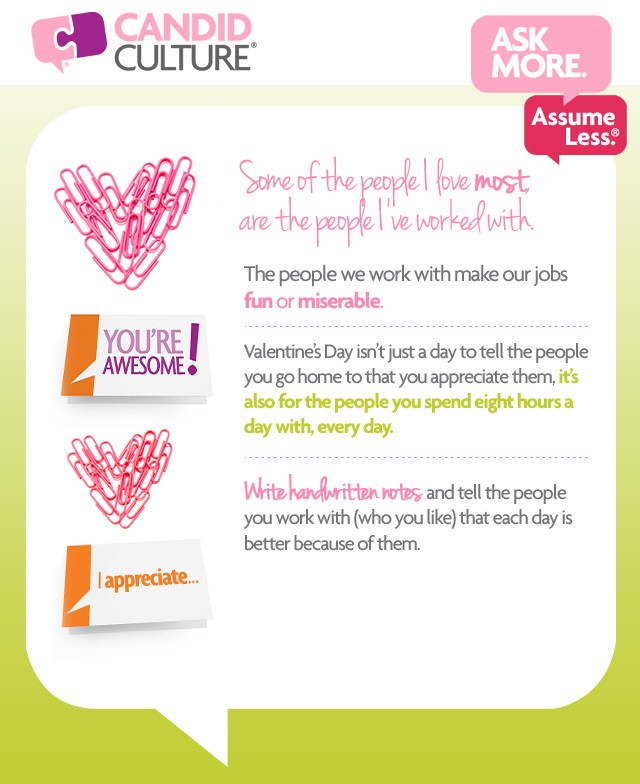
Valentine’s Day is a day we express appreciation for the people closest to us. Don’t limit your appreciation to your loved ones at home – include your coworkers who make work fun and help you get things done. Of course, I hope you’ll express appreciation more than once a year, but Valentine’s Day is an occasion not to miss.
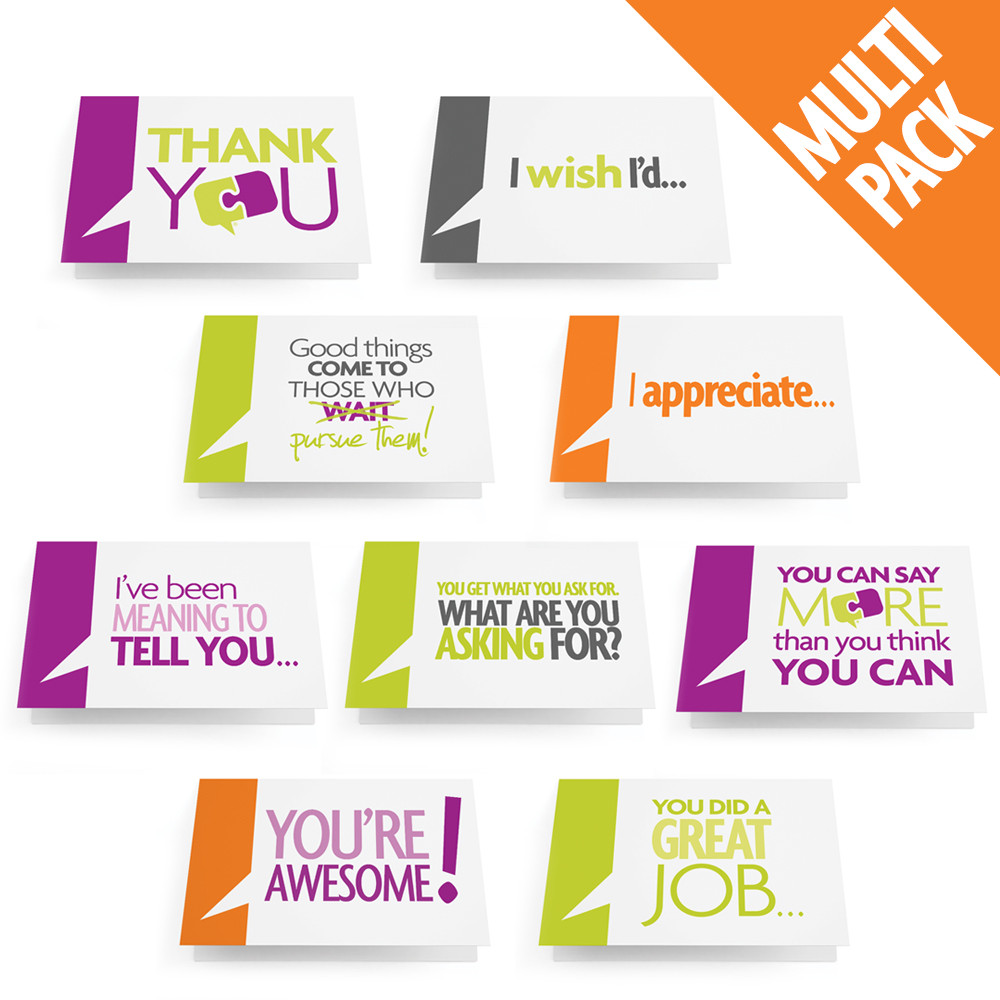
Write the people you work with, who matter most to you, a handwritten note that they’ll keep for a long, long time. You can see our assortment of greeting cards for the workplace HERE. I’ll admit that I collect stationery and love giving and receiving handwritten notes. I suspect the people you work with will appreciate receiving a handwritten note too.
I recently interviewed a candidate who asked for a lot of ‘stuff’ during the interview process. She wanted compensation, perks, accommodations, and benefits that were way outside the norm. I’m assuming she was employing the adage we’ve all heard, that “it can’t hurt to ask.” Unfortunately, it can hurt to ask.
When forging new relationships, we watch (judge) people. We’re trying to figure out who they are and how they are. Are they the person they claimed to be during the interview process? Are they trustworthy? Did I make the right decision in bringing this person into my team, organization, and life?
Requests always make an impression. When we’re building new relationships, requests make an even bigger impression. Candidates who said the commute wouldn’t be an issue, but complain about it two weeks into the job, cause managers to doubt their hiring decision. Coworkers who consistently ask for extensions to deadlines, appear unreliable.
People watch us and silently judge, making assessments about our commitment, reliability and even character. Don’t make people question you. Make reasonable asks.
Five ways to make reasonable requests:
Vet your requests with people who know your company, manager, and/or industry, before making them. A reasonable request in one organization, might not be reasonable in another.
If something is important to you, ask for it during the interview process or at the onset of new projects and relationships. Don’t wait. Waiting to ask for things until after you’ve started a job can damage your relationships and reputation. Managers don’t like bait and switch, even when it’s unintended.
Once you’ve received an emphatic “no”, accept it. I worked with someone who asked for something during the interview process. I said “no” and explained why. He asked again after being hired. This annoyed me and made me feel like he didn’t listen.
If you think a change should be made in your organization, propose a solution. Offer to be the person who drives the process, if appropriate. Pursue the change over a period of months. Ask up to three times for changes to be made. If nothing changes over a period of months, ask the leader you’ve been working with if you should stop asking. The change may not be a priority, and over asking can make you look like a pest who doesn’t understand the organization’s priorities.
If you aren’t sure that what you’re asking for is reasonable, say so. Tell the person what you want and to please tell you if it isn’t a reasonable request.
Ask for feedback on your requests. If you’ve seen me speak, you know I’m a proponent of telling people, “If I do anything that damages our working relationship or makes you question me, I hope you’ll tell me. I promise I’ll take your feedback graciously and say, “thank you.”
Ask for what you want, within reason, be upfront when relationships begin, and build your relationships rather than break them.
Sign Up
Career tips you won't get elsewhere. Sign up to get a free tip card.