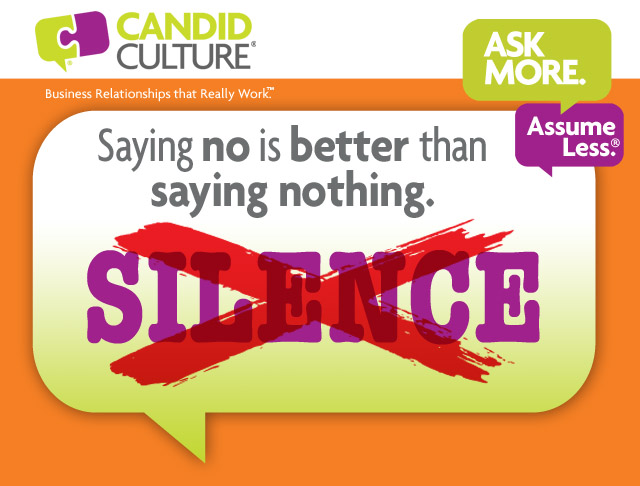
Many people struggle to say no. As a result, when someone has a request that we can’t or don’t want to meet, we often say nothing. We simply don’t respond. Or we put the person off, telling them we’ll get back to them. Then people wonder. “Did they get my request? Should I send the request again? Will I look bad if I ask again? How many times should I ask before I just let the request go?”
Saying no is better than saying nothing. No gives people closure. Silence leaves people in limbo wondering what they should do next.
Saying no can be hard. We don’t want to disappoint or let people down. And yet, you can’t say yes to everything. You can say no and still sound like a responsive, easy-to-work-with, accommodating professional.
Here are ways to say no:
Thank the person for asking. “Thank you for asking me.”
Saying “thank you” acknowledges the other person and buys you time to think about their request.
Tell the person you need some time to think about their request. Ask, “Can I have a few days to think about it? I’ll get back to you by Friday.”
You don’t need to reply in the moment. I often regret things I agree to without thinking through the request thoroughly.
Consider what you really want and are willing to do. It’s much worse to over commit and under deliver than to simply say no or renegotiate requests.
Get back to the person in a timely way (when you said you would) and tell them what you’re willing to do.
How to Say No Option One: Simply say no.
Example: “I really appreciate you asking me to write the proposal for the __________ RFP. I’m not able to do that. Can I recommend someone else who has the expertise and time to do a great job?”
Don’t give a bunch of reasons for saying no. People aren’t interested in why we can or can’t do something; they just want to know if we will do it.
How to Say No Option Two: Agree and negotiate the time frame.
Example: “I’d be happy to do that. The first chance I’ll have to work on this is the last week of the month. Does that work for you?” If the answer is no, negotiate further. Ask, “What is the hard deadline? I can certainly do pieces by then, but not the whole thing. Given that I can’t meet your timeline, who else can work on this in tandem or instead of me?”
How to Say No Option Three: Say no to the request but say what you can do.
Example: “I can’t do _______. But I can do ________. How does that work?”
A review of how to say no:
Acknowledge the request by getting back to the requestor within 24 hours.
Give yourself time to think about and respond to requests.
Negotiate requests to your and the requestor’s satisfaction.
Agree on what you can and are willing to do.
Keep your commitments.
Saying no is hard. But it’s always better to say no than to ignore requests, or to say yes and do nothing.
If you work long enough, you will have a manager who doesn’t delegate well, doesn’t give feedback, and isn’t a great coach. Not everyone is a good manager.
You’re accountable for being successful, regardless of who you work for. Don’t wait for people to tell you what they need and expect, which often happens after breakdowns occur. Set clear expectations at the beginning of anything new and ask for feedback as you make progress. Take your career and success into your own hands. I call this reverse delegation.
Reverse delegation defined: Asking questions until you’re clear what a good job looks like and asking for work to be reviewed in stages, versus solely at the end of a project, ensuring you get all the information you need to be successful. Ultimately, taking your career success into your own hands, where it belongs.
The people you work for and with should tell you what they expect. They should give you feedback along the way. And many won’t. Your career is in your hands, and that’s a very good thing.
When you start a new job, project, or any responsibility, ask the person delegating the work some of these reverse delegation questions:
Reverse Delegation Question one: Why is this project a priority right now? How will it impact the organization?
Reverse Delegation Question two: What does a good job look like? What’s the criteria for success?
Reverse Delegation Question three: What kind of updates would you like? In what format, how frequently, and with what level of detail?
Reverse Delegation Question four: Who in the organization should I work with on this project?
Reverse Delegation Question five: What history, pitfalls, or landmines do I need to be aware of? Has anyone tried to do this before, and if yes, with what outcomes?
Reverse Delegation Question six: Who in the organization supports this project? Who doesn’t?
If you’ve been in your job for a long time or have been working on a project for a while, it’s not too late to ask these questions. Simply approach the person with whom you’re working and say, “I want to be sure I’m doing great work on _____________ project. Can I ask you a couple of questions about the desired end results and how we should be communicating, as I make progress?”
Lots of people aren’t the best delegators. They give us a project, ask if we have any questions, and provide a due date. Don’t fall into the trap of completing an entire project and then asking for feedback. Even if the person delegating the work doesn’t want to review work as it’s completed, ask for that feedback. Schedule weekly or monthly review meetings, present the work you’ve done, and ask for feedback. If you’re worried asking for iterative feedback will make you seem needy or like you don’t know what you’re doing, explain why you’re asking. Say something like, “I want to give you precisely what you’re asking for and don’t want to squander the organization’s resources.”
If you get to the end of a project or responsibility and what you deliver isn’t what the person delegating expected, you didn’t ask enough questions at the beginning and middle of the project, and didn’t get feedback along the way.
People will tell you everything you need to do a good job, if you ask. Take control of your career. Ask more. Assume less.
Running effective meetings is hard. It takes courage. Who wants to tell their boss, peers, and customers to put away their phones, stop side talking, and speak more succinctly? No one. But if you run meetings and don’t manage ‘bad’ meeting behavior, you look bad and you won’t get the results you want.
Meeting facilitators, work with the meeting participants to set expectations everyone agrees to follow. Standard meeting guidelines include not side talking, putting away or silencing electronics, tabling tangents, not interrupting others, speaking succinctly, etc. You can set any behavior guidelines you like as long as the meeting participants agree to those expectations. Ask meeting participants what behavior guidelines they want to follow. The more control you give people, the more buy in you’ll get. Remind people of the guidelines at the beginning of every meeting and then hold people accountable.
Possibly even more frustrating than running a meeting in which participants break all the ‘rules’, is participating in inefficient meetings when you aren’t the facilitator. It’s difficult to sit through a poorly run meeting feeling there isn’t anything you can do to make it better.
Luckily, there are things you can do to improve the meetings you don’t run. None of my suggestions will be comfortable. But think of all the time you’ll save.
Conversation one – running effective meetings: If you want to impact the meetings you attend, approach the facilitator(s), empathize about what a challenging meeting it is to run, tell the person you want to be supportive, and ask if they want to discuss some different ways to manage the meeting. That conversation could sound something like, “Wednesday’s staff meeting is tough to run. Would you be interested in talking through some different ways to manage participant behavior? I have some ideas and would be happy to discuss. I’d like to be helpful.”
Conversation two – running effective meetings: If you want to be more direct, you could say something like, “Can we talk about Wednesday’s staff meeting? It can’t be an easy meeting to run. Key decision makers are missing meetings, and a few people tend to take over the conversation and take us off track. Can I make a few suggestions that might help? What do you think of working with the group to set some expectations people agree follow and then holding people to those agreements? We can share the facilitation responsibilities by assigning jobs during the meeting – back up facilitator, note taker, timekeeper, etc. – so all of the responsibility doesn’t fall to you. What do you think?”
The person running the meetings knows they’re not going well. They just don’t know what to do about it. Offer support. Don’t judge. Be helpful and possibly they’ll be receptive.
The key to running an effective meeting is to set clear expectations people agree to follow, review those expectations at the beginning of every meeting, and speak up when the expectations are violated. All of these things take courage. But meeting participants will be grateful to you for being strong.
Sign Up
Career tips you won't get elsewhere. Sign up to get a free tip card.