When I interviewed for my last job, before starting Candid Culture 19 years ago, the CEO put a mug in front of me with the company’s values on it and asked if I could live by those values at work. He was smart. Hiring someone with the skills to do a job is one thing. Hiring someone who fits into the organizational culture, is another.
Determining if a prospective employee will fit your organizational culture is much harder than determining if someone has the skills to do a job. Often when an employee leaves a job, only to take the same role at another company, they left for fit. They just didn’t feel comfortable. They weren’t a good fit with the organizational culture.
You’ve probably heard discussions about employees who deliver results at the expense of relationships. Or about employees who fellow employees really like, but they just can’t do the job.
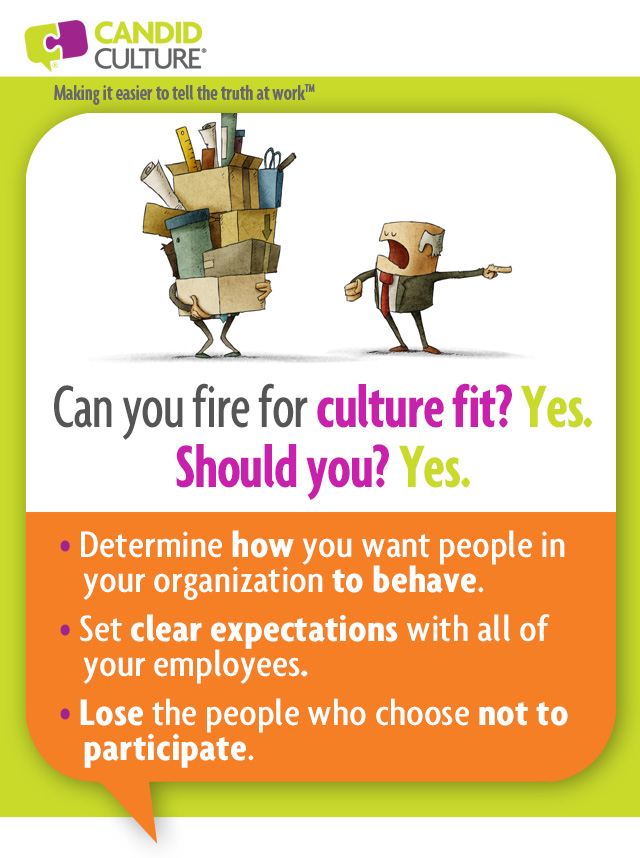
Leaders of organizations need to decide what’s important: What people do? How they do it? Or both. I’m going to assert that both the work employees deliver and how they deliver that work is equally important. I think you should hire and fire for fit.
Work hard to hire people who will fit into your organizational culture. Get rid of people who don’t fit. The impact on your organization’s reputation and on internal and external relationships depends on hiring people who behave consistently with your brand and how you want your organization’s culture to feel.
At Candid Culture, we teach people to have open, candid, trusting relationships at work. Thus, we must hire people who are open to feedback and communicate honestly, and we tell people who don’t model those behaviors to find a better fit
Here are a few ways to ensure you hire people who are a good organizational culture fit:
Share your current or desired culture with job candidates early, often, and clearly.
Work to assess how candidates fit the culture. Use practical interviews, job shadowing, and reference checks to assess organizational culture fit.
Talk about the culture when onboarding employees.
Make behaving according to the culture part of your performance appraisal process.
Reward behavior that matches the culture.
Have consequences for not acting according to the culture. A negative feedback conversation is a consequence.
Ensure your leaders and managers live the culture. Eliminate leaders and managers who aren’t a good culture fit. This takes courage.
When people leave an organization, they don’t often take copies of reports they produced or work they created. And if they do, they rarely look at that work. What they do take, remember for years to come, and find meaning in, are the relationships they built at work. Relationships are dependent on organizational culture.
Determine the organizational culture you want. Talk about it regularly. Require people to act according to the culture. Reward the ones who do. Get rid of the ones who don’t. Make working in your organization feel as you want it to feel.
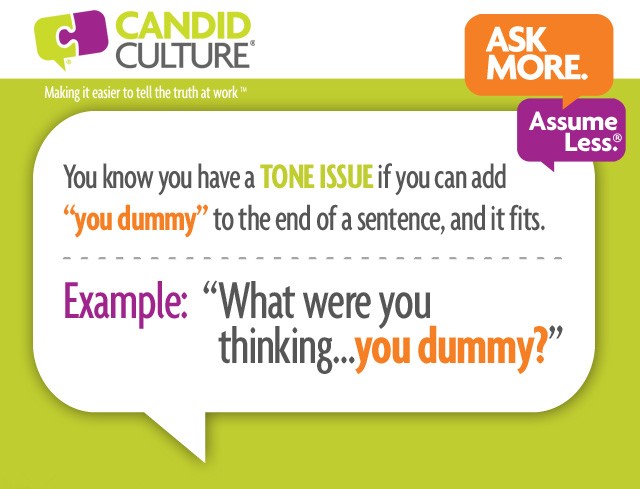
You know when someone gives you ‘the tone’, similar to when people roll their eyes at you? When you get ‘the tone’ you’re being told that the other person is exasperated.
Tone of voice is one of the hardest things to coach because we don’t hear ourselves. People who give people ‘the tone’ rarely know they’re doing it.
One of the best ways I know to effectively coach tone of voice is to ask tone givers to record themselves during meetings and calls, then listen to the recording together and ask what they heard and how they would have interpretated the communication had it been directed at them. Finally, ask if their tone would pass The Grandma Test. Ask, “If your grandmother called and someone spoke to her that way, how would you feel?” No one wants to speak unkindly to their grandma. You can also read emails out loud, adding the tone you ‘heard’, and ask the sender how they would have interpreted the message.
When given the tone, most people feel judged. And when people feel judged, conversations are constrained.
The way to avoid giving ‘the tone’ is to come from a place of curiosity. When you ask the question, “What were you thinking when you approached the customer that way,” you can sound curious or judgmental. Being judgmental evokes defensiveness, which shuts conversations down. Being curious creates discussion.
Consider asking questions like these to invite discussion:
“Tell me more about… Help me understand… What are your thoughts about…. What’s the history behind….”
Any of these questions will lead to a good discussion, if you manage your tone.
If you want to get information or influence someone, ask questions and engage the person in a dialogue. We often try to persuade people by giving them information. This rarely works. Instead of overloading people with data, ask questions that evoke discussion. Through discussion, you might get to a different place. And if not, you’ll at least have learned why the other person thinks as they do, and you will have shared your point of view in a way that is inviting versus off-putting.
It’s easy to give people ‘the tone’ when we’re tired and frustrated. Try to avoid difficult conversations when you’re tired or stressed. Wait to have important conversations until you know you can manage yourself and your tone.
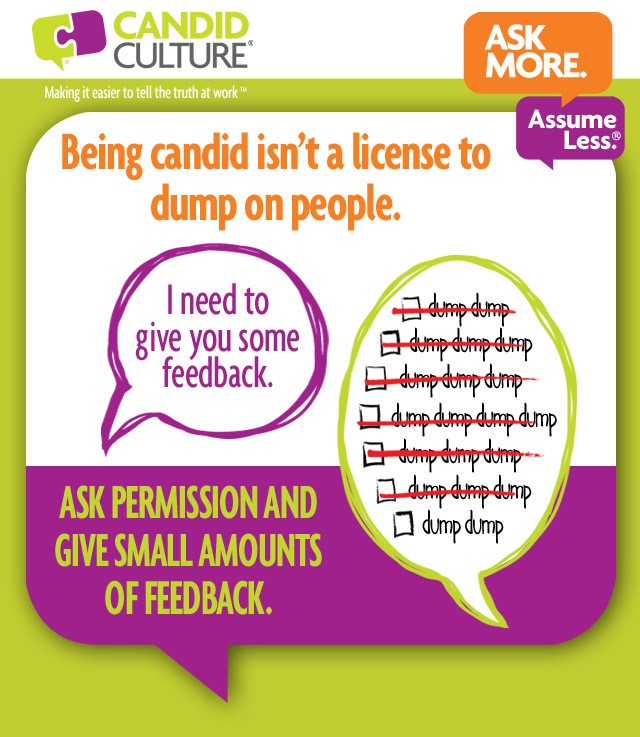
People leave feedback training armed with new skills and unfortunately sometimes use those skills as a weapon. It goes something like this, “I need to have a candid conversation with you.” And then the person proceeds to dump, dump, dump. This couldn’t be more wrong, wrong, wrong.
When you give someone negative feedback you are essentially telling the person they did something wrong. And who likes to be wrong? The ego gets bruised, and people often start to question themselves. This normal reaction doesn’t mean you shouldn’t give feedback, you just need to do it judiciously.
Ask yourself these four questions when deciding whether or not to give someone feedback:
Do I have the relationship to provide feedback? Does the recipient trust me and my motives?
Do I have permission to give feedback? If the recipient doesn’t work for you, you need permission to give feedback.
Is this something the person can do something about? If it’s not a change the recipient can make, keep your thoughts to yourself.
Is the feedback helpful? Ultimately the purpose of all feedback is to be helpful.
Let’s say you’re on the receiving end of too much feedback. What should you do? It’s ok to say “no thank you” to feedback. Here’s what you could say:
“Thank you for taking the time to bring this to my attention. I really appreciate it. You’ve given me a lot of feedback today. I’d like something to focus on that I can impact right now. What’s the most important thing I should do?” You’ve validated the other person and demonstrated openness and interest. You’ve also set some boundaries and expectations of what you will and won’t do.
“Thank you for taking the time to share your requests about… We won’t be making any changes to that and here’s why.” It’s ok not to act on all feedback, simply tell people why you won’t.
“I appreciate your concern. I’m not looking for feedback on that right now.” Can you say that to someone? Yes. Should you? Sometimes. To your boss – no. To someone who offers unsolicited advice that’s outside of their lane, yes. They’ll get the message.
People can only act on and digest small amounts of feedback at a time. Be judicious and assess your motives. The purpose of feedback is to be helpful, when the feedback is requested, and when you have the relationship to give it.
If you receive too much feedback or unsolicited feedback, it’s ok to decline. You’re not the 7-11, aka you’re not always open.
Posted under Career Management on September 7, 2025 by Shari Harley. 2 Comments
Every day I’m annoyed that I’m not perfect. I want to be a combination of Mary Poppins, Super Woman, and Kate Middleton, but I’m not. I’m a business owner, working mom, who just yelled at my son, on his birthday, and ate a large piece of birthday cake with a lot of green icing and sprinkles, despite that I “don’t eat sugar”.
Some days are going to be bad. On those bad days, it’s easy to feel like we’re messing things up and that we are indeed a mess. Instead, give yourself a break. The thing to know and remember, in the moment, is that you’re a human being, doing the best you can.
Here is a list of five ways to give yourself a break and as a result, do your best work.
Set realistic deadlines so you’re not constantly running against time, and overestimate how long everything will take to do.
Before agreeing to a new commitment, ask yourself, “Do I really want to do this?” Try not to commit yourself to things you know, at your core, you don’t want to do. You’ll just resent that commitment when it rolls around and aren’t likely to do your best work.
Turn off the alerts on your phone and laptop when you’re working. You’ll be more focused and get more work done.
Take a day off. Your company offers vacation time for a reason. People do better work when they take time to relax and rejuvenate.
Say “thank you” more and “I’m sorry” less. “Thank you for letting me know” is more empowering than “I’m sorry I missed that.” I’m guilty of apologizing for everything, so much so that one of my employees and I play a game that whoever says she’s sorry first has to throw a dollar in a communal collection pot. Whatever you put attention on will improve.
Some of these things are business focused, some are personal. You bring yourself – your whole self – to work. It’s why you’re good at what you do. People want to work with real people. And real people over commit, make mistakes, and spend too much time on social media at 11:30 pm. Give yourself a break.
You will be passed over for jobs, projects, and opportunities – personally and professionally. People will choose not to buy from you, and they’ll choose not to be your friend. And that’s ok. Not everyone is our right “customer.” The key isn’t to win every opportunity. Rather, it’s what we do when we don’t get what we want.
When you’re done feeling disappointed, mad, and frustrated, get curious. Find out why you were passed over. I’ll never suggest you make changes. I simply want you to know what’s standing in your way, so you have power – the power to choose.
We all have blind spots – things we do that are off-putting to others, that we’re not aware of. For the most part, people won’t tell us our business blind spots, instead, they simply pass us over. Being rejected is feedback, it’s just not specific enough to help us make different choices. If you want to be able to change your behavior, you need to know what behaviors are standing in your way. Then you can choose what, if anything, to do about those behaviors.
When you get turned down for an opportunity, practice these strategies to eliminate your business blind spots:
Allow yourself to have an emotional reaction, to feel disappointed, and to grieve the loss.
When your emotions dissipate, call people who can tell you why you were turned down and ask for feedback. The goal of the conversation: Eliminate your business blind spots.
Be humble and open.
Consider saying something like, “Thank you so much for considering me/us to support your needs. We were disappointed not to win your business. Would you be willing to share what had you choose a different provider and what we could have done differently to be a stronger candidate? I’ll be grateful for anything you’re willing to tell me.”
Depending on the circumstances, you could also say something like, “I wasn’t put on the _______ project. I wonder if you have any information as to why. I appreciate anything you’re able to tell me. Your input will help me grow and eliminate my blind spots.”
Regardless of what you hear, thank the person for the feedback. You can ask for additional information and ask who else you can talk with, but don’t become defensive. The less defensive you get, the more feedback you’ll get. Make it easy to tell you the truth.
Remember, information is power, and power is control. Many people don’t give direct feedback because they’re afraid of the other person’s reaction. Surprise people by being open to feedback and eliminate your blind spots.
Validate feedback that doesn’t feel right to you. If you’re not sure what someone told you is accurate, vet the feedback with other people you trust. Simply ask other people who are aware of your performance, “I received this feedback. Does that resonate with you?”
Sit with the feedback for a few days before taking any action.
When your emotions have passed, decide what – if anything – you want to do with the input you’ve received. Perhaps you want to make changes. Perhaps you don’t. Either way, you have more power than you did before you received any input.
You won’t win them all. The key isn’t avoiding rejection, it’s what you do when you don’t get what you want. Be brave. Be open. Ask for feedback. And you’ll have the power to make different choices next time, if you want to.
Sign Up
Career tips you won't get elsewhere. Sign up to get a free tip card.