Last week I had lunch with a friend. When I returned from lunch, I noticed I had something stuck in my teeth. I was embarrassed and wondered why my friend hadn’t told me.
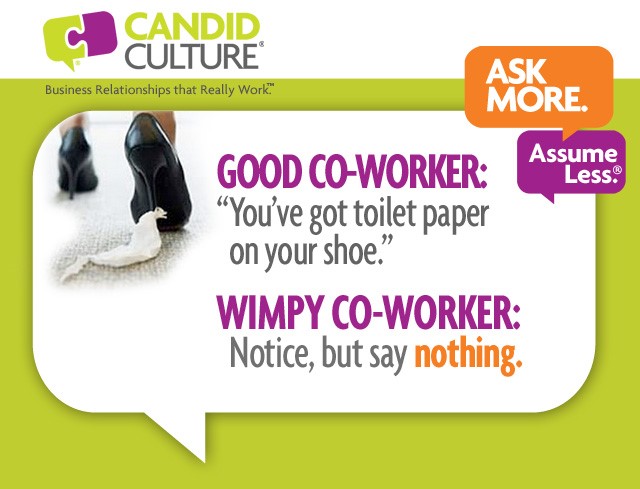
It’s quite possible she hadn’t noticed. But we all know people who notice and say nothing. We could walk around all day with toilet paper on our shoe, lipstick on our teeth, or our fly down, and the people around us won’t tell us.
If you read my blog weekly, you already know that people have been trained not to tell you the truth.
But I think there is more preventing people from telling us the truth. Complete this sentence: “If you have nothing nice to say, _________________________________. Who told you that? Your mother!!!
I do think there’s something to this. We’re raised to believe that it’s not nice to say something to another person that isn’t positive. And in the past, when we did speak up, it’s likely the other person got defensive, so it’s no wonder that we don’t readily give people bad news.
Here are five tips for getting feedback from the people around you:
Establish a core team of people who will always tell you the truth. These can be friends, coworkers, clients, vendors, your boss, etc.
Give people permission, to be honest with you. “Let’s make a deal. I always want you to tell me the truth. If I have something stuck in my teeth, or I’m inappropriately dressed for a meeting, or I’m doing something that damages my reputation, I want you to tell me.”
Make it easy to tell you the truth. “I promise no matter what you tell me and how hard it is to hear, I will say thank you. I won’t get defensive. And if I do, I’ll apologize and try to do better next time.”
Offer to do the same for them. “And if you want me to do the same thing for you, I’m happy to do it.”
Periodically check in with people and ask for feedback. “A few months ago I asked you to tell me anything I said, did, or wore that got in the way of my success. Is there anything you’ve seen that you want to tell me?”
Every time you ask for feedback and take it graciously, you train the person to give you more feedback. On the contrary, every time you get defensive, you make it hard for people to give you feedback, making it likely they won’t do it again.
If you don’t want to walk around looking silly all day, create a safe environment where friends and co-workers can tell the truth.
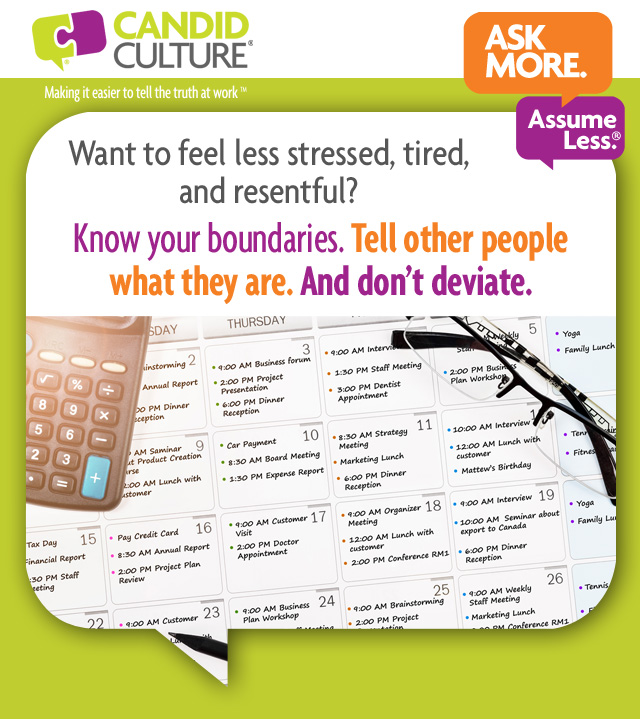
You receive a meeting request for August 5th. Your calendar is open, so you accept the request. You get asked to visit an out-of-state client on August 12th. Your calendar is open, so you say yes. You’re asked to make a presentation in place of a team member who is out of town, on August 14th. You want to be a team player, so you say yes. And soon what was a relatively slow month is booked with meetings, travel, and other commitments. Mid-month you’re tired, over-extended, and resentful. You want to be a good team member and a responsive professional. How do you do both without feeling tired and resentful?
One of the best pieces of advice I heard many years ago was to decide how to handle something before the situation presents itself. For example, if you’re trying to lose weight and you’re going to an event that will have an amazing buffet, decide what you will and won’t eat before you arrive. Choosing not to eat the desserts will be much easier if you’ve made that decision before the event rather than when you’re standing in front of temptation. Managing commitments and schedules can work the same way.
Before having a child, I worked 80 hours a week and traveled up to six days a week. And I loved every second of it. After having my son, I realized that I didn’t want to keep that kind of schedule anymore. I needed to cut back. So, I created clear and specific boundaries for myself. I decided how many days a month I would travel, by what time I needed to arrive home from each trip so I could see my son before he went to sleep, and how many speaking engagements I would commit to each month. When I receive speaking requests, I honor my pre-established boundaries. If I am already on the road the maximum number of days I told myself I would travel, I ask if the client can do a different month or if I can speak virtually. If the answer is no, I turn the work down.
I rarely deviate from my established boundaries. And when speaking requests come in, the decision-making isn’t a struggle. I don’t have to decide if accepting a request will be too much. I’ve already made the hard decisions about the schedule I will keep. So, each incoming request either fits into my already-decided-schedule or it doesn’t.
I work for myself. I have latitude to make decisions about my schedule that I might not if I still had a regular, corporate job. So how do you make and share decisions when you’re not your own boss?
Decide what you want your schedule to look like. How many hours do you want to work a week? What time would you like to start and stop working on most days? How much travel are you willing and able to do? How many meetings can you attend a day and still get your work done, so you’re not working each evening or weekend?
Then communicate your desired schedule to the person you work for. Tell your manager how much travel you would like to do and the hours you would like to work. Then negotiate. You may not be able to maintain the schedule you want all the time, but you certainly won’t if you don’t make your desires known.
The time to tell your manager that you want to reduce your travel is before you’re asked to take a trip, not after. But it’s never too late. If you find yourself too busy or on the road too much, you can always have a conversation and renegotiate.
When people send me an email with five paragraphs, my eyes glaze over. I close the email promising to read it later, but don’t until the sender asks if I received their email. People are busy and have to choose where to invest time. When it comes to communication, often, less is more. The question is, how to be succinct and still be thorough? How do you make sure people know what’s expected without providing so much information that nothing gets read?
I’m going to admit, I struggle with this.
I wrote a repair person, who worked in my house, a two-page, single spaced list of all the things that needed addressing. I don’t want people to have to guess what they have to do. I want to be thorough. It feels like the right and helpful thing to do.
The problem? The repair person didn’t read my list. It was too long. I would have been better off speaking to him live.
I’ve decided to create some communication rules for myself. I’m hoping they’ll be helpful to you as well.
Draft communications and save them as a draft. Read them again a few minutes later and ask, “Can I say this in half as many words? Is all of this information necessary?”
Think communications through rather than communicating impulsively. I’m someone who operates with a high sense of urgency. I suspect my sense of urgency has helped me to be successful personally and professionally, but it also has me send messages before I’ve thought everything through, which leads to seven text messages, rather than one.
Limit yourself to one or two messages. When you know you can send only one email or text message, you’ll likely be more thoughtful about your communications.
Draft succinct instructions and then ask the person what they’re planning to do. This is a delegation technique. Require the person, to whom you’ve delegated, to tell you what they know or don’t know. Then you know how to help.
I suspect that providing the right amount of detail will be something I’ll struggle with forever. The key take aways are this:
People often don’t read long communications. If you can say it in fewer words, do so. Shorter is better. Be complete, but don’t go overboard. Make sure things are said only one time. If you’re not sure someone read or understood what you said or wrote, ask them what they heard or read. Don’t ask, “Do you have any questions?” Or “Does that make sense?” Both are waste-of-time, non-questions.
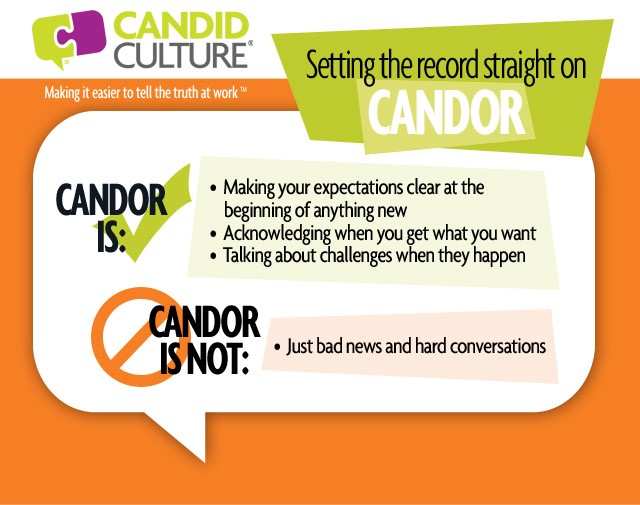
The word candor is not being used on a regular basis. Some people may not know what it means. And, in my experience, people who are familiar with the word often misinterpret candor to mean bad news. Most people expect bad news to come after the question, “Can I be candid with you?”
The definition of candor is, to be honest, truthful and forthright. We at Candid Culture define candor differently. The Candid Culture definition of candor: Telling people what you need before challenges occur. Anticipating everything that can take a project or relationship off track and talking about potential pitfalls before they happen.
Think about the projects and processes in your office – hiring someone new, sourcing a vendor, training people on new software. The potential breakdowns are predictable. You know the pitfalls that can happen when starting anything new because you’ve experienced them.
What if candor sounded like, “We want this project to be smooth. There are a couple of things that will make our work together go well and a few things that may delay the project and have it cost more than we budgeted. Let’s talk about what needs to happen for things to go smoothly, ways to prevent missed deadlines, and how we’re going to handle breakdowns when they happen.”
Some call a conversation like this setting expectations, others call it planning. In my world, these conversations are called candor –talking about what you need when projects begin, rather than letting the anticipatable train wreck happen.
Candor isn’t bad news. It’s telling people how to win with you vs. making them guess.
Examples of candor at work and at home:
“Here a few of my pet peeves… What are your pet peeves? I’ll do my best to avoid doing them.”
“What will frustrate you?”
“I turn off my cell phone alerts off after 9:00 pm, so feel free to text or call me anytime. I’ll respond to all messages in the morning.”
“I respond to text messages mostly quickly, then voicemail, then emails. If you don’t get a reply to an email within two or three days, don’t take it personally. Chances are I haven’t read the message. Feel free to follow up with a text or voicemail.”
“I work best by appointment. Drop by’s are hard because they interrupt my flow. Email or text me if you need something, and I’ll tell you when I can swing by. Does that work for you?”
For the most part, we treat people as we want to be treated. Other people aren’t us. They don’t do things as we do and don’t know what we want. Don’t make people guess how to work with you, what you need, and what you expect. Be candid and tell them! Then ask what the people you work and live with expect from you.
You won’t get what you don’t ask for.
Sign Up
Career tips you won't get elsewhere. Sign up to get a free tip card.