Posted under Career Management on December 25, 2023 by Shari Harley. 0 Comments
So much has changed in the last few years. And what you need to be happy at work may have changed too. The question is, do the people you work for and with know what you need?
You aren’t likely to get what you don’t ask for, but most people don’t ask for very much. We assume that the people we work with will do the right thing without prompting. We’ll get the recognition and compensation we deserve at work because it’s the right thing to do. We’ll be included in important meetings and decisions regardless of from where we are working.
If you read this blog regularly, you already know that I’m a proponent of setting clear expectations and asking more questions before problems occur. Consider what you want and need, anticipate what can go wrong, and plan accordingly before problems happen. Doing that sounds great in theory, but how does it work in practice?
Here are five ways to increase your job satisfaction:
Increasing your job satisfaction tip one: Be honest with yourself about what you need to be happy at work. Rather than tell yourself you won’t get what you need or try to convince yourself that you shouldn’t need something, just admit your needs to yourself.
Increasing your job satisfaction tip two: Share your needs with people who can help you get those needs met. Don’t make people guess. Chances are they won’t guess at all or will guess wrong.
Increasing your job satisfaction tip three: Don’t assume things will go well and just wait and see what happens. Instead, set clear expectations at the beginning of new projects and working relationships.
Here’s how that could sound: “We’re going to be working together for the next six months. Let’s talk about how everyone likes to communicate, what people’s pet peeves are, and the kind of information each person wants to receive.”
Here’s another example of how that could sound: “I’m excited to work on this project with you. There are a few things to know about me that will help us work well together and deliver timely results. I ask a lot of questions. Let me know if this frustrates you. I’m not questioning you; I just have a need to understand why we do what we do. And I work best with a deadline. I am happy to be available off hours, but you probably won’t hear from me before 9 am. You will get messages and work from me at night and on the weekends. Just let me know if you’d prefer I schedule messages to go out during regular business hours.”
People might give you what you need if you ask, but they likely won’t if you don’t. Train others how to work with you.
Increasing your job satisfaction tip four: Agree to talk about things as they happen. Don’t wait until you’re about to explode to speak up.
That could sound like, “I want us to work well together, and things will go wrong. Can we agree that we’ll provide feedback as things happen so we can make timely adjustments?”
Increasing your job satisfaction tip five: Renegotiate when you need to. If you realize you need or want something that you didn’t ask for, go back and ask. It’s never too late.
Here’s how that could sound, “We touch base about once a month and I’m realizing that if we could talk for about 20 minutes once a week, I’d be able to get more done. Can we make that happen?”
Job satisfaction and happiness don’t just happen. The people you work with are not you and they don’t know what you need. Make a regular practice of identifying what you need, making those needs known, and then speaking up when things go awry. You won’t get what you don’t ask for, but you will get what you allow.
No one likes to hear people complain, especially people who go on, and on, and on. But there is a reason people complain for longer than may seem necessary. For the most part, the people who sound like a broken record don’t feel heard. And when people don’t feel heard, they repeat themselves, again, and again, and again.
One of the first practices for how to handle customer complaints taught during customer service training is to acknowledge the other person’s concern. Demonstrate that you listened and heard. We often think that complainers want us to solve their problems. That’s not always the case. Sometimes feeling heard is enough, even if there is no resolution to the complaint.
Last week I had a horrible experience in a hotel. I called the front desk staff to voice my concerns with how an incident was handled. Her response: “Ok….ok….ok.” I wasn’t satisfied. So the next morning I spoke to the front desk manager. She responded by explaining why her staff had done what they did. Still, no apology or demonstration of understanding my frustration. So I went to the hotel general manager, who did all the right things. She listened and apologized. She didn’t defend or explain. And then I stopped escalating my complaint.
Here are a eight tips for how to handle customer complaints:
How to handle customer complaints tip #1: Resist the temptation to defend yourself, your team, or your organization.
How to handle customer complaints tip #2: Watch your tone of voice. If you sound annoyed, the other person will just become more upset and will, you guessed it, continue complaining.
How to handle customer complaints tip #3: Tell the person you’re sorry for their experience. Apologizing doesn’t mean the person is right or that you agree. You are simply sorry they had the experience they did. That could sound like, “I’m sorry that was your experience. That sounds frustrating. That’s certainly not the experience we want customers to have.”
How to handle customer complaints tip #4: Ask clarifying questions, if you need to. That could sound like, “Can I ask you a few questions, so I fully understand the situation?”
How to handle customer complaints tip #5: Paraphrase what the person said to ensure you understand the complaint and to demonstrate that you heard. Nothing sounds better to someone who is upset than another person who understands their concerns. That could sound like, “I just want to be sure I understand your concern. You’re concerned that _______ “ (repeat or paraphrase what the person said.)
How to handle customer complaints tip #6: Apologize again for the person’s experience. Often, all the person wants is an authentic apology. An apology doesn’t admit fault or wrong doing. You are simply apologizing for the person’s perception of their experience.
How to handle customer complaints tip #7: Tell the person what action(s) you’ll take, if any. People like to know that their complaints aren’t wasted.
How to handle customer complaints tip #8: Don’t be a black hole. Circle back to the person and let them know what action was or wasn’t taken.
The key to getting someone to stop complaining is to make the other person feel heard. Acknowledge the complaint. Watch your tone of voice. Apologize for the person’s experience. And watch people’s complaints dissipate more quickly than you thought possible.
Posted under Career Management on December 11, 2023 by Shari Harley. 0 Comments
I’m a big fan of taking responsibility and personal accountability. I think being accountable is easier than passing the buck. When I’m accountable, I have more power and control. When someone else is accountable, I have neither. But there’s a difference between being accountable and apologizing for yourself.
Last week I vowed to stop saying, “I’m sorry.” And yet, the next words out of my mouth were apologetic. Apologizing for oneself is so natural, it’s pervasive, aka, a hard habit to break.
Below are a few strategies for being accountable but not apologetic:
Establish clear priorities and boundaries. Having clearly established boundaries makes decision making easy.
Only commit to things you know you will do. For personal situations, only commit to things you genuinely want to do.
Tell the truth. If you don’t plan to do something, say so, without apology. “Thank you but no” has a lot of power.
Know your limits and what you need to be healthy and functioning at an optimum level. If you need eight hours of sleep, structure your life to get it. If you need weekends focused on your family, do that. Taking care of yourself enables you to take care of others.
Renegotiate when you need to. If you realize something you agreed to isn’t feasible or in your best interest, renegotiate versus suffer through it. Or, keep your commitment, but don’t agree again the next time a similar opportunity or request comes around.
Be careful where you invest your energy. I love my family and friends, and they will never get a printed party invitation or holiday card from me. I want to do both; I really do. But just thinking about collecting addresses puts me over the edge.
Give yourself a break. You’re doing the best you can. You’re a human like everyone else. We’re all doing the best we can.
Being accountable isn’t being perfect, it’s being human. Be yourself. Take care of yourself. And do your best, unapologetically.
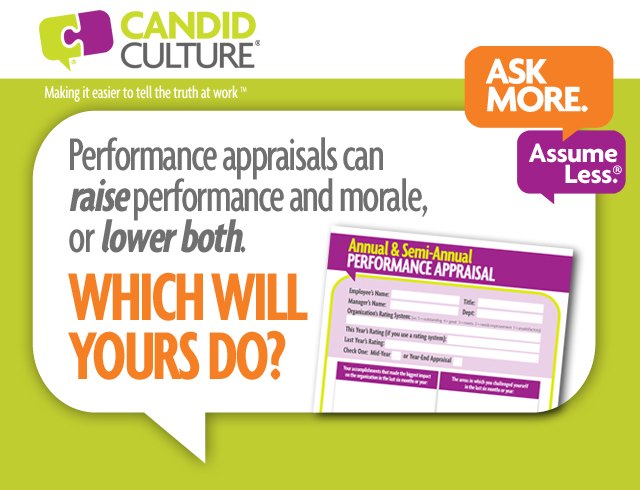
Most people would rather get a root canal than participate in an annual performance appraisal.
The reasons performance appraisals are so difficult is simple:
Most managers don’t deliver timely and balanced (positive and negative) feedback throughout the year.
Many employees don’t ask for regular feedback.
Too much information is delivered during the annual employee performance appraisal.
And as crazy as it sounds, managers and employees haven’t agreed to give and receive regular and candid feedback.
Performance appraisals don’t have to be the worst day of the year.
Here are four steps to ensure performance appraisals are useful and positive:
Managers and employees must agree to give and receive balanced, candid feedback. Don’t assume the agreement to speak honestly is implicit, make it explicit.
Managers, be honest and courageous. Don’t rate an employee a five who is really a three. You don’t do anyone any favors. Employees want to know how they’re really doing, no matter how much the feedback may sting.
Managers, focus on three things the employee did well and three things to do more of next year. Any more input is overwhelming.
Managers, schedule a second conversation a week after the employee performance appraisal, so employees can think about and process what you’ve said and discuss further, if necessary.
The key to being able to speak candidly during an employee performance appraisal is as simple as agreeing that you will do so and then being receptive to whatever is said. And don’t make feedback conversations a one-time event. If you do a rigorous workout after not exercising for a long time, you often can’t move the next day. Feedback conversations aren’t any different. They require practice for both the manager and employee to be comfortable.
Sign Up
Career tips you won't get elsewhere. Sign up to get a free tip card.




 No one likes to hear people complain, especially people who go on, and on, and on. But there is a reason people complain for longer than may seem necessary. For the most part, the people who sound like a broken record don’t feel heard. And when people don’t feel heard, they repeat themselves, again, and again, and again.