Too often people sit at their laptops doing their minimal best while begrudging their boss, organization, or current job, hoping that something better will come along. Or people silently do good work and think that someday someone will notice, and they’ll get the role and recognition they deserve.
If you want to advance your career, you must know how to ask for more responsibility at work.
You may be rolling your eyes thinking, “More? I can’t do more. I already work evenings and weekends. I sleep with my phone and haven’t taken a vacation in two years, and you want me to do more?!?!” Actually, I want you to stop sleeping with your phone and go on vacation. But that’s a post for a different day.
When I say do more, I don’t mean to do anything anyone asks nor anything your organization needs. Offer to take on more work that is aligned with what you want to do AND is important to the leaders of your organization.
Before starting Candid Culture, I had a corporate job, leading an operations unit. Four years into my tenure with the company, one of my peers left, and his role wasn’t refilled. I felt his department was important to our organization’s success, so I offered to run his department, in addition to my own.
My new department was a change agent’s dream. I outlined a strategic plan and long and short-term goals. I re-wrote job descriptions and org charts. But six months into taking on the department, I couldn’t get one change approved. I was confused and frustrated.
I had initially been hired to turn another department around, and I’d been very successful at getting changes approved. Yet this time, I could get nothing approved. After six months of banging my head against a wall, I finally ‘got it.’ The owners of the company didn’t see the department as valuable, thus they weren’t willing to invest in it. Hence why the job sat vacant, until I offered to do it.
I’m embarrassed at how long it took me to see that the only person committed to my new department was me. When my colleague’s senior-level job wasn’t refilled and there was no hiring freeze, I should have known the department wasn’t seen as important.
If you want to know what’s important in your organization, look at where the money is being spent. What departments and/or leaders are getting resources?
When I say ask for more, I mean be strategic about what you ask for.
Ask yourself these questions:
What do I want to do?
Where in the organization are there opportunities to do that kind of work – that is important to the organization’s leaders?
Who will support me in doing this work? Who won’t?
How to ask for more responsibility at work. Tell your boss and/or department leader:
I really enjoy working here. I enjoy the people, the work and our industry.
I’m committed to growing my career with this organization.
I’m interested in learning more about ________________________.
I’d love to run ___________________________.
I think we have some opportunities to make improvements in _____________________.
How could I get some exposure to ____________________.
A project is starting in ______________. I’d love to be on the team. What are your thoughts about that? Would you be comfortable supporting my participation? If yes, how can we make it happen? If not, what would you need from me in order to support it?
The work you take on does not need to be high level. Everyone in an organization does grunt work. Just be sure that whatever you offer to do is seen as integral to the future of the organization. You’re not likely to get what you don’t ask for.
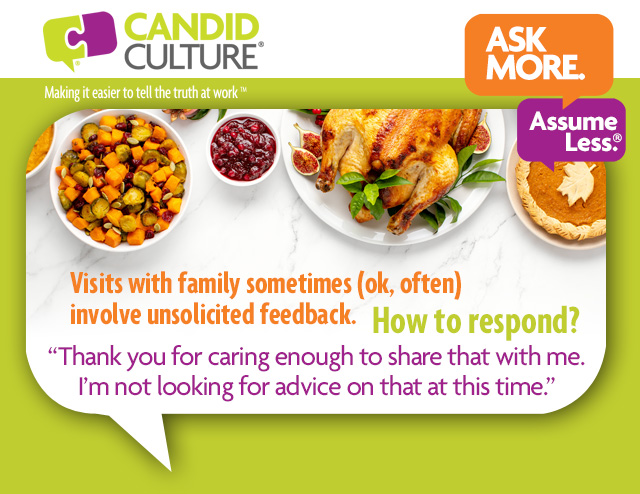
If you visit family and friends this holiday season. you may receive unsolicited feedback and advice. Sometimes people who care and want what’s best for us, provide input we didn’t ask for.
Unsolicited feedback at best feels like someone is trying to help, at worst it feels like criticism. Underneath the feedback might be the message, “If you were doing this right, I wouldn’t need to give you this advice.” I put unsolicited feedback and advice in the same bucket.
If you find yourself receiving unsolicited advice, you don’t have to smile politely and take it. It’s ok to put an end to unwanted feedback and advice.
Simply smile, tell the person you appreciate them caring enough to give you that advice, and say that you’re not looking for advice on that topic at this time. And then smile again. Smiling softens most messages. Say nothing more. Most people will stop talking. What else is there to say?
This method of acknowledging the person talking is respectful and firm. To pull it off, watch your tone. If you can safely add the words, “you dummy” to anything you say, you have a tone issue. Be genuinely appreciative and enforce boundaries. You’re not the 7/11. You don’t have to be open to feedback and others’ input all the time.
If the person continues giving you advice, simply say the same thing again. “Thank you for caring enough about me to share that with me. I really appreciate your concern. And I’m not looking for advice on that at this time.” If the person keeps talking, just say, “I’m going to get a drink.” Then get up and go get a drink.
If stopping unsolicited feedback feels uncomfortable, prevent it. Tell people before you see them, “I don’t want to talk about _____________ (fill in the blank). Please don’t bring it up over Thanksgiving.” You can soften that request any way you like.
Setting boundaries might be feel uncomfortable. But it’s likely not as uncomfortable as having a conversation you don’t want to have and then feeling like you need to avoid someone for the rest of the evening and possibly year. It’s ok to say, “No, thank you. Please pass the pie.”
At some point in your career, you will likely get feedback that doesn’t feel accurate. When receiving feedback you question, rather than dismiss it, vet the feedback with the people who know you best. Assemble a core team of people who know you well, love you, and have your back. The relationships may be personal or professional. These are people who will tell you the truth (as they see it) if you ask.
You might think that you’re a different person at home and at work, thus your friends’ and family’s input isn’t valid in the workplace. I don’t think that’s true. You are who you are, and you’re not a completely different person at home and at work. It’s just not possible to be your real self and turn it on and off at work. Sure, you might have a communication style that you only use at work. You may make decisions at work differently than you do personally. And you are likely to dress differently at work than at home. But you’re not a completely different person after 5:00 pm. If you’re often late, don’t keep confidences, talk too much and too long, or wear clothing that is not your friend, your personal relationships can tell you that.
It’s important to know how you come across, your reputation, and your wins and losses at work. Having this information allows you to manage your reputation and in turn, your career.
The question is, with whom should you vet feedback that doesn’t feel quite right?
Here are four criteria for core team members:
Your core team should be made up of a small number of people (five or fewer) who know you well, love you, and have your back.
You should respect core team members’ opinions.
You must trust your core team and their motives, in relation to your well-being.
You must be open to core team members’ feedback.
Core team members don’t need to be told they’re on your core team. Simply call these people individually when you need input. Tell them the feedback you’ve received and then ask for their opinion.
It’s easy to dismiss feedback that’s hard to hear. The feedback you receive might just be that person’s opinion. But people talk. And one person’s experience of you can impact your career greatly. Manage your career assertively and powerfully by knowing your reputation. Find out the impressions you create. Then you can make decisions about changes you will and won’t make.
Sign Up
Career tips you won't get elsewhere. Sign up to get a free tip card.