Leaders and managers work hard to retain employees. Employees watch how their organization’s leaders and managers work, and often make career decisions based on the hours the most senior people keep.
Employees pay attention to how often managers and senior leaders take time off and whether or not leaders attend meetings and respond to emails while they’re on vacation. Employees observe the late nights that leaders and managers put in and the emails sent at 11:00 pm and on the weekends. I’ve heard lots of employees say, “If I need to work like my boss works to get ahead in this organization, I’m not interested.”
Managers, one of the keys to retaining employees is to communicate expectations. If you’re available while you’re on vacation, but don’t expect employees to do the same, set that expectation. If you send an email outside of regular business hours but don’t expect employees to respond until the next business day, tell them so. They don’t know. Many employees assume that if you email them at night, you expect a reply.
Microsoft has made these situations easy to avoid, with the ability to program emails to go out during regular business hours. And some people state in their email signatures, “I work outside of regular business hours, but don’t expect you to.”
Instead of allowing employees to make assumptions about what managers do and don’t expect, set clear expectations. Be overt and clear. When you hire employees, tell them, “I work most evenings and weekends, but don’t expect you to do so. And I work these hours because I enjoy it, not because I have to. If I email you outside of regular business hours, I am not expecting you to reply.” Retaining good employees begins during the interview process when initial expectations are set.
Managers, if you expect employees to check and respond to emails outside of regular business hours and to be available while on vacation, tell candidates during the interview process.
Employees, if your manager emails you outside of regular business hours and doesn’t tell you whether or not she expects you to reply, ask. Simply say, “I often receive emails outside of regular business hours. How will I know when you need me to reply?” Likewise, if you notice your manager emails you on vacation, you can say, “I typically hear from you when you’re on vacation. Are you expecting me to check in while I’m off?”
The need to ask questions and set expectations goes both ways. Don’t wait to be told. Ask.
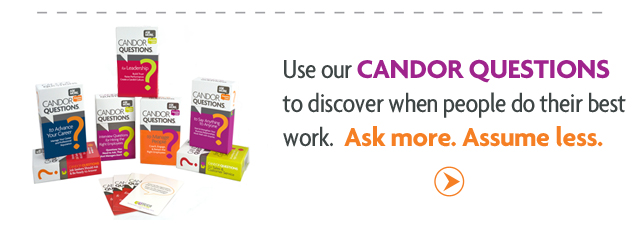
Managers and employees, ask these Candor Questions about working style preferences to aid in retaining employees:
How do you feel about being contacted outside of regular business hours?
If I need to reach you over a weekend or in the evening, what method is best?
Would you prefer I text you so you don’t have to check your email outside of business hours?
What time is too early and too late to call, text, and/or email?
Ask more. Assume less and make retaining employees easier.
People leave feedback training armed with new skills and they unfortunately sometimes use those skills as a weapon. It goes something like this, “I need to have a candid conversation with you.” And then the person proceeds to dump, dump, dump. This couldn’t be more wrong, wrong, wrong.
When you give someone negative feedback you are essentially telling them they did something wrong. And who likes to be wrong? The ego gets bruised and people often start to question themselves. This normal reaction doesn’t mean you shouldn’t give feedback, you just need to do it judiciously.
Ask yourself these four questions when deciding whether or not to give someone feedback:
Do I have the relationship to provide feedback? Does the recipient trust me and my motives?
Do I have permission to give feedback? If the recipient doesn’t work for you, you need permission to give feedback.
Is this something the person can do something about? If it’s not a change the recipient can make, keep your thoughts to yourself.
Is the feedback helpful? Ultimately the purpose of all feedback is to be helpful.
Let’s say you’re on the receiving end of too much feedback. What should you do? It’s ok to say “no thank you” to feedback. Here’s what you could say:
“Thank you for taking the time to bring this to my attention. I really appreciate it. You’ve given me a lot of feedback today. I’d like something to focus on that I can impact right now. What’s the most important thing I should do?” You’ve validated the other person and demonstrated openness and interest. You’ve also set some boundaries and expectations of what you will and won’t do.
“Thank you for taking the time to share your requests about… We won’t be making any changes to that and here’s why.” It’s ok not to act on all feedback, simply tell people why you won’t.
“I appreciate your concern. I’m not looking for feedback on that right now.” Can you say that to someone? Yes. Should you? Sometimes. To your boss – no. To someone who offers unsolicited advice that’s outside of their lane, yes. They’ll get the message.
People can only act on and digest small amounts of feedback at a time. Be judicious and assess your motives. The purpose of feedback is to be helpful, when the feedback is requested and when you have the relationship to give it.
If you receive too much feedback or unsolicited feedback, it’s ok to decline. You’re not the 7-11, aka you’re not always open.
Lots of people joined organizations virtually in the last few years and have never met their coworkers in person. Many people are working hybrid and may only see coworkers a few times a month, if at all. You may be wondering how you build relationships and your career when you don’t see the people you work with. Here is the short answer – talk to people. Pick up the phone. You don’t need to have video calls, if you don’t want to. You just need to talk to people.
People need human contact. We even need to connect with the people we don’t like – when we work with them. Text and email don’t replace talking to people.
We stopped talking to each other long before so many people began working from home. Email has been overused for years. We emailed the people we sat next to at work. We exchanged 20 emails on one topic rather than picking up the phone. We ask permission to call our friends to catch up. Texting a friend to ask, “Is it ok if I call you tomorrow morning?” is the norm. We exchange 50 texts to determine where and when to meet for lunch.
Maybe people think email and texting is easier, less intrusive, faster. Less intrusive, yes. Easier, sometimes. Faster, no.
Call the people you work with. Ask for the best time to call or schedule calls, depending on people’s preferences. Have the conversations you’d have if you ran into them in the hallway at work. Talk through the projects you’re working on. If you’re new to the organization, ask their role and how your role impacts theirs. Calls don’t have to be long. People just need contact. And while you’re on the phone, get questions answered in five minutes rather than with 25 emails.
Giving feedback upwards is hard. Giving feedback downward is hard. Giving feedback to peers can be the hardest of all. We work closely with our peers. They’re often our friends. And still, we need to be able to speak freely when our coworkers violate our expectations.
The key to being able to give peers feedback (to give anyone feedback) is to agree that doing so is not only acceptable but expected. Before agreeing to give and receive feedback, peers need to set clear expectations of how they’ll work together and treat each other.
Telling people how you want to work with them is always easier than asking someone to change their behavior. But it often just doesn’t occur to us to tell our peers what we want and need from them. We’re busy. They’re busy. And don’t they already know what courteous workplace behavior looks like? Return all emails within a day or two, tell people if you’re running behind on a project and will miss a deadline, and call into meetings on time from a quiet workspace. Aren’t all of these behaviors fairly obvious? Do I really need to tell people these are my expectations? Uh….yes, you do.
If you don’t want employees dumping these challenges on their managers, help employees talk to each other.
Here are seven steps to help people who work together set expectations and hold each other accountable:
Schedule a meeting during which people working together can discuss what they need from each other to be satisfied and productive. Then facilitate a discussion during which the group creates 5 – 7 behavior guidelines each person agrees to follow.
Put the list of agreed-upon behaviors in a shared folder. Leave the guidelines there indefinitely.
Give each person in the group permission to talk to individuals who violate the guidelines. This is very, very important. For the most part, employees won’t tell a peer they are missing deadlines, gossiping, or is distracted during meetings. People will suffer in silence and avoid the offender rather than speak up about the behaviors that frustrate them. Ask the group to grant each other permission to speak up when guidelines are violated. Giving each other permission to speak up will make future conversations possible – difficult but possible. Without permission and these agreed-upon behaviors in place, people will suffer in silence or talk about each other, not to each other.
Ask everyone in the workgroup to take feedback graciously, responding with “thank you for telling me,” rather than with defensiveness.
Two weeks after making the list of guidelines, get the group together on a call to review the list, and make any necessary changes to it. Discuss behaviors that were omitted, aren’t realistic, and are realistic but aren’t being followed.
Then follow up by facilitating a monthly conversation during which group members give honest feedback about which guidelines are being followed and which are not, and problem solve as a group. These conversations aren’t a chance to embarrass or call people out in front of a large group. If one person is violating a guideline, that conversation should happen individually. Group conversations keep the lines of communication open – which is essential to making working with others work.
You will need a strong facilitator for the group discussions. The facilitator must tease out people’s thoughts while making sure no one gets blasted in front of the group. Don’t let concerns, that you know exist, be brushed under the rug. Group members must openly and regularly discuss what is and isn’t working about their work environment, or frustrations will build, and unhappiness and dissension will ensue.
It’s not too late to put these practices in place, even with a group that has been working together for a long time. Just schedule the conversation and explain why you’re having it. People will be relieved and grateful.
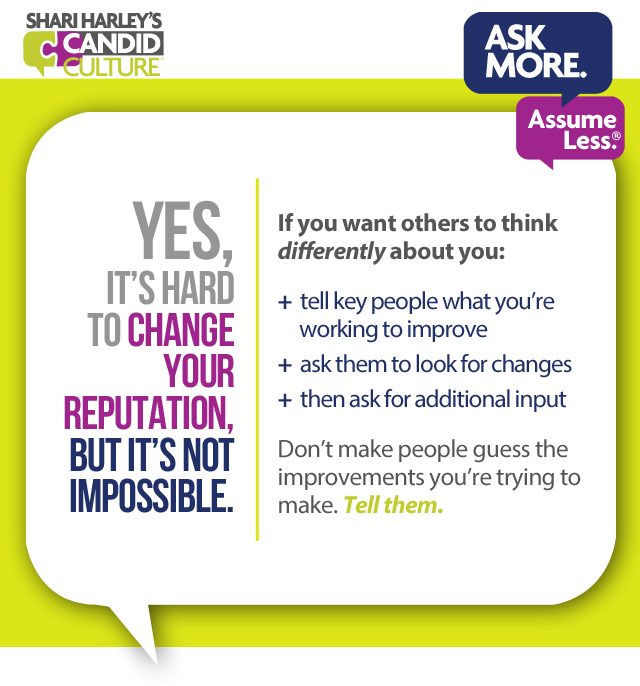
We know impressions are made quickly and are hard to change. But it’s not impossible to repair a damaged reputation. If you want to change how people see you, I’d suggest being very overt about the changes you’ve made. Don’t simply alter your behavior and wait for people to notice. They likely won’t.
Once people have formed an opinion about you, that’s often their opinion for as long as they know you. For example, if you have a tendency to be late, even if you periodically show up on time, your friends and coworkers will think of you as the person who is always late. If you work with someone who tends to miss deadlines, even if she periodically turns work in on time, you’ll think of her as someone who misses deadlines.
Once people make a decision about us, that’s often how they’ll see us for the duration our relationship. So if you want to repair your reputation, you’re going to have to do it overtly. Making changes and hoping people notice, won’t produce the desired result.
Here Are Eight Steps to Repair Your Reputation:
Ask people who can impact your reputation and whose judgment you trust for feedback.
Work hard to manage yourself and not get defensive. Respond to all feedback, no matter how hard it is to hear or how invalid it may feel with, “Thank you for telling me that. I’m going to think about what you said. I may come back to talk more later.”
Once you’ve absorbed the feedback, decide what, if any, changes you will make.
Change your behavior for a period of weeks.
Return to the people who gave you feedback, tell them about the behavior changes you’ve made, and ask them to observe your behavior.
Tell the people who gave you feedback that you’ll ask them for feedback again in a few weeks, and you want to know what they see.
Return to the people who gave you feedback and ask what changes they have or haven’t noticed.
Repeat steps 3 through 7 at least quarterly. Everyone periodically does things that can damage their reputation.
Overtly pointing out the behavior changes you’ve made, asking people who are important to you to pay attention, and give you additional feedback, is key to altering your reputation. Most people working to change their reputation don’t do this. They make behavior changes and hope others notice. If you want to alter your reputation and how others see you, you need to do so overtly. Tell people the changes you’ve made; don’t make them guess. Ask people to observe your behavior, and then ask for more feedback. And no matter how hard the feedback is to hear, don’t get defensive. Becoming defensive will ensure you don’t get feedback the next time you ask.
Sign Up
Career tips you won't get elsewhere. Sign up to get a free tip card.