How many times have you sent someone five emails and become frustrated when none were returned? Or you thought an employee was happy, only to be surprised when they quit? Or you needed to talk with someone but couldn’t get their attention, so you walked by their office throughout the day, wondering if it was ok to knock? Working with other people doesn’t have to be so hard.
Taking the time to ask team building questions is much faster than recovering from missteps with other people. Ask the questions at the beginning of anything new – when you hire a new employee, get a new customer, or start a new project. And keep asking the questions as you work with people.
I use the Candor Questions below, when I onboard a new team member at Candid Culture. The questions help the entire team get to know each other better and learn how to work together.
What will keep you working here and what would make you leave?
What’s the best way to get information to you – voicemail, text, or email?
What time is too early?
What time is too late?
Do you leave your email and/or text alerts on at night/when you go to sleep?
Would you prefer I send all emails and text messages during regular business hours?
What frustrates you at work?
What are your pet peeves?
What’s something you want to learn, skill or business wise, that you haven’t had a chance to do?
What’s something you wish I would start, stop, or continuing doing?
We move so fast at work and are so focused on completing goals, we often don’t take the time to really get to know the people we work with. I feel very strongly that asking the team building questions above will help people work better together. We’ll make fewer ‘mistakes’ with each other, and get more done with less stress and more ease. As William Ury said in his book, Getting to Yes, “Go slow to go fast.”
Asking questions about working style preferences and goals is an ongoing process, and it’s never too late. You can ask the team building questions during meetings or just slip them into your conversations. The process doesn’t have to be formal or time consuming. The point is simply, don’t guess what people need and are expecting from you, ask.
Posted under Career Management on June 20, 2023 by Shari Harley. 1 Comments
Fifteen years ago, I quit my corporate job to start Candid Culture. I had almost no business relationships or contacts outside of my corporate job. Thinking I should network, I registered to attend the Society for Human Resource Management (SHRM) National Conference in Las Vegas. It’s the largest HR conference in the world; approximately 15,000 people attend. I flew to Las Vegas to attend the conference but I was so terrified about my new undertaking, I spent three days in bed, ordering bad room service, paralyzed by fear. I barely left my hotel room and attended almost none of the conference.
Last week I spoke at that same conference – the SHRM National Conference – also in Las Vegas, to an in-person audience of 750 people. Things have come full circle.
When something feels big and I’m not sure what to do, I do nothing. And my hunch is I’m not alone. The key to getting through anything large, scary, or intimidating is to start. Any action will do. The key is simply taking action.
Here are five actions you and your manager can take to make taking action more likely:
Action #1: What often stands in the way of taking action is that we aren’t sure what to do. Perhaps we aren’t sure we can do the task at hand. Or we can’t see what the end result should look like. Or the project feels so big that even thinking about starting is tiring. Ask questions and ask for help.
Most managers aren’t great delegators. When assigning a project, managers often ask, “Do you have any questions?” This is an ineffective question because few people want to admit to having questions about a project that feels so big, all they want to do is avoid it. Or managers ask, “What do you need from me?” when most people have no idea what they need.
Don’t be afraid to ask questions until you’re clear about what a good job looks like, and ask for help.
Action #2: Managers, ask better questions. Rather than asking if employees have questions, ask, “What’s your plan? What are you doing to do first? What are you doing to do next?” These questions will tell you what employees know and don’t know. Asking, “Do you have any questions” or “does this make sense” tells you nothing.
Action #3: Do one small thing, anything, towards achieving the goal. And do it now. Don’t wait until the right time. There is no right time.
Action #4: Managers, delegate projects with multiple, short deadlines. Ask to review work as it’s completed versus when the entire project is due.
Action #5: Give yourself small windows of time to work on a project. If you give yourself 30 uninterrupted minutes to work, you’re likely to invest that time. If you dedicate a day, you’re likely to get distracted and fill the time with other things.
Trust that you can do what’s in front of you. Someone wouldn’t have asked you to do something if they’d didn’t have confidence that you could do it. And if this is a goal you set for yourself, and it’s something you really want, deep down, you know you’re capable of doing it.
If you’re overwhelmed or don’t believe you can do something, call someone who has more faith in you than you have in yourself. Let that person fill you with confidence until you can generate it for yourself. When I started Candid Culture, I was filled with fear and quite honestly, was convinced I was going to fail. But everyone around me believed I could do it. And their confidence carried me until I could generate my own.
You get an email that annoys you, hit reply, type your thoughts, hit send, and feel instant regret. We’ve all done this. We’re frustrated and we let the other person know.
Feedback via email is always a bad idea. You don’t know how the recipient will read and interpret your message. You can’t manage the tone of the message or give the person a chance to respond. And more often than not, the recipient will reply equally frustrated. And now the non-conversation begins –back and forth, back and forth.
Email is for wimps and voicemail isn’t any better! No texting either. End the madness and pick up the phone or take a shower and meet via video. Things are resolved most quickly and easily by talking about them.
I’m consistently surprised at how much feedback is delivered via email. And it’s only gotten worse with people working virtually. I’ll admit to occasionally being guilty of it too. I’m in a hurry and I want to get something done quickly. Or my emotions get the best of me and I feel compelled to respond to a situation quickly. So I send an email or a text message that I know I shouldn’t send. Then I regret it and spend the rest of the day apologizing and feeling badly for communicating impulsively.
If we want people to want to work with us and perform at their best, we need to consider how our actions impact them. Yes, it’s easier to send a quick email or text. But doing so invariably annoys the other person and damages your relationship. People can work with you, around you, and against you. If people want to work with you, they’ll work harder and produce better work.
Slow down. When you need to give feedback, ask yourself what you want the other person to do. Then ask yourself, how do I need to communicate to get the result I want? Then pause, breathe, and pick up the phone.
Posted under Team Building on June 4, 2023 by Shari Harley. 0 Comments
Early in my career, I worked with a woman I didn’t get along with. We were on the same team and had the same job, but didn’t see eye to eye on how to approach work or solve problems. And when we didn’t agree, things got ugly. I have to admit to being afraid of her.
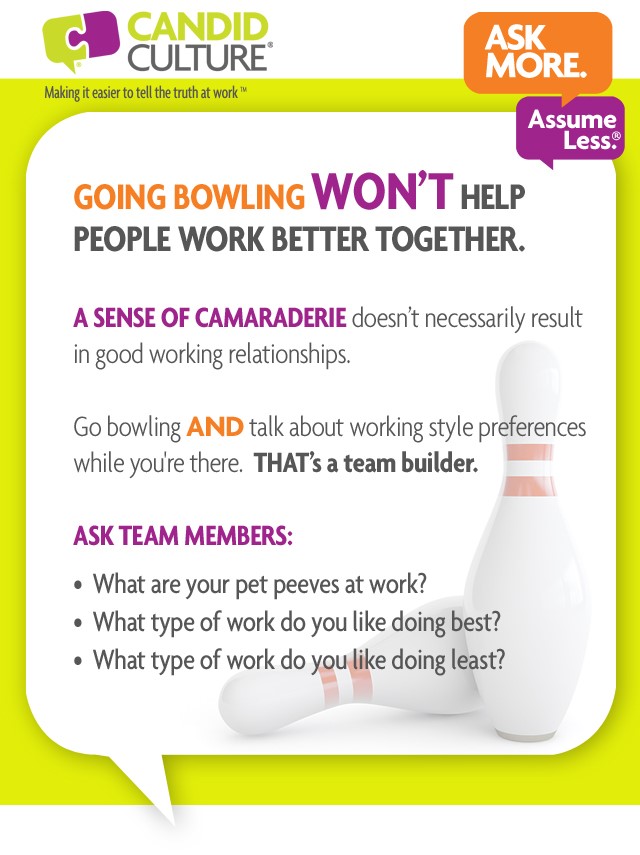
The odd thing is that socially, we did fine. When our team socialized outside of work, we had fun and got along well. That’s when I realized that there was no correlation between camaraderie and working well together.
Lots of teams go bowling, to baseball games, and out for happy hour as team building activities. And while team members may enjoy being together at these events and get to know each other personally, they don’t learn how to work well together and how to resolve conflict.
Go bowling or out for happy hour, just don’t expect people to work better together as a result of those activities. If you want to do impactful team building activities, give team members a chance to learn about each other and themselves, and make agreements of how team members will work together in the future. Create occasions for candid conversations.
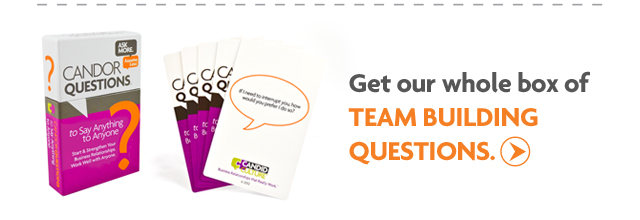
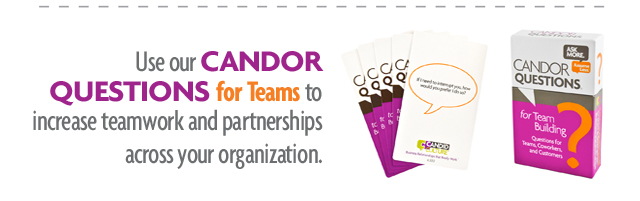
When I lead corporate team building activities, I put people in small groups, give the group a box of Candor Questions for Team Building and time to answer the questions. People talk about things they should have talked about when they started working together. Team members learn about each other’s working style preferences and what each person needs from both the job and each other. But most importantly, team members have permission to talk about things they normally don’t, and begin to create a climate of candor, which is essential for any group of people working together. For a team to work well together, it must be safe to tell the truth. Teams need to talk about the things that impact them most – each other.
So go bowling and out for happy hour. But also create opportunities for team members to talk about the things that matter most — how they impact each other at work.





 te
te