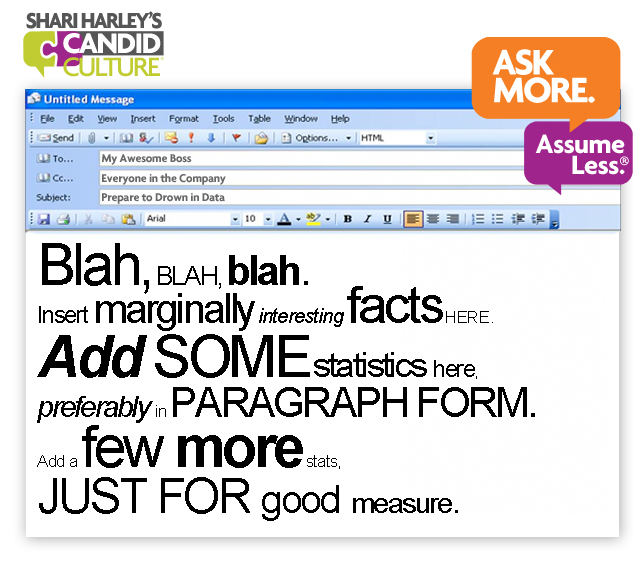
When I get an email that has multiple paragraphs I look at it, decide I don’t have time to read it, and close it out, promising to go back to it later when I have more time, which never happens.
If you want your emails read, shorter is better.
Here are a few tips for writing effective emails that are more likely to be read:
Put a specific subject in the subject line that says what the email is about.
This does not include your name. We already know your name.
Example: “Meeting” (that’s not specific). Instead try: “Meeting to agree upon February goals.”
Highlight and bold important parts of the email.
Limit this practice so what’s bolded and highlighted stands out.
If everything is bold, nothing stands out.
Use bullets.
Use the fewest number of words possible.
Use links that send readers to relevant information.
Offer to provide additional information, if desired.
The shorter your emails are, the more likely they are to get read. You can always offer additional information, but readers won’t get to the detail if they never read the email. When it comes to writing effective emails, shorter is better.
When you use GPS in your car for driving directions, the GPS only provides one direction at a time. GPS tells you what to do now and what to do next. Your car can only go one direction at a time. And humans can likely only remember one or two directions at a time. When you coach people, you are their GPS, supporting them in achieving a desired goal efficiently.
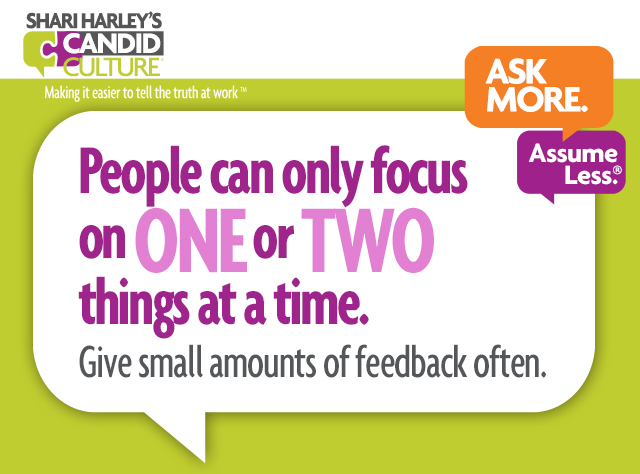
Coach and give feedback like your GPS. Give one or two pieces of feedback at a time. Then give the person time to make changes and improve before giving more feedback.
What I hear every day, and every day it makes me shudder:
Manager: “One of my employees has been making a lot of mistakes. He seems disengaged (p.s. “disengaged” is Cap’n Crunch, vague and thus not real feedback). I’m not sure what’s happening.”
Most people hoard feedback. We wait for the right time, aka when we’re comfortable. That time will never come. The right time to give feedback is when something happens or shortly thereafter. Practice the 24-hour guideline and the one-week rule. Wait 24 hours to give feedback if you’re mad, but not longer than a week. Give feedback when you’re not upset, but soon after the event occurs, so people remember what you’re talking about.
Feedback is hard on the ego. The more feedback we receive in one conversation, the harder it is to hear. People need to feel successful. Receiving too much feedback at one time makes us feel we can’t be successful, so why bother. Pick the biggest and most impactful behaviors. Wait. And then give more feedback.
When it comes to feedback, keep this mantra in your head – recency, frequency. Recency, frequency. Short, weekly, feedback conversations – five minutes long – are better than sixty-minute feedback conversation once a month or quarter. You’ll see more behavior change and protect team member’s ego. Shorter and more frequent is better.
It’s not unusual to ask who is at fault when mistakes in an organization are made. We want to know who was to blame. Before asking who is accountable for a mistake, I’d ask what lead to the mistake. Was the error a people or a process issue?
If a document with mistakes is shared with people outside of an organization, there is a process issue.
Yes, someone made a mistake. Someone wasn’t careful or knowledgeable enough to catch the error. But if a document’s accuracy is important, more than one person should be looking at that document before it leaves the organization. When only one person looks at an important document, there is a process issue.
Processes include: The practices followed and the tools used when creating, proofreading, saving, and storing work.
William Ury, author of the negotiation books Getting to Yes and Getting Past No, said, “Be easy on the people and hard on the process.” When mistakes happen, evaluate the processes surrounding that work. What allowed the mistake to go out the door unchecked? Would a different process with more checks and balances and more eyes on the work have prevented the error?
After evaluating the processes or lack thereof, coach the person who made the mistake. Fill the gap that allowed the mistake to happen, but first, evaluate your processes.
My son’s first soccer coach would frequently tell the kids, “You get what you get and you don’t throw a fit.” As adults receiving performance appraisals, I think we can do better.
Performance appraisals are, for many, the most dreaded day of the year. Most employees anticipate the meeting, wondering what their manager will say. In addition to hearing about the situations your manager and others in your organization observed throughout the year, why not tell your manager what you’d like to know?
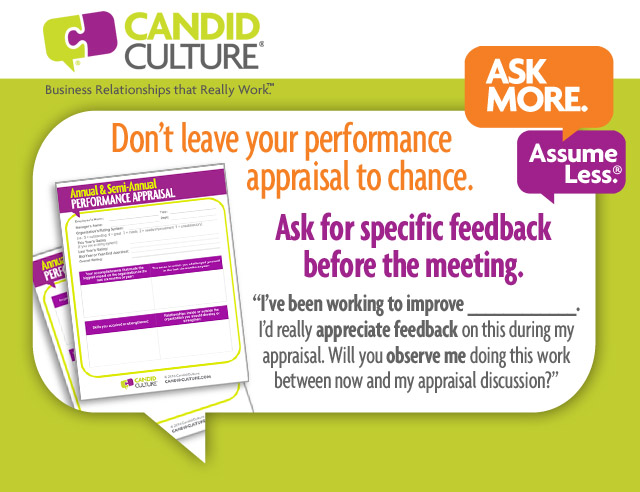
It’s perfectly appropriate to tell your manager if you’d like feedback about a specific aspect of your performance or about your work on a certain project or piece of work. And the time to ask for this feedback is at least one month BEFORE your appraisal meeting.
Most people don’t like to be caught off guard or feel that they can’t answer a question. Asking for feedback in the moment, that your boss can’t address, may embarrass your manager. Don’t put managers on the spot. Set your boss and yourself up for success by asking for specific feedback BEFORE meetings, and give your manager a chance to observe you doing that kind of work.
If you want to know how you manage telling internal or external clients “no”, give your boss a chance to see or hear you do this. If you want feedback on how you built relationships with peers virtually this year, give your boss a chance to observe that behavior or time to ask your peers for input.
Ask a vague question, get a vague answer. Ask a specific question, get a specific answer. If you want specific feedback, let your manager know and give her time to observe you doing the actions you’re asking about BEFORE the feedback conversation.
A few years ago, I facilitated a company-wide training program for an 80-person organization. Early in the program, we were talking about career deal breakers and I asked someone in the group to share a deal breaker, so I knew that everyone was clear on what is and is not a true deal-breaker. An employee spoke up. She said, “I’ve been here six weeks. I’m overwhelmed and exhausted. If I don’t get some help soon, I’m leaving.” People in the room gasped audibly. And everyone surely thought the same thing – “She’s done. She’ll be gone by Friday.”
I ran into the organization’s CEO at the Denver airport two weeks later and we had dinner together. Over dinner, I asked if I could give him some advice. I said, “That woman who spoke up during the training did you a huge favor. You spent time and money to become a more candid organization; she gave you the opportunity to demonstrate whether or not you really mean it. Make sure nothing (bad) happens to her.”
It can be really hard when people disagree with us. Leaders institute a new practice, employees resist. Employees say they agree with a policy during a meeting but managers hear otherwise after the meeting.
It may feel easier to introduce a practice and ask employees to follow it without asking what they think. And sometimes it makes sense to do that. You don’t need to involve employees in every decision. But in an organization, it has to be safe to offer a counter-point-of-view. It must be safe to disagree.
Disagreement is hard. But silence and the fear of speaking up is dangerous. Organizations full of yes people don’t innovate. They don’t solve problems or find new ways to save costs. They don’t grow, develop, or change. Hearing the truth takes courage and persistence. Put your ego aside and ask – again and again and again.
Every time I work with a new organization, at least one employee pulls me aside and tells me about the organization’s “list”. Employees who speak up and say things the leadership team disagree with get put on the “list”. And employees who make the “list” disappear from the organization. Mind you, no one has ever seen this “list”, but employees everywhere are convinced it exists. And this is a challenge for leaders.
Even leaders who do all the right things regarding asking for and being open to all kinds of input are up against the belief that it isn’t safe to tell the truth at work. There may be no consequences whatsoever for speaking up, but the perception of the negative consequence is what matters. And this perception is powerful and pervasive across organizations.
So what is to be done? How do leaders get the truth when employees are afraid, disbelieving, and perhaps cynical?
Below are seven practices for leaders and managers to get more truth in their organization:
Put your ego aside. It hurts when people disagree with our beliefs or approach, and we’ll be fine. Let curiosity rather than your ego run the show.
Ask for input. Ask again and again and again. Employees may eventually believe that you really want their input.
Ask for input in different ways – in-person roundtable discussions, email, and surveys.
Ensure there are no negative consequences for speaking up. You can coach employees on how they spoke up and make suggestions for diplomacy, but reward the courage it took to speak up.
Share what you learn after gathering data. Don’t be a black hole. Give more information than you think you need to.
Tell employees the ideas you’re accepting and those you’re rejecting and why. It’s ok not to accept and act on all feedback. But close the loop and explain the rationale for decisions.
Be human. Admit failure, fear, worry, and wins. People trust leaders who are human, and humans have feelings and make mistakes. I’ll follow a humble leader further than a polished and seemingly perfect one.
Sign Up
Career tips you won't get elsewhere. Sign up to get a free tip card.