One of managers’ and employers’ biggest complaints is the inability to hire critical thinkers – employees who question. I hear this complaint all the time. Yet we often find the people who ask questions irritating and bothersome. “Why do they have to look for what’s wrong? Why can’t they just say, “ok”?
Questioners are often seen as boat rockers, challenging the status quo. They are ‘difficult’.
We can’t have it both ways. We can’t hire people who think critically, who don’t question.
I’m not talking about people who can’t make a decision and are constantly asking managers to validate their solutions or employees who use managers as google rather than doing their own research. I’m talking about squelching the counter-point-of-view.
If you want employees who identify and solve problems and create new products and ways of working, then you need to reward those who question.
One of the reasons employees may not ask questions is the fear of appearing as if they don’t know. Who likes to admit they don’t know something at work? It takes strength to admit, “I don’t know.” Managers and leaders need to model the behaviors they want to see. We need to ask our own questions visibly and regularly. We need to admit when we don’t know. We need to be willing to be wrong and to let others see it.
There is an old workplace adage, you get what you reward. Does your organization have an award for the employee who asks the most questions? If not, create one. Do you recognize employees publicly who are willing to point out inefficient processes and costly systems? Do you have a reward system in place for employees who fail trying to fix a problem or create something new? If we get what we reward, what are we rewarding?
I’m embarrassed how often I do things I don’t want to do because I’m afraid of looking bad. I agree to things I don’t want to do. I even suggest doing things I don’t want to do, because I think it will look bad if I don’t. Then I have deep regrets.
If I’m aware of this practice, why do I keep doing it, over and over and over? I suspect the need to look good and be liked is so pervasive, it over-powers reason and self-talk. Telling myself, “Don’t do it. You will regret this,” doesn’t help. The need for approval is all-powerful (to me).
My old boss told me many years ago, “Your need to be liked will kill you as a manager,” and he was right. It’s why I can’t interview my own candidates. I want them to like me too.
I suspect I’m not alone here. I lot of us say yes when we want to say no. We extend ourselves and regret it later.
What can be done, at an organizational level, to prevent ourselves and fellow employees from over-extending?
Sanction, at a team and organizational level, that sometimes it’s ok to say no.
Suggest that at times people take 24-hours before agreeing to take on a new task or project.
Make room for negotiation, so people can say yes on terms that work for them.
Authenticity wins. Speak your truth and know that it’s ok.
I recently interviewed a candidate who asked for a lot of ‘stuff’ during the interview process. She wanted compensation, perks, accommodations, and benefits that were way outside the norm. I’m assuming she was employing the adage we’ve all heard, that “it can’t hurt to ask.” Unfortunately, it can hurt to ask.
When forging new relationships, we watch (judge) people. We’re trying to figure out who they are and how they are. Are they the person they claimed to be during the interview process? Are they trustworthy? Did I make the right decision in bringing this person into my team, organization, and life?
Requests always make an impression. When we’re building new relationships, requests make an even bigger impression. Candidates who said the commute wouldn’t be an issue, but complain about it two weeks into the job, cause managers to doubt their hiring decision. Coworkers who consistently ask for extensions to deadlines, appear unreliable.
People watch us and silently judge, making assessments about our commitment, reliability and even character. Don’t make people question you. Make reasonable asks.
Five ways to make reasonable requests:
Vet your requests with people who know your company, manager, and/or industry, before making them. A reasonable request in one organization, might not be reasonable in another.
If something is important to you, ask for it during the interview process or at the onset of new projects and relationships. Don’t wait. Waiting to ask for things until after you’ve started a job can damage your relationships and reputation. Managers don’t like bait and switch, even when it’s unintended.
Once you’ve received an emphatic “no”, accept it. I worked with someone who asked for something during the interview process. I said “no” and explained why. He asked again after being hired. This annoyed me and made me feel like he didn’t listen.
If you aren’t sure that what you’re asking for is reasonable, say so. Tell the person what you want and to please tell you if it isn’t a reasonable request.
Ask for feedback on your requests. If you’ve seen me speak, you know I’m a proponent of telling people, “If I do anything that damages our working relationship or makes you question me, I hope you’ll tell me. I promise I’ll take your feedback graciously and say, “thank you.”
Ask for what you want, within reason, be upfront when relationships begin, and build your relationships rather than break them.
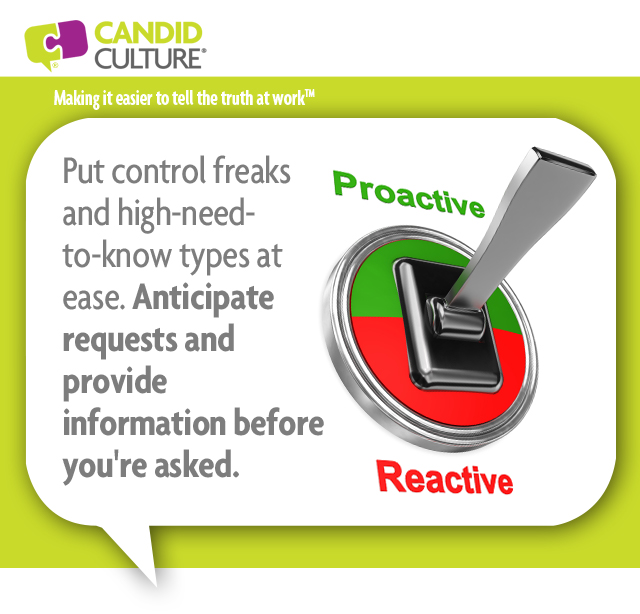
Frustrated by a control freak, micromanager, or a high-need-to-know type? Controlling behavior stems from a need that isn’t being met. Identify the need, meet it, and your life gets easier.
If someone wants more updates, information, or involvement than you’re comfortable with, the person has a need that isn’t being met. When you meet the need, the person will likely back off.
I ask the people who work for me to not make me ask for anything twice. Meaning, if I ask for an update the week before a speaking engagement, anticipate that I’ll want that information for all engagements. Confirm by asking me and then provide the data without being asked for all future engagements. Getting the information regularly without having to ask builds trust and credibility.
Here are six tips for working with control freaks:
1. If you don’t know, ask:
The person’s work-related goals. What are they working on this quarter and year?
What the person is concerned about at work? What are they worried about?
How do they like to communicate – in-person, email, phone, video, voicemail, or text?
How often do they want information, in what format, and with how much detail?
2. Provide more information than you think you need to, and then ensure the person wants that information in the future.
3. If you’re asked for information, ask why the person wants it, and if they want it in the future. Then provide the information before you’re asked.
4. If someone is overly involved in your work and you feel you have no freedom, state your observation and ask for information. That could sound like, “You’ve been involved with each major decision with this project. I’m used to working with less oversight. Do you have a concern about my approach?” Then you negotiate. Everything is a negotiation.
5. The approach in number four will likely put the other person on the defensive. A less confrontational approach is to discuss and agree upon levels of involvement and supervision when projects begin. That could sound something like, “What kind of involvement do you want to have in this project? What do you want to do? What do you want me to do? What kind of updates would you like, how often, and with how much detail?” It’s always easier to prevent a problem than to fix one.
6. Lastly, don’t take anything personally. Oversight and involvement may be a reflection of how someone feels about your performance, but it might not. When in doubt, ask.
Sign Up
Career tips you won't get elsewhere. Sign up to get a free tip card.