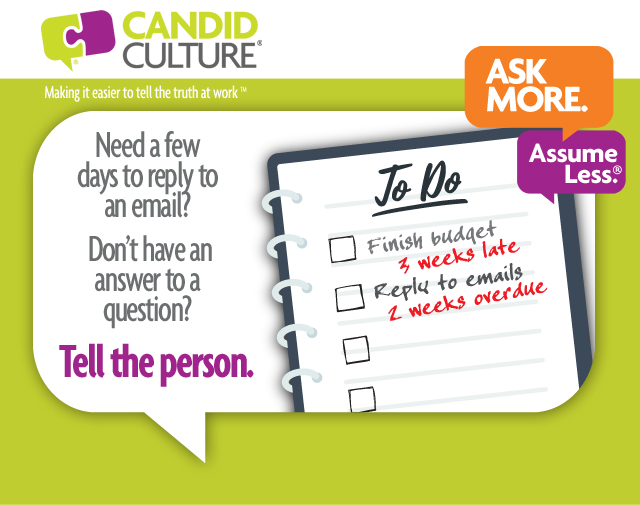
You open an email (or a few hundred) telling yourself you’ll reply later, but never do. Feeling ambitious, you agree to a deadline you can’t meet. Needing a break, you take a few days off but don’t put an out-of-office message on your email.
We’ve all taken too long to reply to an email, missed a deadline, or simply taken too long to provide someone with information. It’s ok to take time to respond, not to have all the answers, and take time off. We simply need to provide timely and accurate status updates.
When people don’t hear back from us in what they consider a timely way, they start to wonder (at best), and judge us (worse), or tell others we’re non-responsive and unreliable (worst). Don’t make people wonder if you received their message, send a timely status update and tell the truth.
If you’re behind and need more time than usual to respond to emails, tell people that. Respond to emails within 24-hours and tell senders you received their message and it will be (fill in the blank) before they hear back from you. When you get an email that requires research, respond within 24-hours and tell the person how long it will take to find the information. If you’re out of the office and don’t plan to read or respond to emails, tell people the dates you’re out.
In the absence of knowledge people make stuff up, and it’s never good. Filling in the blanks isn’t malicious. People simply have a need to know what’s happening. And when they don’t know, they invent stuff. It’s how the brain works. When we don’t hear back from people in what we consider a timely way, we start to wonder. “Did they get my message? Why aren’t they responding? What’s wrong?”
It’s ok to need time to respond. It’s ok to be running behind. It’s ok to take time off. Simply let people know the true status. Manage your reputation and business relationships. Don’t make people guess.
Last week one of my friends was concerned about something happening at her son’s school. She wrote out what she planned to say to the school principal and sent it to me to read. Her letter was long, with lots of unnecessary details. I read five paragraphs before understanding what the situation was even about. I revised her letter. My version was three sentences and easy to write. Why? Because it’s not my child and not my situation.
One of the things that makes giving feedback and making requests particularly difficult, is our emotional involvement. We’re invested in the outcome. The stakes feel high. And that emotion makes everything harder.
If you’re struggling with a message you need to deliver, get some help. The person who helps you craft a succinct, specific, and unemotional message doesn’t have to be a feedback expert or a manager. The person just can’t be involved. As long as the person isn’t emotionally involved, they’ll be helpful.
When you ask for help, don’t ask for advice. Instead of asking a friend or colleague, “What would you do in this situation,” ask, “What would you say?” These are very different questions. You want the specific words to resolve whatever you’re struggling with.
Asking someone for help planning a challenging conversation or message begs the question, isn’t asking for that type of help a form of gossip? It could be. So be careful who you ask.
When asking for help planning a message or conversation, ask someone in your organization who is at your same level or above (title-wise) or ask someone outside of the organization. Change the names of the people involved; protect people’s anonymity. And be clear if you are asking for help to plan a conversation or if you are venting. They are not the same.
The most effective feedback and requests are unemotional, factual, and succinct. Sometimes we need other people who are not involved to help us get there.
A professional athlete would never get on the court or field without knowing exactly what will score them points and penalties. But many of us go to work every day without knowing how we’re being evaluated.
If you’ve ever had a performance review or received feedback that caught you off guard or have completed a project and were told your work wasn’t quite what was expected, you didn’t have enough information upfront. Don’t wait for people to tell you what they need and expect (which often happens after breakdowns occur), set clear expectations at the beginning of anything new and ask for feedback as you make progress.
The people you work for and with should tell you what they expect. They should give you feedback along the way. And many won’t. Your career management is in your hands, and that’s a very good thing.
When you start a new job, project, or any responsibility ask the person delegating the work some of these questions:
Career Management Question one: What does a good job look like?
Career Management Question two: What’s the criteria for success?
Career Management Question three: How will you know you picked the right person for the job?
Career Management Question four: Why is this project a priority right now? How will it impact the organization?
Career Management Question five: What kind of updates would you like? In what format, how frequently, and with what level of detail?
Career Management Question six: How often do you want to review my work?
Career Management Question seven: Who in the organization should I work with on this project?
Career Management Question eight: What history, pitfalls, or landmines do I need to be aware of? Has anyone tried to do this before, and if yes, with what outcomes? Who in the organization supports this project? Who doesn’t?
If you’ve been in your job for a long time or have been working on a project for a while, it’s not too late to ask these questions. Simply approach the person with whom you’re working and say, “I want to be sure I’m doing great work on _____________ project. Can I ask you a couple of questions about the desired end results and how we should be communicating as I make progress?”
Lots of people aren’t the best delegators. They give us a project, ask if we have any questions, and provide a due date. Don’t fall into the trap of completing an entire project and then asking for feedback. Even if the person delegating the work doesn’t want to see your progress, ask for that feedback. Schedule weekly or monthly review meetings, present the work you’ve done, and ask for feedback. If you get to the end of a project or responsibility and are surprised by the reaction, you didn’t ask enough questions at the beginning and middle of the project.
People will tell you everything you need to do a good job, if you ask. Take control of your career. Ask more. Assume less.
Sign Up
Career tips you won't get elsewhere. Sign up to get a free tip card.