Archive for October, 2022
Leaders with virtual and hybrid workforces are worried about losing their organization’s culture. Some organizations are calling employees back into the office to retain culture. Others are hosting in-person social events, retreats, and meetings to help employees reconnect and strengthen culture.
Getting together in person is nice but it isn’t always possible. And what happens when everyone goes home? Culture is built on a daily basis.
Organizational culture is an outcome of the decisions we make and how those decisions get made, how we treat people, and how we communicate and work together. If you want to strengthen your organization’s culture, do it every day.
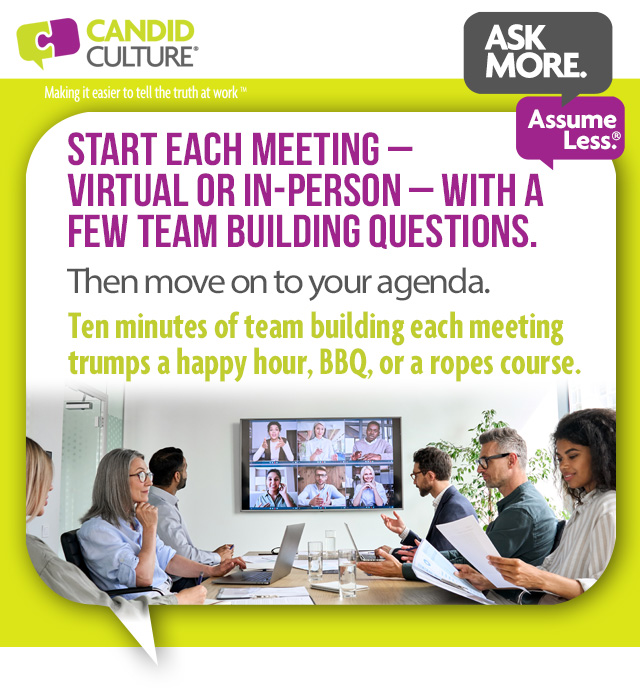
To strengthen your culture, take small regular actions.
Start each meeting helping employees get to know each other better, from a work perspective.
Host town halls at least twice a year.
Host roundtable discussions between senior leaders and a diverse sample of your workforce.
Have leaders and managers leave employees a weekly voicemail. Share a recent success, challenge, or goals. Keep messages short and authentic. Set the tone for the week.
All of these actions can be done virtually or in a hybrid setting.
Give employees opportunities to talk to each other about the things that matter most at work. Do this regularly – at least a few times a year.
You don’t need to spend a lot of money to strengthen and retain your culture. Go small, go cheap – regularly.
When something ‘bad’ happens, my seven-year-old is quick to ask who is at fault, hoping, of course, it’s not him. I’m trying to get him to use the word accountability instead, and to understand that if he has some accountability, he has some control over what happens. If he has no accountability, he has no control. A tough concept for a seven-year-old.
Stuff happens. People won’t give you what you need to complete projects. Things will break. When breakdowns happen, I always ask myself, “What could I have done to prevent this situation?” or “What did I do to help create this situation?”
It may sound odd that I always look at myself when breakdowns occur, even when it’s someone else who didn’t do their job. It’s just easier. When I can identify something I could have done to make a situation go differently, I feel more in control – aka better.
I’m the person who gets off a highway jammed with traffic. The alternative route may end up taking longer, but at least I’m moving. I feel like I’m doing something and thus have more control. Taking responsibility for what happens to you is similar. When you’re accountable for what happens, you can do something to improve your situation. When someone else is accountable, you’re at the mercy of other people and have very little control.
There are, of course, exceptions to the practice that “we’re accountable.” Terrible and unfair acts of violence, crime, and illness happen to people, about which they have no control. But in general, in our day-to-day lives, there is typically something we did to contribute to a bad situation or something we can do to improve it.

Here are four practices for improving difficult situations even when you didn’t create the mess (alone).
- Ask more questions. If you’re not clear as to what someone is expecting from you, ask. Even if their instructions aren’t clear, it is you who will likely be held accountable later.
- Tell people what you think they’re expecting and what you’re planning to do, to ensure everyone’s expectations are aligned. This beats doing weeks’ worth of work, only to discover what you created isn’t what someone else had it mind.
- Ask for specific feedback as projects progress. Don’t wait until the end of a project to find out how you performed.
- Admit when you make a mistake or when you wish you had done something differently. Don’t wait for someone to tell you. Saying, “I’m sorry. How can I make this right with you?” goes a long way.
These are really delegation practices.
I am always asking the questions, “What could I have done differently? What did I do to contribute to this situation, what can I do now to make this situation better?” I encourage you to do the same, even when someone else drops the ball. You can’t control others, but you can control you. And your happiness and success is your responsibility.
I had a colleague at my last job, before I started Candid Culture, who was a peer and a friend. We were at a similar level and would periodically sit in one of our offices, with the door closed, talking about the bad decisions our company’s senior leaders made. One day I realized that these conversations were exhausting to me. They were negative and didn’t make me feel better. In fact, they made me feel worse.
Some people assert that venting is cathartic and makes people feel better. It doesn’t.
I’ll use an analogy I read in one of Deepak Chopra’s books. When you put a plant in the closet and don’t give it light or water, it withers and dies. When you put a plant in the sunlight and water it, it grows. And the same is true for people. What you give attention to gets bigger. What you deprive attention goes away.

Your life is made up of the people you spend time with and what you talk about. What are you talking about?
If you’re complaining, unless you’re planning a conversation to address a challenge or problem, you’re venting. And talking about what frustrates you will only make you more frustrated.
My advice: Do something about the things you can impact and let the other stuff go.
The phrase Quiet Quitting is everywhere since appearing in a Tik-Tok video earlier in the year. Essentially quiet quitting is doing your job – just what is asked – not more and not less. Quiet quitters do good work during work hours, not on weekends and not at night. Quiet quitters don’t volunteer to do work outside the scope of their job, that they’re not paid to do.
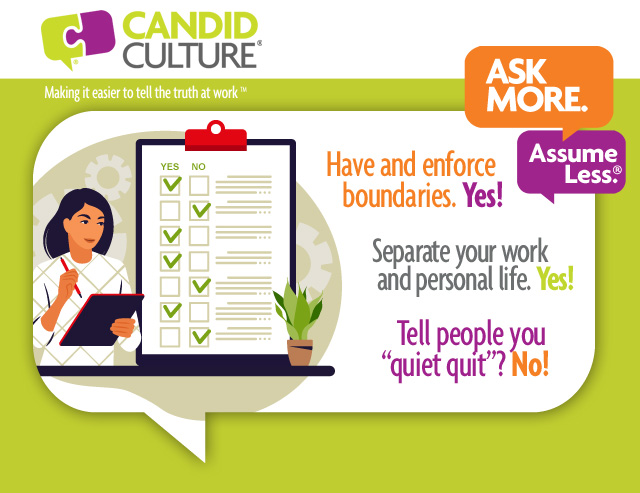
Is there anything wrong with doing your assigned job and not more? No. Should you do it? If you want to. Should you use the phrase “quiet quit” at work or even with friends? No.
The definition of quiet quit is widely debated. Does it mean doing you minimal best, clocking it in, coasting, slacking, doing things other than work during work hours? It’s confusing and controversial.
The definition of the word quit is to leave, typically permanently. As a business owner who hires and works hard to retain team members, I don’t want my employees thinking of themselves as quiet quitters. It feels like a mentality – one foot out the door. And while the phrase quiet quit may not mean uncommitted, it has that connotation, so why use it?
If anything has become clear in the last almost-three years, it’s that many people want a different life. Many of us discovered that we enjoy being home, don’t want to commute long distances, travel for work, or miss family and social events because our jobs require it. So, let’s talk about that at work.
Employees – find the words to tell your boss what you need rather than labeling yourself with a controversial and confusing descriptor. Managers, find a way to talk with employees about what they need to be satisfied and stay in a job.
Employees and managers are often uncomfortable talking about the things that matter personally. Employees are often afraid to say what they need, for fear of being sidelined or fired. Managers are often afraid to raise the subject of what employees really need for fear of not being able to meet those needs. So, employees quiet quit and managers quietly hope for the best.
How about doing this instead – managers and employees meet individually, virtually, or in-person, every few weeks. Make a work-life check in a regular part of the conversation. Put the topic on the agenda to normalize the discussion and make talking about how work impacts personal an expected part of the conversation. Then start the discussion with something like, “I want us to be able to talk about how work fits in and supports your desired personal life. I want this job to support the vision you have for your life. I may not always be able to give you want, but I certainly can’t if I don’t know what those needs are.”
The world has changed, we have changed, and our needs have changed. We need to be able to talk about those changes without hesitation, worry, and fear. Instead of quiet quitting, schedule a conversation and open the discussion with something like, “I really enjoy my work here. There are a few things I’m realizing I need. Can we talk about it?”
Every day I’m annoyed that I’m not perfect. I want to be a combination of Mary Poppins, Super Woman, and Kate Middleton, but I’m not. I’m a business owner, working mom, who hasn’t seen the inside of a gym since my son was born, who recommits to better self-care every day, only to break that commitment in eleven different ways by 10:00 am.
Some days are going to be bad. On those bad days, it’s easy to feel like we’re messing things up and that we are indeed a mess. Instead, give yourself a break. The thing to know and remember, in the moment, is that you’re a human being, doing the best you can.

Here is a list of five ways to give yourself a break and as a result, do your best work.
-
- Set realistic deadlines so you’re not constantly running against time, and overestimate how long everything will take to do.
- Before agreeing to a new commitment, ask yourself, “Do I really want to do this?” Try not to commit yourself to things you know, at your core, you don’t want to do. You’ll just resent that commitment when it rolls around and aren’t likely to do your best work.
- Turn off the alerts on your phone and laptop when you’re working. You’ll be more focused and get more work done.
- Take a day off. Your company offers vacation time for a reason. People do better work when they take time to relax and rejuvenate.
- Say “thank you” more and “I’m sorry” less. “Thank you for letting me know” is more empowering than “I’m sorry I missed that.” I’m guilty of apologizing for everything, so much so that one of my employees and I play a game that whoever says she’s sorry first has to throw a dollar in a communal collection pot. Whatever you put attention on will improve.
Some of these things are business focused, some are personal. You bring yourself – your whole self – to work. It’s why you’re good at what you do. People want to work with real people. And real people over commit, make mistakes, and spend too much time on social media at 11:30 pm. Give yourself a break.