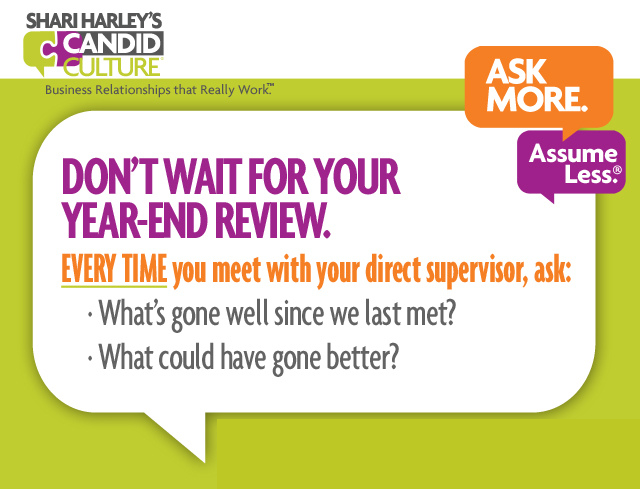
Most people wait way too long to give feedback. Instead of waiting to give feedback until you’re about to explode in frustration, or until a formal review, give feedback every time you meet with someone.
Managers, make it a practice to meet with each of your employees at least once a month. Short meetings twice a month or weekly would be better. But if you’re not doing one-on-one meetings now, start meeting monthly. If you’re meeting monthly, start meeting twice a month. Employees need one-on-one time with their boss. Team meetings and casual conversations do not replace individual meetings.
Direct Report One-on-One Meeting Agenda:
The direct report comes to the meeting ready to discuss:
1. What they are working on that is going well.
2. What they are working on that is not going well.
3. What they need help with.
4. Then the manager gives feedback on what went well since the last meeting and what could be improved.
5. The employee also gives the manager feedback on what has gone well since the last meeting and what could be improved.
Feedback goes both directions. Managers, if you want your employees to be open to your feedback, ask for feedback from your employees on what they need from you. Give feedback on both the work and your working relationship. A poor working relationship often motivates employees to leave a job, but it’s the last thing that gets discussed.
Feedback discussions should be short. You can say anything in two minutes or fewer. No one wants to be told they aren’t cutting it for 20 minutes. Say what you need to say and end the conversation or move on to another topic.
If you’re not giving your employees regular feedback, you can use this language to start:
“I’m realizing that I’m not giving you enough feedback. I want to be helpful to you. If I don’t provide regular, timely feedback, I’m not being as helpful as I could be. I’d like to start a regular practice of meeting monthly, getting an update from you on how things are going, and giving each other feedback on what went well and what could be improved since our last meeting.”
If you work for someone who is not forthcoming with feedback, ask for feedback. You’re 100% accountable for your career. Don’t wait for your manager, customers or peers to give you feedback. Ask for feedback on a regular basis.
Here’s how you can ask for feedback from your manager:
“Your feedback helps ensure I’m focused on the right work. Can we put a monthly meeting on the calendar, and I’ll tell you what I’m working on, where I do and don’t need help, and we can discuss how things are going?”
If meetings get cancelled, reschedule them. If your manager says these meetings aren’t necessary or they don’t have time, tell them, “Your regular input is helpful to me. What’s the best way to ensure we catch each other for a few minutes each month?” Meaning, push the issue.
If your manager still doesn’t make time for the meetings or doesn’t provide clear and specific feedback, even when you ask for examples, ask your internal and external customers and coworkers for feedback. The people you work closely with see you work and will likely give feedback, if asked.
No news is not necessarily good news. Waiting six months or a year to receive performance feedback is like going on a road trip from St. Louis to Los Angeles but not consulting a map until you arrive in New York, frustrated and far from your desired destination.
Managers: Meet with employees monthly, semi-monthly or weekly, and give feedback every time you meet.
Employees: Ask your managers, customers, and coworkers for regular feedback, and take control of your career.
Lots of organizations send out employee engagement surveys with the desire of improving employee engagement and retention; unfortunately, they often damage both in the process.
There are a few employee engagement survey pitfalls that luckily are easy to avoid.
Here are three practices to follow when sending out employee engagement surveys:
Shorter is better. I hate to say this, but no one wants to fill out your employee engagement survey. It’s time consuming, employees doubt the survey will yield results, and employees worry that their feedback isn’t really confidential.
Make your employee engagement survey easy to fill out by making it short. And by short, I mean 10 questions or fewer. You’ll get a better response rate to a 10-question survey than a 65-question one.
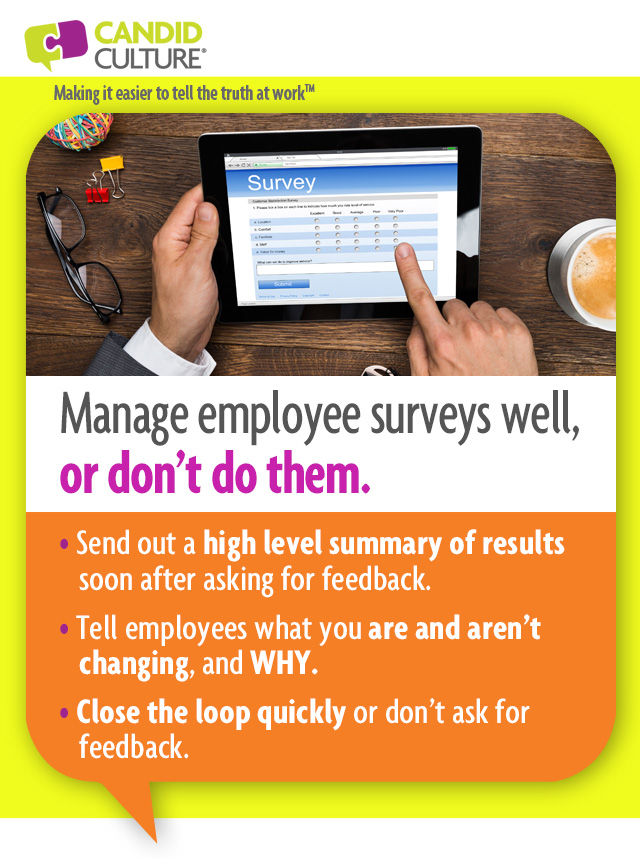
Provide employees with survey results quickly. Most organizations ask for too much information. Leaders are overwhelmed by the survey information, so they spend months and months reviewing it, while employees comment on yet another employee survey with no communication.
Send out a succinct communication sharing the top few learnings – the good and the not-so-good — within a few weeks of sending out the survey. You don’t need to take action at the same time. Simply keep employees in the loop by communicating a quick summary of what you learned. If you wait too long to share the feedback, it often never gets communicated. And the next time you send out a survey, employees will remember the absence of information and be hesitant to fill it out.
Within 90-days, tell employees what you will and won’t be changing, based on the survey feedback, and tell them why. Employees don’t need or expect all of their input to be utilized. Closing the loop with clear communication about what you are and aren’t changing, and why, is often sufficient.
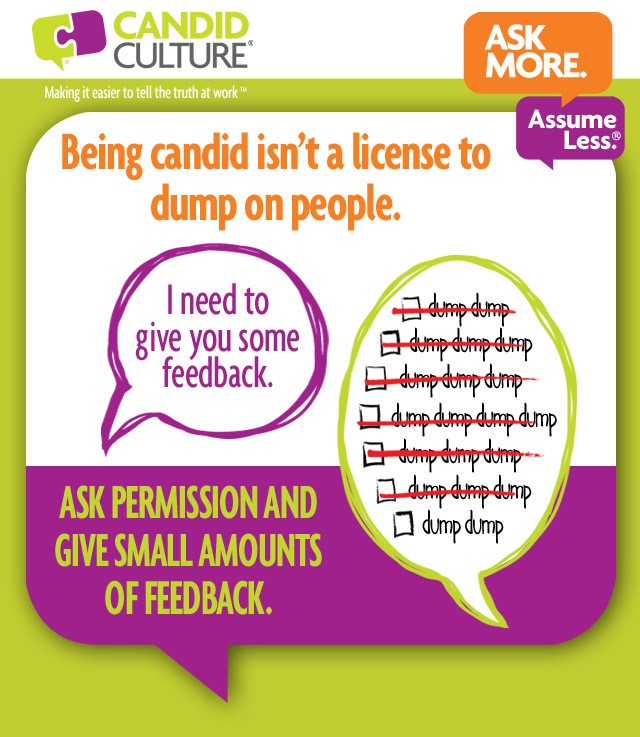
People leave feedback training armed with new skills and they unfortunately sometimes use those skills as a weapon. It goes something like this, “I need to have a candid conversation with you.” And then the person proceeds to dump, dump, dump. This couldn’t be more wrong, wrong, wrong.
When you give someone negative feedback you are essentially telling the person they did something wrong. And who likes to be wrong? The ego gets bruised, and people often start to question themselves. This normal reaction doesn’t mean you shouldn’t give feedback, you just need to do it judiciously.
Ask yourself these four questions when deciding whether or not to give someone feedback:
Do I have the relationship to provide feedback? Does the recipient trust me and my motives?
Do I have permission to give feedback? If the recipient doesn’t work for you, you need permission to give feedback.
Is this something the person can do something about? If it’s not a change the recipient can make, keep your thoughts to yourself.
Is the feedback helpful? Ultimately the purpose of all feedback is to be helpful.
Let’s say you’re on the receiving end of too much feedback. What should you do? It’s ok to say “no thank you” to feedback. Here’s what you could say:
“Thank you for taking the time to bring this to my attention. I really appreciate it. You’ve given me a lot of feedback today. I’d like something to focus on that I can impact right now. What’s the most important thing I should do?” You’ve validated the other person and demonstrated openness and interest. You’ve also set some boundaries and expectations of what you will and won’t do.
“Thank you for taking the time to share your requests about… We won’t be making any changes to that and here’s why.” It’s ok not to act on all feedback, simply tell people why you won’t.
“I appreciate your concern. I’m not looking for feedback on that right now.” Can you say that to someone? Yes. Should you? Sometimes. To your boss – no. To someone who offers unsolicited advice that’s outside of their lane, yes. They’ll get the message.
People can only act on and digest small amounts of feedback at a time. Be judicious and assess your motives. The purpose of feedback is to be helpful, when the feedback is requested, and when you have the relationship to give it.
If you receive too much feedback or unsolicited feedback, it’s ok to decline. You’re not the 7-11, aka you’re not always open.
The purpose of feedback isn’t to teach people a lesson, it’s to elicit certain behavior.
Below are six strategies for giving helpful and succinct upgrade feedback:
Write down your message. Save it as a draft. Re-read it later, when you’re not emotional, then cut the words in half. Shorter is better.
Remove emotion. Examples are helpful, emotion is not. Emotion: You embarrassed me. Example: You raised your voice at me in front of others.
Remove judgments. Vague words are judgmental. Judgment: Your behavior was unacceptable. Specific: You rolled your eyes at a coworker.
When you can deliver your message in about a minute, without emotion or judgment, you’re ready to speak.
Deliver all upgrade feedback in a private setting, behind a closed door.
Then, let it go. When the conversation is over, it’s over. Don’t stay angry or remind the person of the situation. If the behavior is repeated, discuss it then.
Say only what you need to. Deliver messages privately. Protect the ego, which is fragile. Let people save face.
“If you have nothing nice to say, don’t say anything at all.” Most of us grew up hearing these words. Last week I used them with my six-year-old son, and instantly regretted it. He said something hurtful to me and I told him to keep those thoughts to himself.
I want him to keep his thoughts to himself if he doesn’t like a kid at school or doesn’t want to play with someone. Walk away, find another place to play, is often my guidance. But with me? With me I want him to be honest, always, even if it hurts.
Every time we talk with people, we train them how to interact with us. If I tell my son not to tell me the truth, I teach him to protect my emotions and stifle his. I teach him I’m not strong enough to handle the truth and that I’m someone who needs protecting. I teach him that he can’t be honest with me.
If you want your coworkers, boss, family and friends to be honest with you, make it easy to tell you the truth. Take in what others say without visibly reacting. Say “thank you” for whatever feedback and input you get, even when you want to say everything but. Take the time to ‘get over’ hard messages and then discuss further, when you’re not angry.
People learn quickly. If we react to suggestions, input, and feedback negatively, people learn that we can’t take challenging data and they stop giving it to us. I don’t want to be the person the people I care about are afraid to talk with because my reaction is just too hard to deal with.
Should you care about everyone’s feedback? No. Should you ask everyone for feedback? No. Should you be open to everyone’s feedback? No. Be open to feedback from the people who matter most to you. Open your heart and your mind. Close your mouth. Even when you want to do everything but. Strengthen your relationships and train people that you can handle the truth.
Sign Up
Career tips you won't get elsewhere. Sign up to get a free tip card.