Running effective meetings is hard. It takes courage. Who wants to tell their boss, peers, and customers to put away their phones, stop side talking, and laser their communication? No one. But if you don’t manage ‘bad’ meeting behavior, you look bad and you won’t get the results you want.
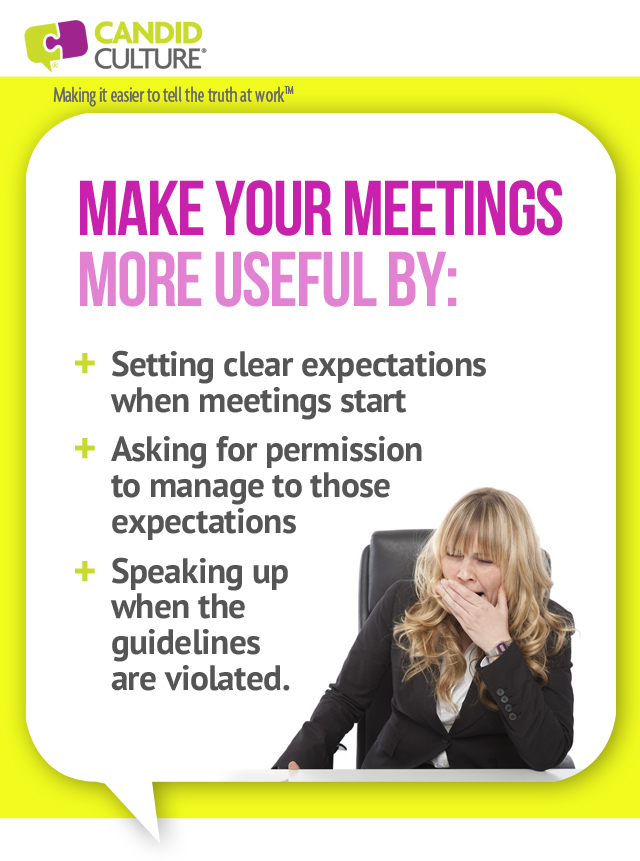
If you run meetings, work with the meeting participants to set expectations everyone agrees to follow. Standard meeting guidelines for running effective meetings include not side talking, putting away or silencing electronics, tabling tangents, not interrupting others, speaking succinctly, etc. You can set any behavior guidelines you like as long as the meeting participants agree to those expectations. Ask meeting participants what behavior guidelines they want to follow. The more control you give people, the more buy in you’ll get.
Possibly even more frustrating than running a meeting in which participants break all the ‘rules’, is participating in inefficient meetings when you aren’t the facilitator. It’s difficult to sit through a poorly run meeting feeling there isn’t anything you can do to make it better.
Luckily, there are things you can do to improve the meetings you don’t run. None of my suggestions will be comfortable. But think of all the time you’ll save.
Conversation one – running effective meetings: If you want to impact the meetings you attend, approach the facilitator(s), empathize about what a challenging meeting it is to run, tell the person you want to be supportive, and ask if they want to discuss some different ways to manage the meeting. That conversation could sound something like, “Wednesday’s staff meeting is tough to run. I empathize with you. Would you be interested in talking through some different ways to manage participant behavior? I have some ideas and would be happy to discuss. I’d like to be supportive.”
Conversation two – running effective meetings: If you want to be more direct, you could say something like, “Can we talk about Wednesday’s staff meeting? It can’t be an easy meeting to run. I empathize with you. Key decision makers are missing meetings, and a few people tend to take over the conversation and take us off track. Can I make a few suggestions that might help? What do you think of working with the group to set some expectations people agree to be managed to and then holding people to those agreements? We can share the facilitation responsibilities by assigning jobs during the meeting – back up facilitator, note taker, timekeeper, etc. – so all of the responsibility doesn’t fall to you. What do you think?”
The person running the meetings knows they’re not going well. They just don’t know what to do about it. Offer support. Don’t judge. Be helpful and possibly they’ll be receptive.
The key to running an effective meeting is to set clear expectations people agree to follow, review those expectations at the beginning of every meeting, and speak up when the expectations are violated. All of these things take courage. But meeting participants will be grateful to you for being strong.
When you feel you’ve been wronged, it’s natural to want to lay into the offending person, give negative feedback, and tell him exactly what you think. The problem with doing this is that as soon as a person feels accused, he becomes defensive. And when people are put on the defensive and feel threatened, they stop listening. And you’ve potentially damaged your workplace relationship.
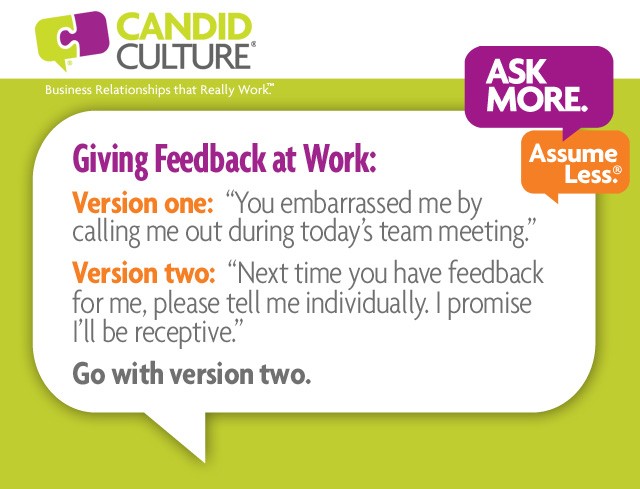
When someone does somethingfor the first time that violates your expectations, use the lowest level of intervention necessary. Allow the person to save face, and ask for what you want, without giving an abundance of negative feedback and pointing out all the things he’s done wrong.
Likewise, when you cut your finger while cooking, you put a Band-Aid on your finger. You don’t cut off the finger. This is true with business communication too.
When you’re facilitating a meeting, you can ask the two people who are side talking to stop, or you can go third grade on them and ask, “Is there something you want to share with the rest of us?” Both methods will stop the behavior. But one embarrasses the side talkers a lot, the other only a little.
Likewise, when one of your coworkers takes credit for your work, you can give feedback and say, “I noticed you told Mike that you worked on that project, when we both know that you didn’t. Why did you do that?” Or you can skip the accusation and ask a question instead, saying, “I noticed you told Mike you worked on that project. Can I ask why you did that?” From there you can have a discussion, give feedback if you need to, and negotiate.
When your boss doesn’t make time to meet with you, rather than saying, “You don’t make time for me. That makes it hard for me to do my job and makes me feel unimportant.” Instead consider saying, “I know how busy you are. Your input is really important in helping me move forward with projects. How can we find 30 minutes a week to connect so I can get your input and stay on track?”
In each of the situations above, you’d be justified in calling the person out and giving negative feedback. And it might feel good in the moment. But being right doesn’t get you closer to what you want, and it can damage your workplace relationships.
Practice good business communication –say as little as you have to, to get what you want. If this method doesn’t work, then escalate, communicate more directly, and give direct feedback. The point is to get what you want, not to make the other person look bad. The better the ‘offender’ feels after the conversation, the more likely you are to get what you want in the future.
Many people worry about giving feedback because they fear they don’t have the ‘right’ words. They’re concerned they’ll say ‘it’ wrong and damage their relationships.
Feedback is hard enough to give without worrying about saying everything perfectly. Worry less about having all the right words and more about whether or not people trust your motives.
When people trust your motives – why you’re giving feedback – you can say almost anything. When they don’t trust your motives, you can say almost nothing.
Getting negative feedback is hard. It’s easier to listen to feedback when we trust the person who’s giving us the feedback – we know their intentions are to help versus to judge or hurt us.
Speak from the heart, be authentic, and worry less. Be yourself. If you’re nervous to say what you want to say, tell the other person you’re nervous. If you’re struggling to find the right words, say so. If you’re worried you’ll damage the relationship or that it isn’t your role to give the feedback, say that. Authenticity goes a long way.
How’s how to give feedback you’re apprehensive about:
How to give feedback example one: Consider saying, “There’s something I need to talk with you about, but I’m concerned that I won’t use the right words and will damage our relationship.”
How to give feedback example two: “There’s something I want to talk with you about, but I’m concerned how it will come across. Is it ok if I say what I need to say?”
How to give feedback example three: “I want to give you my thoughts on something, but I’m concerned that it’s not my place to do so. Is it ok if I share my ideas about _________?”
Other people aren’t expecting you to be perfect. But they do want to know they’re working with a human being. And human beings are fallible. We have fears. We make mistakes. And sometimes we don’t say things perfectly.
You don’t have to be perfect; you just have to be real.
Sign Up
Career tips you won't get elsewhere. Sign up to get a free tip card.