Archive for December, 2021
It’s the time of year when people start to think about their goals for 2022 and make New Year’s resolutions. I won’t suggest you do either. You likely have enough to do. My only suggestion (in this arena) is to ensure you’re doing what you really want to do.
There are lots of things we need to do and think we should be doing. And it’s really easy to get caught up in that long list of could and should do’s. If that list brings you joy, do those things. If not, consider another path.
I’m pretty sure at least one person reading this blog has a magnet or card hung at their desk with the words, “What are you going to do with your one precious life?” As far as we know, we only get one go around. So, while the question may be overused, what are you going to do to create your life with the time you’re given?
I have an existential friend who is trying to convince me that there is no such thing as time. I am not persuaded. All we have is time, and it’s the only thing we can’t get back. You can gain weight and lose weight, make money and lose it, make friends and lose them, but you can never get back your time. So, what are you doing with your time?
You create your life.
A few questions to consider:
- What do you love doing most? How often are you doing that?
- What’s most important to you in life? Does what’s most important to you make up a majority of where your time and energy goes?
- How much time do you spend doing things you think you should be doing, but don’t really want to be doing?
- How much time do you spend doing things someone else wants you to do?
I’m not suggesting you live an indulgent life without compromise. If you’re in relationship with other people, you will, at times, do things you don’t want to do. But I’m hoping that doing things out of obligation is not what your life’s about.
Not everyone in your life will approve of your choices. That’s ok. This is your life. Don’t knowingly harm anyone or anything. Besides that, I don’t know of any rules, except for this, don’t get to the end of the road and wonder “what if.” Create your life.
Read How to Say Anything to Anyone and take charge of your career and life. Holiday offer! Buy 3 books at candidculturepress.com and we’ll send you a 4th book free. Offer ends 1/10/22.

It’s easy to forget about team building when you’re working virtually, or to think that team building can’t be don’t virtually, or to decide to wait to do team building until your whole team can get together in person. My advice; don’t wait.
Often the most meaningful aspects of work are the people we work with and the relationships we build. When you leave a job, you leave your laptop and take your friendships. You can build team work virtually, you just need to make the time.
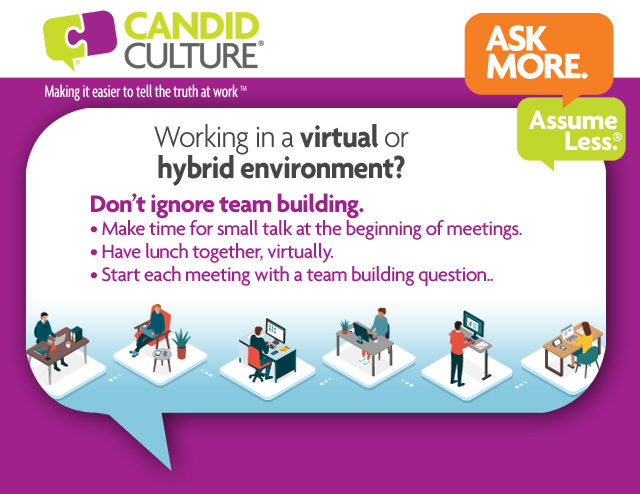
Even if you’re type A and tightly wound (like I am), spend the first few minutes of meetings on small talk, just like you would if you were gathering in a physical conference room. Ask what people are doing for the holidays. Commiserate over vacations you’re missing and food you know you shouldn’t be eating.
Eat lunch together, virtually. Remember when people used to sit together in the office breakroom or cafeteria? Why not eat together via video? Team building doesn’t have to be elaborate. It can just be spending time together, talking about things other than work.
Humans need people contact and relationships. People are missing other people. Connections with our coworkers make us feel connected to our organizations.
Small talk and group lunches create camaraderie, but they don’t teach people how to work together. In addition to social activities, give people a chance to talk about working style preferences too. You don’t have to do personality assessments and long training programs to build teamwork. Just give people a chance to talk about how they like to work, on a regular basis.
Tell you team you want to help people get to know each other better so work gets done more easily. Start each team meeting with one of the questions below, then move on to your meeting agenda. Do this all year.
Here are a few team building questions you can use:
What are your pet peeves at work?
What time of day do you do your best work?
Do you leave your email, phone, or text alerts on at night? If I text you after hours, will you get a ping?
If I email you on weekends and evenings, do you think I expect a response? Would you prefer I send messages only during regular business hours?
What work do you like to do most?
What work do you like to do least?
What’s an area of our business you’d like to learn more about?
What’s something you’d like to learn to do that you don’t have a chance to do now?
Read a question to the group. Give everyone at the meeting the opportunity to answer the question about themselves. And remember, the meeting leader/facilitator speaks last. People will often follow the most senior person’s lead. You want people to answer authentically rather than providing what they think is the ‘right’ answer.
Team building doesn’t have to take a lot of time or money. Don’t wait until everyone is back in the office or for a future retreat. Help coworkers spend time together formally and informally, getting to know each other better now.

Most ‘feedback’ sounds like this:
- You’re awesome.
- Good job.
- Nicely done.
- You’re cutting corners.
- You have a bad attitude.
- You’re not committed.
- You’re careless.
- You’re disengaged.
I’m not sure why, I wish I could give you a good reason, but the vague phrases above are what come out of people’s mouth’s first when giving feedback. To prevent giving fake feedback, you have to prepare.

There is a reason you think the person is awesome or has a bad attitude. What did they do that created that impression? Until you can describe what the person did to create an impression, you’re not ready to give feedback. You’re better off saying nothing.
All of the phrases above are opinions with no facts. Opinions are judgments. Feeling judged makes people defensive. When people are defensive, it’s hard to listen.
The purpose of feedback is to help another person. Give the person enough information that they know what to replicate and what to change. Before you give feedback, write down three things the person did that created your impression. If you can’t give an example, wait to have the conversation until you can. It’s better to say nothing than to say something vague and unhelpful.
Vague positive feedback sounds inauthentic. Vague negative feedback is judgmental. Neither strengthens your relationship or are helpful.
If you really want to be heard and you want to be helpful, provide an example. No example, no feedback.
No one (I know) enjoys writing, delivering or receiving performance feedback. It’s time consuming to write, challenging to deliver, and can be difficult to hear. Unfortunately, most performance management systems – goal setting forms, performance appraisal templates and online templates – don’t make the process easier. Instead, they make it harder. Short and simple is best.
When I started managing leadership development for a mutual fund company, I inherited a 12-page performance appraisal form and what seemed like 89 competencies. One of the business leaders I supported told me, “I’m not asking my people to use this form. If you can give me something that’s one page, I’ll have my managers use it.” That conversation sent me on a mission to make all performance management forms one or two pages. And really, why shouldn’t they be? People can only focus on leveraging and changing a few things at a time. Why give more feedback than that at any given time?
If you’re chasing people to use your performance management tools and templates, you have the wrong forms. In my experience, when people find something easy to use and valuable, they’ll use it. If something is difficult to use or doesn’t seem to add value, people drag their heels.

Here are a few ideas for making your performance management process easier:
Make your forms and templates simple. No performance management tool should be more than two pages. In a performance appraisal – quarterly, annual, or otherwise – identify up to three things the person did well and a max of three things they can either do more, better, or differently next year. Anything more is overwhelming and a set up for disappointment, frustration, and overwhelm.
If you have additional areas for the person to work on, meet again in 90-days and assess how the person has done with the three pieces of feedback already provided. If they have made significant progress on the things they were already working on, add a few new things to work on. If significant progress hasn’t been made on the existing feedback, wait to add more.
I know your existing performance management templates may not allow for what I’m suggesting. If you’re working with a template that requires more input, write up to three clear, succinct, and actionable bullets in each required area and not more. Bullets are better than paragraphs. Be specific. “Great job” is not feedback. Neither is, “needs improvement.” Give a specific example or two. No example, no feedback.
Resist the urge to write paragraphs of vague feedback or to accept that type of feedback in a self-appraisal. Paragraphs of feedback take too long to write and often say little. I’d suggest spending less time writing performance feedback and instead spend the time observing performance, asking others for input on the person’s performance, and writing three succinct, specific bullets that describe an action taken or outcome produced. Specific feedback is meaningful, useful, and received with less defensiveness.
Click below to see our suite of one and two-page performance management templates.