Archive for October, 2021
Last week one of my friends was concerned about something happening at her son’s school. She wrote out what she planned to say and sent it to me to read. Her notes were long, with lots of unnecessary details. I read five paragraphs before understanding what the situation was even about. I revised the notes. My notes were three sentences and easy to write. Why? Because it’s not my child, not my situation.
What makes giving feedback and making requests particularly difficult is our emotional involvement. We’re connected to the outcome. The stakes feel high. And that emotion makes everything harder.

If you’re struggling with a message you need to deliver, get some help. The person who helps you craft a succinct, specific, and unemotional message doesn’t have to be a feedback expert or a manager. The person just can’t be involved. As long as the person isn’t emotionally involved, they’ll be helpful.
When you ask for help, don’t ask for advice. Instead of asking a friend or colleague, “What would you do in this situation,” ask, “What would you say?” These are very different questions. You want the specific words to resolve whatever you’re struggling with.
Asking someone for help planning a challenging conversation or message begs the question, isn’t asking for that type of help a form of gossip? It could be. So be careful who you ask.
When asking for help planning a message or conversation, ask someone in your organization who is at your same level or above (title-wise) or ask someone outside of the organization. Change the names of the people involved; protect people’s anonymity. And be clear if you are asking for help to plan a conversation or if you are venting. They are not the same.
The most effective feedback and requests are unemotional, factual, and succinct. Sometimes we need other people who are not involved to help us get there.
So much has changed in the last year and a half. And what you need to be happy at work may have changed too. The question is, do the people you work for and with know what you need now?
You aren’t likely to get what you don’t ask for, but most people don’t ask for very much. We assume that the people we work with will do the right thing without prompting. We’ll get the recognition and compensation we deserve at work because it’s the right thing to do. We’ll be included in important meetings and decisions regardless of from where we are working.
If you read this blog regularly, you already know that I’m a proponent of setting clear expectations and asking more questions before problems occur. Consider what you want and need, anticipate what can go wrong, and plan accordingly before problems happen. Doing that sounds great in theory, but how does it work in practice?

Here are five ways to increase your job satisfaction:
Increasing your job satisfaction tip one: Be honest with yourself about what you need to be happy at work. Rather than tell yourself you won’t get what you need or try to convince yourself that you shouldn’t need something, just admit your needs to yourself.
Increasing your job satisfaction tip two: Share your needs with people who can help you get those needs met. Don’t make people guess. Chances are they won’t guess at all or will guess wrong.
Increasing your job satisfaction tip three: Don’t assume things will go well and just wait and see what happens. Instead, set clear expectations at the beginning of new projects and working relationships.
Here’s how that could sound: “We’re going to be working together for the next six months. Let’s talk about how everyone likes to communicate, what people’s pet peeves are, and the kind of information each person wants to receive.”
Here’s another example of how that could sound: “I’m excited to work on this project with you. There are a few things to know about me that will help us work well together and deliver timely results. I ask a lot of questions. Let me know if this frustrates you. I’m not questioning you; I just have a need to understand why we do what we do. And I work best with a deadline. I am happy to be available off hours, but you probably won’t hear from me before 9 am. You will get messages and work from me at night and on the weekends. Just let me know if you’d prefer I schedule messages to go out during regular business hours.”
People might give you what you need if you ask, but they likely won’t if you don’t. Train others how to work with you.
Increasing your job satisfaction tip four: Agree to talk about things as they happen. Don’t wait until you’re about to explode to speak up.
That could sound like, “I want us to work well together, and things will go wrong. Can we agree that we’ll provide feedback as things happen so we can make timely adjustments?”
Increasing your job satisfaction tip five: Renegotiate when you need to. If you realize you need or want something that you didn’t ask for, go back and ask. It’s never too late.
Here’s how that could sound, “We touch base about once a month and I’m realizing that if we could talk for about 20 minutes once a week, I’d be able to get more done. Can we make that happen?”
Job satisfaction and happiness don’t just happen. The people you work with are not you and they don’t know what you need. Make a regular practice of identifying what you need, making those needs known, and then speaking up when things go awry. You won’t get what you don’t ask for, but you will get what you allow.
It’s been almost two years that we’ve been looking into people’s homes on Zoom. Life and work have changed, and people have a variety of feelings about those changes. Some people miss working in person and can’t wait to go back to the office. Some people love working from home and never want to go back. What’s important is the ability to talk about how we feel and what we need from work – with the people we work for.
Most people suffer in silence, concerned to ask for what they want or need at work. Managers find out their employees are unhappy when they come across employees’ resumes on the internet.
The world has changed and how we interact needs to change to. Your manager may not be able to allow you to work from home all the time, but she certainly won’t if you don’t tell her what you want.
We need to cross the line, having conversations that perhaps we haven’t had in the past.
Managers, in addition to checking in on work progress, talk about how employees are doing and what they need going forward to be satisfied and do their best work.
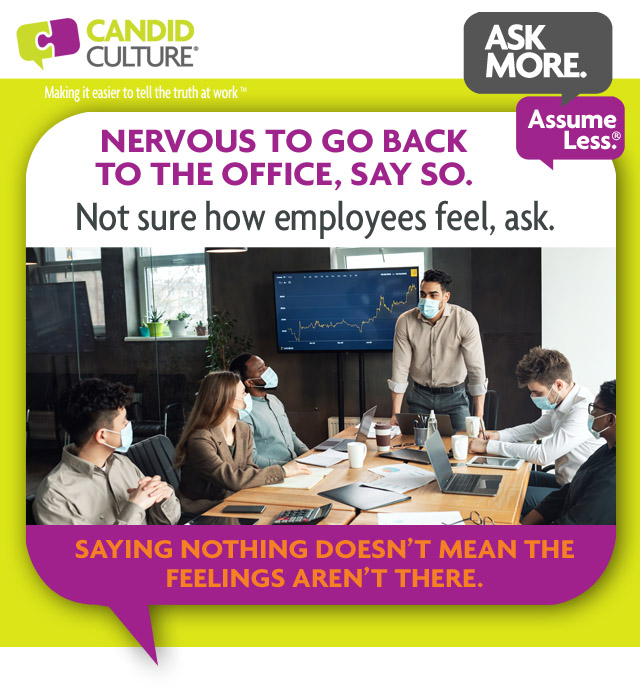
Questions to ask during regular check-ins:
I’m not a fan of asking, “How are you doing?” It’s a vague question, and vague questions produce vague answers. But many employees will go their whole career without being asked how they’re doing. It demonstrates caring. It’s a place to start.
Here are some better questions to ask employees:
- What’s changed for you in the last 18 months?
- What have you learned about yourself in the last 18 months?
- What has changed about what you need from work, if anything, in the last 18 months?
- What would you tell me if you weren’t concerned about how I would react?
Managers, even if you ask these questions, employees may not feel comfortable answering. Managers can lead by example by talking about themselves. Share how your life, needs, and desires have changed. Share your own constraints. When managers show vulnerability, they convey it’s ok for employees to do so as well.
Also, tell employees that you really want to know the answers to the questions and assure employees there won’t be negative consequences for speaking candidly. Projects won’t be taken away. Careers won’t be impacted. You’re just talking. If employees never want to come into the office or travel, or want to work part-time, yes, jobs and careers may be impacted. But a conversation is just that, a conversation.
You won’t get what you don’t ask for.

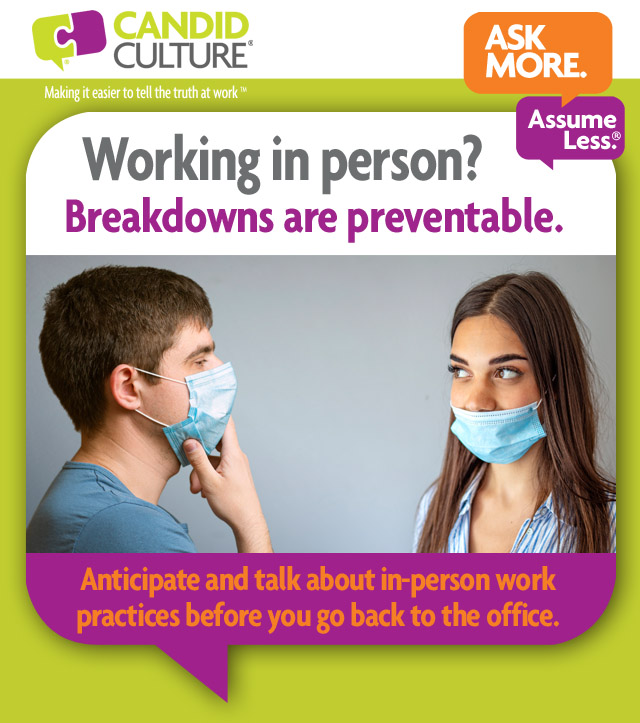
Perhaps you’re going back to work in person part or full time and you’re nervous. Will people sit closer than you’re comfortable sitting? Will people wear masks? Will someone ask you to wear a mask when you don’t think it’s necessary? Yes, yes, and yes. All of these things are likely to happen. And addressing each situation will be uncomfortable. The good news is, if all of these events are predictable, they’re also preventable.
The time to talk about how people will behave in the office, is before people return to the office. Preventing a breakdown is always easier than addressing one.
Managers, get your team members together via phone or video and outline the organization’s expectations around masks, physical distancing, etc. Be explicitly clear. “Everyone is expected to be courteous and use common sense.” is not clear. My definition of being courteous and using common sense is different from yours. Follow the meeting up with written expectations that reiterate what you outlined during the meeting.
Direct reports, speak candidly with your managers about what you need. If you’re not comfortable working in an open floor plan, talk about it before you go back to the office. If you’re not comfortable attending a meeting with others in a conference room, have the conversation before the first in-person meeting. It’s ok to have concerns, and it’s ok to talk about them.
Teams, get together via phone or video before you go back to the office and agree on the practices you will follow. For example, if your organization’s policy is to wear a mask and a team member’s mask is below their nose, everyone on the team has the right to ask the person to pull it up. If a team member feels people are sitting too close, it’s ok to ask for space.
My point isn’t which Covid safety practices to employ. My point is to have the conversations before you return to the office. Anticipate every possible outcome. Talk with friends and colleagues who are already working in person and ask for the pitfalls and breakdowns they’ve experienced. Set clear expectations with your manager, peers, and internal and external customers. Then agree to talk about breakdowns as they happen. If you can predict it, you can prevent it.