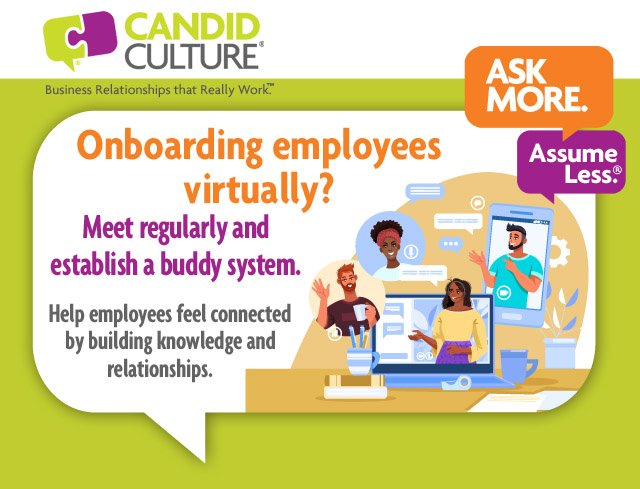
Starting a new job is like the first day of school. It’s scary. Who will I have lunch with? How do I make copies and get reimbursed for expenses? Who do I need a good working relationship with? Starting a new job virtually is even more challenging. Who are these people I work with and how do I reach them?
We need to help new employees acclimate to people and processes, and this introduction increases tenfold when starting a job virtually.
“People leave managers not jobs” is an old phrase. I’ll widen the net a bit – people leave companies, not jobs. People unhappy at one company often take a similar job at a different company. They like being an accountant, auditor, marketing manager, they just didn’t like working for __________ (fill in the blank) at __________ (fill in the blank).
Here are six practices for helping new, virtual employees acclimate and feel at home quickly:
Focus on relationships first and workplace goals second.
I onboard all new employees – virtual or in-person – with a handful of Team Building and Manage People Candor Questions. My first meeting with employees has nothing to do with goals or objectives. Instead, we talk about working-style preferences and pet peeves. We get to know each other and build trust. As Stephen Covey said in his book the Seven Habits of Highly Effective People, “Deposit into the emotional bank account.” And as William Ury said in his book on negotiation, Getting to Yes, “Go slow to go fast.”
2. Make it safe and easy to ask questions.
Few people like to admit they don’t know something. I’d rather have my new employees pick up the phone or email me with a question than spend 60-minutes of frustration searching for an answer.
Ask, “What questions do you have” each time you meet and wait longer than you think you should for the answer. People always have questions. Make room for them to ask.
3. Have multiple people train new employees.
Training a new employee develops the person doing the training and builds immediate relationships.
4. Set up a system for people to ‘interview’ others throughout the organization – a virtual meet and greet of sorts.
5. Have team meetings on video.
I know, I know, people are tired of video meetings. Make them short, sweet, and regular.
6. Meet one-on-one weekly with new employees.
I suggest weekly meetings for at least the first six months, and protect the meeting time. If one-on-one’s with employees get cancelled, reschedule immediately. Cancelling meetings with direct reports without rescheduling sends the message that the direct report isn’t important.
Working with people virtually isn’t that different from working with people in person. Pick up the phone. Use video. Talk with people weekly. Ask questions. Wait for answers. Make sure new employees ‘meet’ and are exposed to a lot of people throughout the organization. People leave companies, not jobs.
Many people struggle to say no. As a result, when someone has a request that we can’t or don’t want to meet, we often say nothing. We simply don’t respond. Or we put the person off telling them we’ll get back to them. Then people wonder. “Did they get my request? Should I send the request again? Will I look bad if I ask again? How many times should I ask before I just let the request go?”
Saying no is better than saying nothing. No gives people closure. Silence leaves people in limbo wondering what they should do next.
Saying no is hard. We don’t want to disappoint or let people down. And yet, you can’t say yes to everything. You can say no and still sound like a responsible, easy-to-work-with, accommodating professional.
Here are ways to say no:
Thank the person for asking. “Thank you for asking me.”
Saying “thank you” acknowledges the other person and buys you time to think about their request.
Tell the person you need some time to think about their request. Ask, “Can I have a few days to think about it? I’ll get back to you by Friday.”
You don’t need to reply in the moment. I often regret things I agree to without thinking through the request thoroughly.
Consider what you really want and are willing to do. It’s much worse to over commit and under deliver than to simply say no or renegotiate requests.
Get back to the person in a timely way (when you said you would) and tell them what you’re willing to do.
How to Say No Option One: Simply say no.
Example: “I really appreciate you asking me to write the proposal for the __________ RFP. I’m not able to do that. Can I recommend someone else who has the expertise and time to do a great job?”
Don’t give a bunch of reasons for saying no. People aren’t interested in why we can or can’t do something; they just want to know if we will do it.
How to Say No Option Two: Agree and negotiate the time frame.
Example: “I’d be happy to do that. I can’t do it before the last week of the month. Would that work for you?” If the answer is no, negotiate further. Ask, “When do you really need it? I can certainly do pieces by then, but not the whole thing. Given that I can’t meet your timeline, who else can work on this in tandem or instead of me?”
How to Say No Option Three: Say no to the request but say what you can do.
Example: “I can’t do _______. But I can do ________. How would that work?”
A review of how to say no:
Acknowledge the request by getting back to the requestor within 24 hours.
Give yourself time to think about and respond to requests.
Negotiate requests to your and the requestor’s satisfaction.
Agree on what you can and are willing to do.
Keep your commitments.
Saying no is always hard. But it’s always better to say no than to ignore requests, or to say yes and do nothing.
Your boss’s job is to help you eliminate obstacles, ensure you have the resources you need to be successful, and to be a coach. A manager’s job is also to evaluate you.
Managers only have so many points of reference to evaluate their employees’ performance. If you tend to vent with your boss how your internal customers are difficult to work with, your boss doesn’t know that you don’t do this with everyone. It’s a point of reference that makes an impression. How do I know this? I learned it the hard way.
My last boss, before I started Candid Culture, was the best boss I ever had. He always had my back. He was knowledgeable about the business and happy to share his knowledge. He trusted me and gave me a lot of latitude. And I confused that positive relationship with that of a confidante.
I felt comfortable with my boss, so I complained about my internal customers to him. I thought he was a safe person to do that with. I was wrong. He eventually told me he had no way to determine that I didn’t vent with everyone. My naïve decision to vent to my boss was a point of reference about my professionalism and not a good one.
It would have been fine to tell my boss I was struggling to work with an internal customer and to ask for suggestions for how to work better with the person. It would have been fine to say that I was frustrated or discouraged and was in need of support. It’s ok to share problems and breakdowns and leverage your boss to find solutions and to get help. Asking your boss to help you solve a problem you haven’t been able to solve yourself is expected. Using your boss as a therapist is not.
I don’t want you to be paranoid, to feel that you have to watch every word that comes out of your mouth, and that you always have to be on your guard. Just know the role people in organizations play. Leaders and managers have to determine who is successful in their current role and who is a good fit for future roles. So be mindful of how you show up and to whom.
We all know impressions are formed quickly and are hard to change. If someone sees you once a week, one a month, once a quarter, what are they seeing? People only know what we show them and what others tell them.
I know this post is political. I’m almost hesitant to write it. But I don’t want you labeled as someone with poor judgment or someone who can’t manage their emotions. Remember, let your boss see the poised professional you are. Let your friends and family see the rest.
Sign Up
Career tips you won't get elsewhere. Sign up to get a free tip card.