Many people worry about giving feedback because they’re concerned they don’t have the ‘right’ words. They’re concerned they’ll say ‘it’ wrong and damage their relationships.
Feedback is hard enough to give without worrying about saying everything perfectly. Worry less about having all the right words and more about whether or not people trust your motives.
When people trust your motives – why you’re giving feedback – you can say almost anything. When they don’t trust your motives you can say almost nothing.
Getting negative feedback is hard. It’s easier to listen to feedback when we trust the person who’s giving us the feedback – we know their intentions are to help versus to judge or hurt us.
Speak from the heart, be authentic, and worry less. Be yourself. If you’re nervous to say what you want to say, tell the other person you’re nervous. If you’re struggling to find the right words, say so. If you’re worried you’ll damage the relationship or that it isn’t your role to give the feedback, say that. Authenticity goes a long way.
How’s how to give feedback you’re apprehensive about:
How to give feedback phrase one: Consider saying, “There’s something I need to talk with you about but I’m concerned that I won’t use the right words and will damage our relationship.”
How to give feedback phrase two: “There’s something I want to talk with you about, but I’m concerned how it will come across. Is it ok if I say what I need to say?”
How to give feedback phrase three: “I want to give you my thoughts on something but I’m concerned that it’s not my place to do so. Is it ok if I share my ideas about _________?”
Other people aren’t expecting you to be perfect. But they do want to know they’re working with a human being. And human beings are fallible. We have fears. We make mistakes. And sometimes we don’t say things perfectly.
You don’t have to be perfect, you just have to be real.
The most frequent question I’m getting these days is how to manage business relationships virtually. Here is the short answer – talk to people. Pick up the phone. You don’t need to have video calls, if you don’t want to. Showering is a personal choice. You just need to talk to people.
People need human contact. We even need to connect with the people we don’t like – when we work for and with them. Text and email don’t replace talking to people.
We stopped talking to each other long before so many people began working from home. Email has been overused for years. We emailed the people we sat next to at work. We exchanged 20 emails on one topic rather than picking up the phone.
We ask permission to call our friends to catch up. Texting a friend to ask, “Is it ok if I call you tomorrow morning?” is the norm. We exchange 50 texts to determine where and when to meet for lunch.
Maybe people thinking email and texting is easier, less intrusive, faster. Less intrusive, yes. Easier, sometimes. Faster, no.
Call the people you work with. Ask for the best time to call, if you like. Check in on them. Ask how they’re doing. Yes, there may be a crying child or a barking dog in the background. It’s ok. Calls don’t have to be long. People just need contact. They need to know that you care and are ‘in it’ with them. And while you’re on the phone, get questions answered in five minutes rather than with 25 emails.
It’s been eleven months that many people are working from home who would ordinarily go into an office. Some people are content with the fancy-on-the-top, jammies on the bottom video-work life, others are feeling lonely and isolated. Some employees have a private, uninterrupted work setting, others are trying to find a quiet place to participate in meetings while a partner and kids are also at home. Working from home amid distractions and loneliness is tricky and we need to be able to talk about it.
Managers, your employees don’t want to tell you they’re struggling, lonely, distracted, or can’t make certain meetings or deadlines. They want you to think everything is fine, that they’re fine. Who likes to admit to their boss that they can’t keep up or are unhappy at work?
If a manager loves working from home and has a quiet, uninterrupted work environment, it may be easy to miss employees’ challenges. Managers need to cross the line and ask questions they otherwise wouldn’t.
Don’t assume employees are fine. Don’t assume employees will tell you if they’re not. They likely won’t. You need to ask and make it easy and safe to tell you the truth.
Managers, ask employees these questions:
What’s your work environment like?
What constraints are you under?
What’s a realistic work schedule right now?
What do you want me to know?
What do you need?
It may seem like it’s too late to ask. It’s not. It’s never too late. Simply be honest. It could sound something like, “I wanted to check in and see how you’re doing working from home. I want to ask some questions so I can support you. I wish I’d asked before. I’m sorry I didn’t.”
Managers who are willing to tell employees they wish they’d done something differently earn loyalty and trust for showing vulnerability and humanity. Strong managers admit mistakes.
If you’re nervous that employees will delve into arenas that are too personal, set parameters for the conversation. It’s ok to set boundaries when asking questions. You could say, “I want to talk about some of the constraints you may be under working from home. I’m sorry I didn’t ask before. Let’s focus on things I can support you with and stay away from items I can’t help with like finances and personal relationships.”
Then be prepared to help employees problem solve. Maybe employees need a different work schedule or different deadlines or deliverables. Maybe employees need help setting expectations with peers and clients around when they can and can’t attend meetings.
Make it safe to talk about how employees are really doing and what they need to be successful in today’s circumstances. Tell employees that you really want to know, you’re sorry you didn’t ask before, and that it’s safe to tell the truth. Then problem solve with employees. And ask the same questions periodically. Make talking about work environment, schedule, and expectations a regular conversation.
Organizations are working hard to retain employees. Employees are watching how their organization’s leaders and managers work, and often make career decisions based on the hours the most senior people keep. Not a recipe for retaining employees.
Many employees pay particular attention to how often managers and senior leaders take time off and whether or not leaders attend meetings and respond to emails while they’re ‘off.’ Employees observe the late nights that leaders and managers put in and the emails sent at 11:00 pm and on the weekends. I’ve heard lots of employees say, “If I need to work like my boss works to get ahead in this organization, I’m not interested.”
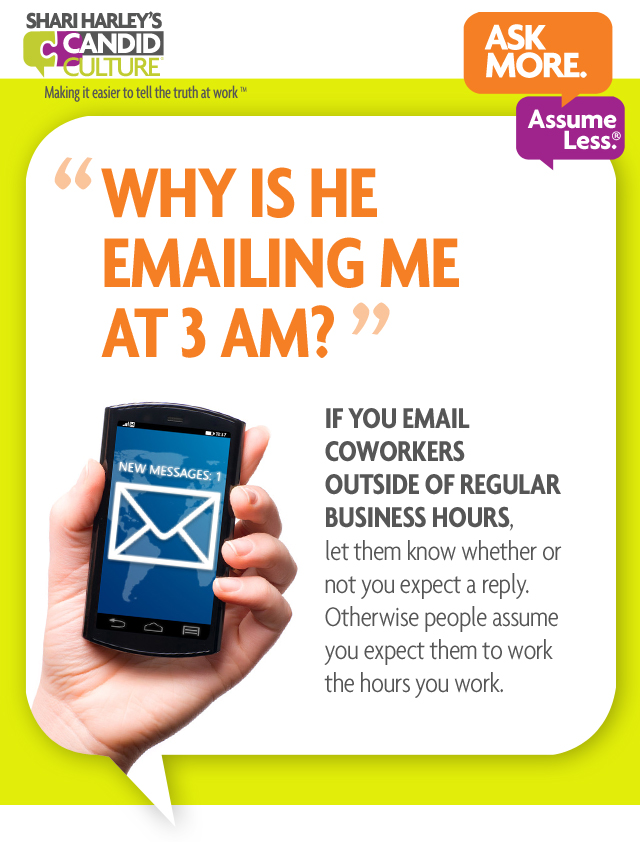
Managers, one of the keys to retaining employees is to communicate expectations. If you’re available while you’re on vacation, but don’t expect employees to do the same, set that expectation. If you send an email outside of regular business hours but don’t expect employees to respond until the next business day, tell them so. They don’t know. Many employees assume that if you email them at night, you expect a reply.
Instead of allowing employees to make assumptions about what managers do and don’t expect, set clear expectations. Be overt and clear. Tell employees, “I work most evenings and weekends, but don’t expect you to do so. And I work these hours because I enjoy it, not because I have to. If I email you outside of regular business hours, I am not expecting you to reply.” Retaining good employees begins during the interview process when initial expectations are set.
Managers, if you expect employees to check and respond to emails outside of regular business hours and to be available while on vacation, tell candidates during the interview process. If working long hours is a criteria for promotion, set that expectation. It’s completely fine to expect long hours and for employees to be accessible outside of regular business hours. There is nothing wrong with either expectation. There is only a problem if employees don’t know that’s the expectation.
Employees, if your manager emails you outside of regular business hours and she doesn’t tell you whether or not she expects you to reply, ask. Simply say, “I often receive emails outside of regular business hours. How will I know when you need me to reply?” Likewise, if you notice your manager emails you on vacation, you can say, “I typically hear from you when you’re on vacation. Are you expecting me to check in while I’m off?”
The need to ask questions and set expectations goes both ways. Don’t wait to be told. Ask.
Managers and employees, ask these Candor Questions about working style preferences to aid in retaining employees:
How do you feel about being contacted outside of regular business hours?
If I need to reach you over a weekend or in the evening, what method is best?
Would you prefer I text you so you don’t have to check your email outside of business hours?
What time is too early and too late to call, text, and/or email?
Ask more. Assume less and make retaining employees easier.
Sign Up
Career tips you won't get elsewhere. Sign up to get a free tip card.