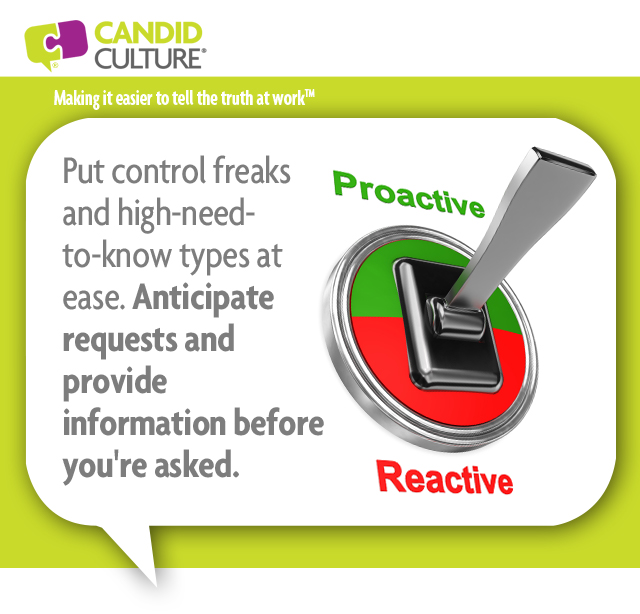
Frustrated by a control freak, micromanager, or a high-need-to-know type? Controlling behavior stems from a need that isn’t being met. Identify the need, meet it, and your life gets easier.
This is similar to what salespeople learn during good sales training. The customer wants to buy the car but doesn’t make a purchase. She visits the dealership three times, but just can’t pull the trigger. She has some sort of concern. If the salesperson can identify the concern, he can possibly resolve it, and sell the car. Working with control freaks is the same.
If someone wants more updates, information, or involvement than you’re comfortable with, he has a need that isn’t being met. When you meet the need, the person will likely back off.
I ask the people who work for me to never make me ask for something twice. Meaning, if I ask for an update the week before a speaking engagement, anticipate that I’ll want that information for all engagements. Confirm by asking me and then provide the data without being asked for all future engagements. Getting the information regularly without having to ask builds trust and credibility.
Here are six tips for working with control freaks:
If you don’t know, ask:
The person’s work-related goals. What are they working on this quarter and year?
What the person is concerned about at work? What are they worried about?
How does s/he like to communicate – in-person, email, phone, video, voicemail, or text.
How often does s/he want information, in what format, and with how much detail.
2. Provide more information than you think you need to, and then ensure the person wants that information in the future.
3. If you’re asked for information, ask why the person wants it, and if s/he wants it in the future. Then provide the information before you’re asked.
4. If someone is overly involved in your work and you feel you have no freedom, state your observation and ask for information. That could sound like, “You’ve been involved with each major decision with this project. I’m used to working with less oversight. Do you have a concern about my approach?” Then you negotiate. Everything is a negotiation.
5. This will put the other person on the defensive. A less confrontational approach is to discuss and agree upon levels of involvement and supervision when projects begin. That could sound something like, “What kind of involvement do you want to have in this project? What do you want to do? What do you want me to do? What kind of updates would you like, how often, and with how much detail?” It’s always easier to prevent a problem than to fix one.
6. Lastly, don’t take anything personally. Oversight and involvement may be a reflection of how someone feels about your performance, but it might not. When in doubt, ask.
If a friend asked you to do something, you did it, and she didn’t say thank you, you’d probably think twice the next time she asked you for something. The people you work with are not different.
If you don’t say thank you to employees, they too will stop doing things you think are important. Human beings thrive on recognition and relationships. We need both to survive. And when we don’t feel connected or appreciated, we find appreciation elsewhere.
If you think saying “thank you” to the people you work with is unnecessary, consider this example. An overwhelmed employee feels strapped for time. She produces a 30-page report every month that takes hours of her time. No one has ever talked with her about how the report is used and why it’s important. So when she is overwhelmed and decides that something needs to go, she stops doing work that appears not to add value—the 30-page report. It turns out the report reflects her department’s results and is reviewed by the CEO, CIO, CFO, and COO. Oops.
There are managers who think that a paycheck is enough of a thank you to employees (old school) and that any other thank you to employees is unnecessary (this doesn’t work). Human beings want to make a difference. We don’t like doing tasks we perceive as not being impactful. So tell the people you work with that their work matters by saying thank you, and how you say thank you matters. Saying, “Thanks for doing such a great job on that project” doesn’t go nearly as far as saying, “Thank you for taking over the Briggs proposal. You shepherded the proposal from beginning to end and made sure no detail was overlooked. You made all of us look good and we would not have won the business without you.” Like all feedback, specific feedback is meaningful and drives future behavior. Vague feedback feels inauthentic and doesn’t tell the recipient what to replicate in the future.
Onto why it’s important to say “I’m sorry.” Some people think that saying you’re sorry puts you in a weak position and that you will lose employees’ respect. This couldn’t be further from the truth. Strong people admit when they’re wrong. Weak people can’t admit mistakes. Admitting fault ingratiates you to other people. Refusing to take responsibility alienates you.
It’s very frustrating to work hard and never be told “thank you.” Likewise, it’s upsetting when people don’t apologize for dropping the ball and making mistakes. It’s so easy to say “thank you” and “I’m sorry,” and it costs nothing. The more you demonstrate appreciation for the people you work with and take responsibility for your mistakes, the harder people will work on your behalf.
Giving feedback upwards is hard. Giving feedback downward is hard. Giving feedback to peers can be the hardest of all. We work closely with our peers. They’re often our friends. And still, we need to be able to speak freely when our coworkers violate our expectations.
The key to being able to give peers feedback (to give anyone feedback) is to agree that doing so is not only acceptable but expected. Before agreeing to give and receive feedback, peers need to set clear expectations of how they’ll work together and treat each other.
Telling people how you want to work with them is always easier than asking someone to change their behavior. But it often just doesn’t occur to us to tell our peers what we want and need from them. We’re busy. They’re busy. And don’t they already know what courteous workplace behavior looks like? Return all emails within a day or two, tell people if you’re running behind on a project and will miss a deadline, and call into meetings on time from a quiet workspace. Aren’t all of these behaviors fairly obvious? Do I really need to tell people these are my expectations? Uh….yes, you do.
If you don’t want employees dumping these challenges on their managers, help employees talk to each other.
Here are seven steps to help people who work together set expectations and hold each other accountable:
Schedule a meeting during which people working together can discuss what they need from each other to be satisfied and productive. Then facilitate a discussion during which the group creates 5 – 7 behavior guidelines each person agrees to follow.
Put the list of agreed-upon behaviors in a shared folder. Leave the guidelines there indefinitely.
Give each person in the group permission to talk to individuals who violate the guidelines. This is very, very important. For the most part, employees won’t tell a peer s/he is missing deadlines, gossiping, or is distracted during meetings. People will suffer in silence and avoid the offender rather than speak up about the behaviors that frustrate them.
Ask the group to grant each other permission to speak up when guidelines are violated. Giving each other permission to speak up will make future conversations possible – difficult but possible. Without permission and these agreed-upon behaviors in place, people will suffer in silence or talk about each other, not to each other.
Ask everyone in the workgroup to take feedback graciously, responding with “thank you for telling me,” rather than with defensiveness.
Two weeks after making the list of guidelines, get the group together on a call to review the list, and make any necessary changes to it. Discuss behaviors that were omitted, aren’t realistic, and are realistic but aren’t being followed.
Then follow up by facilitating a monthly conversation during which group members give honest feedback about which guidelines are being followed and which are not, and problem solve as a group. These conversations aren’t a chance to embarrass or call people out in front of a large group. If one person is violating a guideline, that conversation should happen individually. Group conversations keep the lines of communication open – which is essential to making working with others work.
You will need a strong facilitator for the group discussions. The facilitator must tease out people’s thoughts while making sure no one gets blasted in front of the group. Don’t let concerns, that you know exist, be brushed under the rug. Group members must openly and regularly discuss what is and isn’t working about their work environment, or frustrations will build, and unhappiness and dissension will ensue.
It’s not too late to put these practices in place, even with a group that has been working together for a long time. Just schedule the conversation and explain why you’re having it. People will be relieved and grateful.
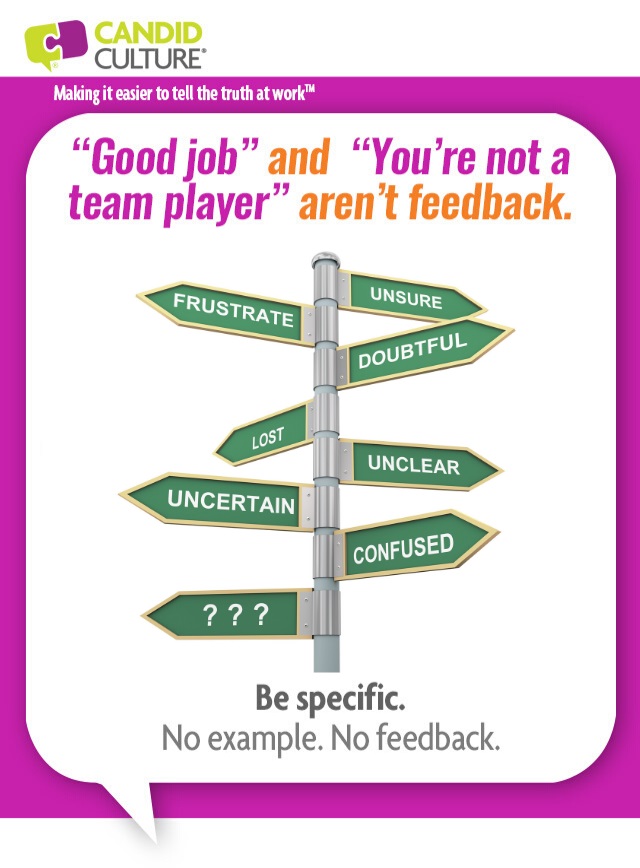
Want to know why people get defensive when you give feedback and why they often don’t change their behavior? Because what you’re giving them isn’t actually feedback.
“You’re awesome to work with” isn’t feedback. Neither is “You did a great job.” “Your work isn’t thorough” isn’t either. Neither is, “You were inappropriate.”
Most of what we consider feedback isn’t feedback at all. It’s vague, unhelpful language that leaves people wondering what they need to do more, better, or differently.
There are only two reasons to give feedback – to encourage someone to either change or replicate a behavior. Unfortunately, most of the ‘information’ we give is too vague to help people do either.
When you coach or give feedback, you serve as someone’s GPS. Like the GPS on your phone, you need to be so specific the person knows precisely what to change or replicate. If you were driving and your GPS said, “Good job” or “I think you’re off track,” you’d throw the GPS out the window and get a map.
If you give someone what you consider feedback and he says, “I don’t know what you mean, can I have an example?” you’ll know you weren’t helpful.
Here are six tips for giving helpful feedback:
Giving feedback tip one: Write down what you plan to say, then strip out half the words. Shorter feedback with fewer words is better.
Giving feedback tip two: Practice what you plan to say out loud. Have you noticed that what you ‘practice’ in your head is typically not what comes out of your mouth?
Giving feedback tip three: Before having the ‘real’ conversations, give the feedback to an independent, third-party and ask her to tell you what she heard. Ensure who you talk with will maintain confidentiality. Your organization doesn’t need more gossip.
Giving feedback tip four: Tell someone else about the conversation you need to have, and ask him what he would say. Anyone not emotionally involved in the situation will do a better job than you will. Again, ensure confidentiality.
Giving feedback tip five: Ask the feedback recipient what he heard you say. Asking, “Does that make sense?” is an ineffective question. “Do you have any questions?” isn’t any better.
Giving feedback tip six: Give one to three examples of what the person did or didn’t do, during the conversation. If you don’t have an example, you’re not ready to provide feedback, and anything you say will evoke defensiveness rather than behavior change.
Giving feedback doesn’t have to be so hard. Be so specific that your feedback could be used as driving directions. The purpose of feedback is to be helpful.
Sign Up
Career tips you won't get elsewhere. Sign up to get a free tip card.