I want each of my employees to be happy and to enjoy their jobs and enjoy working for me, every day. That can’t and won’t happen, especially right now. Some days are hard. Some are dull. Sometimes I’m fun and easy to work for. Lots of days I’m not.
I had a manager years ago who told me that my need to be liked by my employees would take me down. He was right. Unfortunately, I’m not the only manager with this challenge.
Lots of managers tell me they’re hesitant to give feedback because they’re afraid employees will quit. Other managers do work they know they shouldn’t be doing because they don’t want to burden their employees.
Not every day will be great. And that’s ok. Work is a roller coaster. Some days are awesome. Others are the pits. Your job isn’t to make people happy at every moment, it’s to create a supportive environment and ensure people have the tools to be successful.
My employees have all the tools they need to be successful. I work hard to set clear expectations and give timely positive and upgrade feedback. The rest is up to them. Some days I’m sure they’re happy. Most days, hopefully. And I’m sure there are days that other jobs sound appealing.
Here are five actions to create a positive culture at work:
Office culture tip #1: Set clear expectations at the beginning of every new project and task. The root of frustration and unhappiness is thwarted expectations.
Office culture tip #2: Ask for and be open to feedback from your employees and coworkers. Ask for feedback regularly and work to respond with, “Thank you for telling me that.”
Office culture tip #3: Respond to feedback by changing what it makes sense to change. Giving feedback that is never acted upon creates cynicism and distrust.
Office culture tip #4: Provide a rationale for your decisions. It’s fine to do things the way you want to do them, even if others disagree. Explain your rationale. You’ll get more buy-in.
Office culture tip #5: Don’t be afraid to make decisions that are unpopular. There is a reason that you want to do what you want to do, the way you want to do it. Vet your plans, when appropriate. Be open to others’ input. And then do what you think is right (within the scope of your role).
Your job isn’t to please everyone and trying to do so will likely produce lesser results and be exhausting.
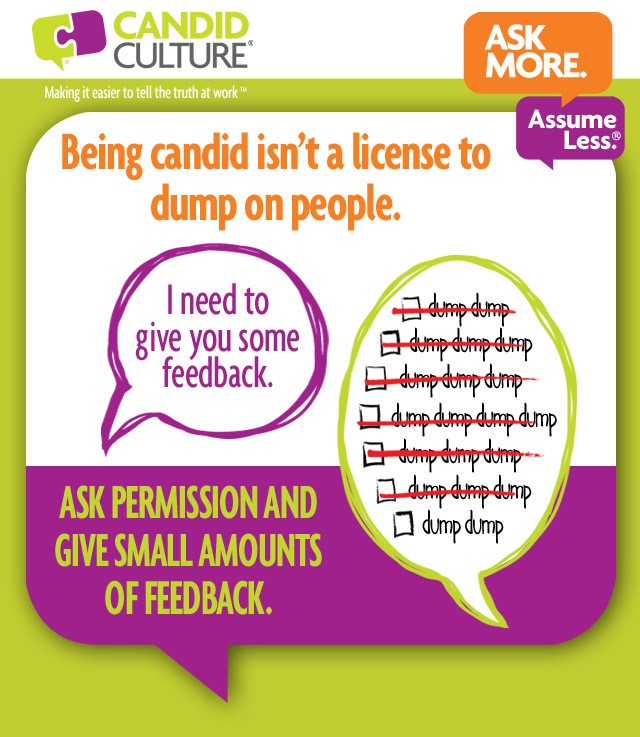
People leave feedback training armed with new skills and
they unfortunately sometimes use those skills as a weapon. It goes something
like this, “I need to have a candid conversation with you.” And then the person
proceeds to dump, dump, dump. This couldn’t be more wrong, wrong, wrong.
When you give someone negative feedback you are essentially telling him that he did something wrong. And who likes to be wrong? The ego gets bruised and people often start to question themselves. This normal reaction doesn’t mean you shouldn’t give feedback, you just need to do it judiciously.
Ask yourself these four questions when deciding whether
or not to give someone feedback:
Do I have the relationship to provide feedback?
Does the recipient trust me and my motives?
Do I have permission to give feedback? If the recipient
doesn’t work for you, you need permission to give feedback.
Is this something the person can do something about?
If it’s not a change the recipient can make, keep your thoughts to yourself.
Is the feedback helpful? Ultimately the purpose
of all feedback is to be helpful.
Let’s say you’re on the receiving end of too much feedback.
What should you do? It’s ok to say “no
thank you” to feedback. Here’s what you could say:
“Thank you for taking the time to bring this to my
attention. I really appreciate it. You’ve given me a lot of feedback today. I’d
like something to focus on that I can impact right now. What’s the most
important thing I should do?” You’ve validated the other person and
demonstrated openness and interest. You’ve also set some boundaries and
expectations of what you will and won’t do.
“Thank you for taking the time to share your requests about…
We won’t be making any changes to that and here’s why.” It’s ok not to act on
all feedback, simply tell people why you won’t.
“I appreciate your concern. I’m not looking for feedback on
that right now.” Can you say that to someone? Yes. Should you? Sometimes. To
your boss – no. To someone who offers unsolicited advice that’s outside of
their lane, yes. They’ll get the message.
People can only act on and digest small amounts of feedback
at a time. Be judicious and assess your motives. The purpose of feedback is to
be helpful, when the feedback is requested and when you have the relationship
to give it.
If you receive too much feedback or unsolicited feedback, it’s
ok to decline. You’re not the 7-11, aka you’re not always open.
There was way too much guessing at work before most people began working from home. Without visual cues, figuring out how to work with people is even harder. You may find yourself thinking, “I’m going to miss this deadline. I wonder what the consequences will be?” Or perhaps, “She said she wanted input on this project. I wonder if she really meant that, and how much feedback is ok to provide?” Or maybe, “He asked for a proposal. Is he expecting something elaborate, or will a one-pager do?”
We often don’t know what others are expecting from us, so we guess. The problem with guessing is that we may do more work than we actually need to, and not in the way the other person wants it. Even worse, when we don’t work according to others’ expectations, they aren’t likely to tell us. Instead, they tell others and make decisions about us that aren’t positive.
I’m a fan of asking lots and lots of questions, preferably at the beginning of anything new. Anticipate all that can happen, get in front of breakdowns, and set clear expectations by asking questions. The people who participate in virtual and in-person training with me get an entire box of questions to ask. And the homework is to go ask more questions of the people they work most closely with. Asking questions will always be easier than recovering from violated and often unstated expectations.
If you want fewer breakdowns and frustrations at work, ask the following questions of the people you work with:
What do you want to do, on this project, and what do you want me to do?
What does a good job look like?
What will be different in the organization when this project is finished?
How would I frustrate you and not even know it?
How often do you want to receive updates from me?
Do you want to receive all the details or just big picture information?
Do you want to receive the information in bullet form or paragraphs?
It’s never too late to ask questions like these. It’s ideal to ask the question at the beginning of a piece of work. But asking in the middle or even towards the end is fine too. People will appreciate that you asked, whenever you ask.
The days I’ve struggled to be with my young son during this
stay-at-home period are the days his behavior is other than I expect. Jumping, running,
and racing around at bedtime when I expect it to be a calm, quiet time. Eating
ice cream sandwiches before breakfast when I had already said no. Continuing to
play during clean-up time when we had agreed to clean up toys together.
Working with our coworkers, managers, employees, and customers is not different. “I tell people if I’m going to be late or not attend a meeting. Why can’t other people do that?” “I touch base with my employees weekly to see what they need. Why can’t my boss do that?” “I tell vendors if I don’t want to do business with them. Why can’t potential customers just tell me if they don’t want to work with us?”
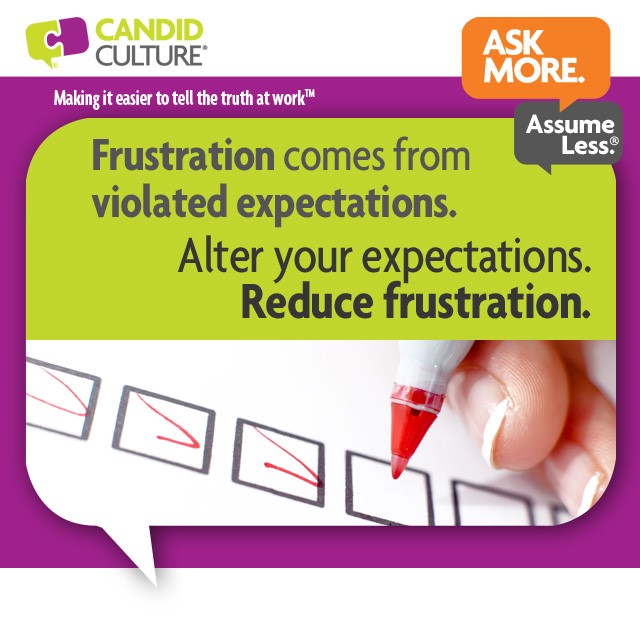
All of these frustrations stem from violated expectations. I
expected you to do x. You did y. That’s – irritating, infuriating,
flabbergasting.
To be less frustrated and enjoy working with others more, change
your expectations.
I know bedtime is going to be wild, so I need to budget more time to allow for running and jumping before we settle into our bedtime routine. Or better yet, I need to accept that running and jumping are part of our bedtime routine. If someone has a history of not responding to emails or phone calls, I give them more lead time knowing I won’t hear back for a week. I work with the person instead of against them.
It’s easy to think that changing expectations is the same as
lowering expectations. It really isn’t. It’s altering the way we work with
people to reduce struggle. It’s working with versus working against. Altering
expectations is challenging. It takes a lot of patience and preparation.
Below are four ways to change your expectations with people who don’t do things as you think they should:
Remind yourself how this person engages, based on your past experiences with the person. Not to be cynical, but your coworker will likely do something today the same way she did it last week. Remembering how people typically work will help you set your expectations accordingly and you’re likely to be less frustrated when she takes a week to reply to an email.
Set clear expectations when you begin working with people. “I need to get back to my client with this information by Wednesday. I know that’s a quick turn-around. If I don’t hear back from you tomorrow, what’s the best way to get in touch with you?”
I need to tell my son that if he eats sweets when he isn’t supposed to, I won’t buy any more. When it’s clean-up time, any toy my son doesn’t help put away goes into storage for a while.
Follow through on the expectations you’ve set. If you told your coworker you’re going to call and text when you haven’t heard back from them, you need to do that. If the agreement is to escalate when something isn’t done or that you do it yourself and that person isn’t able to provide input, you need to do that.
Following through on expectations is
tricky. No one wants to be the ‘’bad or mean” person who holds others to
account. And sometimes holding people to established expectations results in anger
and backlash.
I’ll never forget the first time I
taught at the graduate level at a local university. I set the expectation that I
would deduct 10% from assignments that were turned in late. When I followed through
on that expectation my students were irate and complained to the Dean, telling
her I was unfair.
It was hard to reduce students’ grades. But if I didn’t follow through when expectations were violated, there was no point in setting expectations. It only undermines me and makes me seem like a person who doesn’t mean what she says.
Lastly, be real with people, not harsh or stringent, but real. If you’re struggling to work with someone or struggling to follow through on expectations, tell people that.
“I really need to get this information by Friday,
and I don’t know what to do. I’m feeling stuck.”
“I want us to have a good working relationship,
but I see that we’re struggling. Can we talk about it?” “I’m realizing I need more
contact with you. How can we find 15-minutes a week to connect live?”
No communication techniques supersede being
authentic and courageous. When you don’t know what to do or say, just be real. “I’m
realizing this isn’t working but I don’t know what to do. I don’t want to go around
you. What do you think we should do?” Working with other people and being a
powerful communicator takes courage.
People aren’t us. They won’t do things our way. To be less frustrated, alter your expectations. Be ready for others to do things their way and plan for that. And when you can, set clear expectations with everyone involved in how projects and work will be managed. And it’s ok to get upset and express frustration. Be real, be yourself, and plan ahead.
My four-year-old son and I have been at home alone together
for seven weeks. No friends, no family, no childcare, no help in our house – just
us. Some days are amazing, others are exasperating. The good days are when I’m
focused on Grayson and am not swimming in a sea of what-if distractions. The bad days are when I’m filled with fear
and worry.
Some days I’m consumed with concern about the future. When will we be able to fly? When will I be able to do what I’m most passionate about – working with groups of people at conferences and training sessions? When should I have my staff ramp up? How can we cut costs? Will summer camps be canceled? What will we do this summer when it’s 100 degrees and pools are closed? When will it be safe to have our childcare provider return to our home? Will my son have school in the fall?
Intellectually I know that the only way to be happy,
regardless of the circumstances, is to be present. There is nothing to compare
to the present. When we live in the present there is no past and no future –
there is only now. Nothing can be wrong with now because there is nothing to
compare the current time and experience to.
I’m way out of my lane here. As you likely know, I don’t
typically stray from my expertise – helping people communicate and work better
together at work. Zen philosophy is not my area of expertise. But I have a
feeling you’re like me – losing sleep, (possibly) gaining weight, and suffering
about what the future might look like.
I want to enjoy this precious time with my little boy. We’ll
never have time like this again – just us. Next year he’ll be older and not so
interested in playing trains and trucks with me. He’ll want to go to his
friends’ house versus playing in our backyard together. Precious, fleeting
time.
I can’t do anything about when it will be safe to travel, be
in a hotel ballroom, or send my son to school. I can look into my child’s
precious eyes and remember that my job is to be here for him, today. To be
great for him, regardless of the circumstances. I can keep in touch with you
and find out how you and your coworkers and customers are doing. I can offer
webinars that, while not in-person, are an effective way to connect with people
and help build necessary skills.
I can focus on the actions I can take now.
Here are seven strategies I’m using to stay in the here
and now:
Do what you need to function at a decent level each day: I need six hours of sleep and a tidy house.
Structure your workday for success: Work in small
chunks. Tell your boss, coworkers, and customers when you’ll be available. Be
realistic and forthright.
Put your cell phone away and silence alerts when you’re with family or doing things for yourself.
When you find yourself thinking about the future, direct
your thoughts to something you can impact.
Call a friend or coworker you haven’t talked to in a
long time.
Smile at whomever you’re with, just because. You’ll
both feel better.
Do one thing every day that makes you happy – a long shower, time outside, activities with your family, read a book. Something that takes you away from the what-if’s playing ping pong in your head.
Silence your concerns about the future, for now. Be present with whomever you’re with. See if things look and feel better.
Sign Up
Career tips you won't get elsewhere. Sign up to get a free tip card.