Many managers are asking the question, “How do I manage
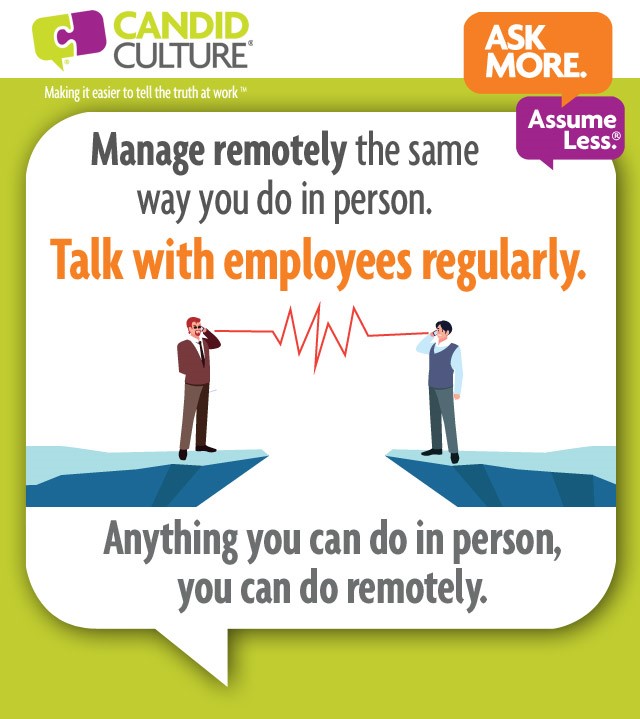
employees remotely?” Managing employees remotely isn’t too different than
managing in person. Whether someone is sitting with you or in their home
office, the steps involved in managing people are the same.
There are a few things effective managers do repeatedly. Do
these handful of things and managing people will go well, provided you have the
right person in the job. Managing someone who is a good fit for their current
job is challenging but doable. Managing a person who is not a good fit for
their job is extraordinarily hard. No management practices or skills supersedes
hiring the right person. Hiring the right people is the single most important
thing managers do. Managing and coaching employees are the next most important
things managers do.
Here are the three things effective managers do:
Set clear expectations:
Conversation with new/inexperienced
employees: “This is what I want you to do and by when.”
Conversation with experienced employees: “What do you think needs to be done and when is a manageable deadline?”
2. Delegate:
New/inexperienced employees: “Here is my
vision of how this should look.”
Experienced employees: “What’s your vision of how this should look?”
3. Review work, coach, and give feedback:
Review small pieces of work so
employees can course correct as they go, reducing wasted time and frustration.
Agree on a schedule to review work in process, so employees feel supported and
not micromanaged.
New/inexperienced employees: “Here
is what I would do differently and why.”
Experienced employees: “Here are my
areas of concern. What changes do you think need to be made?”
Repeat
That’s all you need to do. It’s so simple. And so hard.
Managing employees is very challenging.
Here are five ways to make it easier to manage well:
Spend time at the beginning of working relationships and projects getting to know employees work styles and preferences and sharing your own.
Check in with employees regularly, asking questions that elicit what employees need to be successful.
Have frequent, short conversations. A weekly 15-minute touch base is more effective than a monthly 60-minute meeting.
Do a plus/delta every time you meet, giving positive and upgrade feedback as events happen. Waiting to give feedback negatively impacts results and damages trust.
Have courage and know that employees want to work for a manager who sets clear expectations and gives clear feedback. Working in the dark is frustrating and difficult.
If you’re hesitant to do any of the actions above or are worried about how those actions will be perceived by employees, tell employees that. Be authentic and candid. You could say something like, “I want to review your work more frequently than I have in the past, but I’m concerned how you’ll perceive that.” “I want to give you regular, timely feedback to be helpful to you, and know feedback can be hard to hear.”
Lastly – remote meetings can be held via video conferencing but don’t need to be. Sometimes it’s nice to talk via phone and not have to get dressed up or manage your facial expressions. If you’re not sure if you should meet with employees via video or phone, ask them. Setting clear expectations is the first step in managing all business relationships effectively.
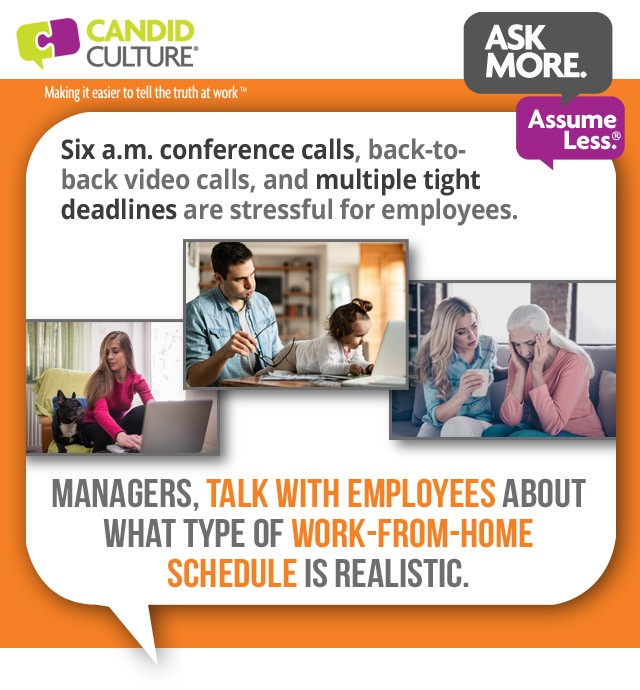
You’ve been on video calls for the past two hours. Your kids are bored, you aren’t accustomed to working alone at home and miss working in an office with other people, you don’t have a quiet, interruption-free environment in which to work, or your parents have called eight times.
Everyone you
work with is dealing with different circumstances. Some are perfectly content
working a full day at home, others are finding the experience isolating and
lonely. Some have no distractions at home and others have many. But we won’t
know what others are dealing with and how those circumstances impact work
schedules and deliverables if we don’t ask.
Managers, employees, and coworkers need to talk to each other about the constraints they’re dealing with and what a realistic work schedule looks like right now, and those conversations may be personal. They’re likely more personal than the conversations you’ve had in the past and that may be uncomfortable.
Managers, before setting goals, assigning projects, or scheduling meetings, talk to employees about what a realistic workday looks like right now.
Here’s how
the conversation could go: “I know working from home all the time is different
from you’re used to. I want to get a sense of what a realistic schedule is for
you and what kind of challenges you’re dealing with. We can create deadlines
and deliverables from there.”
Managers share about your own situation and set expectations with your employees, coworkers and with your own boss. It could sound something like this: “I have two young kids at home and I’m bringing my parents food each day. I check and return emails before 7:00 am, while my kids are still asleep. I log back on and am available for calls from 9:00 am – 10:30 am. I’m out of commission until 3:00 pm. I work from 3:00 pm – 4:30 pm and then I’m available at night from 8:00 pm – 9:30 pm. I know it’s not ideal, but it is my reality. Let’s figure out how to ensure you get what you need from me given the schedule.”
These are the conversations we need to be having and no one wants to have them. Who wants to admit to their boss, employees, and coworkers that they’re not able to work and focus for much of the day? No one. But pretending like we can participate in six hours of video calls each day or that our availability and productivity isn’t impacted is stressful and unrealistic. We are humans working with other humans and we need to be real with one another.
Managers ask your employees what a realistic work schedule looks like and find out what they’re able to do on a given day. Employees, broach the conversation with managers and coworkers. Be honest and ask for flexibility. It’s better to set expectations upfront than to surprise and disappoint.
The most frequent question I’m getting these days is how to manage business relationships (specifically employees) remotely. A future tip and blog are dedicated to this, but I’ll give you the short answer now – talk to people. Pick up the phone. You don’t need to have video calls if you don’t want to. Showering is a personal choice. You just need to talk to people.
People need human contact. We even need to connect with the people we don’t like – when we work for and with them. Text and email don’t replace talking to people.
We stopped talking to each other long before we all began
working from home. Email has been
overused for years. We email the people we sit next to at work. We exchange 20
emails on one topic rather than picking up the phone. We ask permission to call
our friends to catch up. Texting to ask, “Is it ok if I call tomorrow morning?”
is the norm. We’ll exchange 50 texts to determine where and when to meet for
lunch.
Maybe people thinking email and texting is easier, less intrusive,
faster. Less intrusive, yes. Easier, sometimes. Faster, no.
Call the people you work with. Ask for the best time to call, if you like. Check-in on them. Ask how they’re doing. Yes, there may be a crying child or a barking dog in the background. It’s ok. Calls don’t have to be long. People just need contact. They need to know that you care and are ‘in it’ with them. And while you’re on the phone, get questions answered in five minutes rather than with 25 emails.
We all know people who have been furloughed, taken pay cuts, or who were laid off over the past few weeks. It happened fast. Business has slowed or ceased in many industries, businesses are shut, people aren’t working. There are loans and tax refunds in place to motivate employers not to reduce employees’ hours or to reduce headcount.
Business leaders are doing the best they can to make decisions that will keep businesses afloat. It is a difficult time to run a business and manage people.
I too am confronted by these decisions in my own business. I had a new person who was supposed to start on March 16th. I have part-timers who aren’t coming in right now. I have an open job I’m not filling.
I want to
suggest you play the long game letting your personal and professional goals drive
your decision making, and I know this is very, very difficult. It’s difficult for
me too.
Maybe you need
to lay people off or reduce hours or compensation. Communicate with those
employees from a place of TLC – communicate early and often. Give as much information
as you can. Be as generous as you can.
Generosity
comes in all forms. It is not necessarily financial.
Tell employees the benefits that are available to them. Be realistic about when employees may receive checks. But also share how you feel about these employees and how difficult it is to reduce compensation and jobs. People want to work for people who are authentic and care about them. Don’t be afraid to show you care. Call and check-in with employees who aren’t working. Ask how they’re doing. Demonstrate concern.
There is a
long game in how we make business decisions but also in how we treat people.
Treat people like they’re family and you’re working to have a long-term relationship.
Lastly, try not
to make decisions from fear. This is a tricky one and one I can’t say I’m doing
well. I’ve made a few too many recent
decisions out of fear. But fear is not a powerful place to stand. Fear is paralyzing
and limiting.
When making personal and professional decisions, consider your long-term goals. Ask, “What do I want my business to look like in one year, three years, five years? What do I need to do today to achieve those goals, within today’s scary reality.” Act from your goals, not your momentary fear. You may need to remind yourself of this from moment to moment. I know I do.
Think future.
Be realistic. Act with care and humanity. Play your long game personally and
professionally.
Sign Up
Career tips you won't get elsewhere. Sign up to get a free tip card.