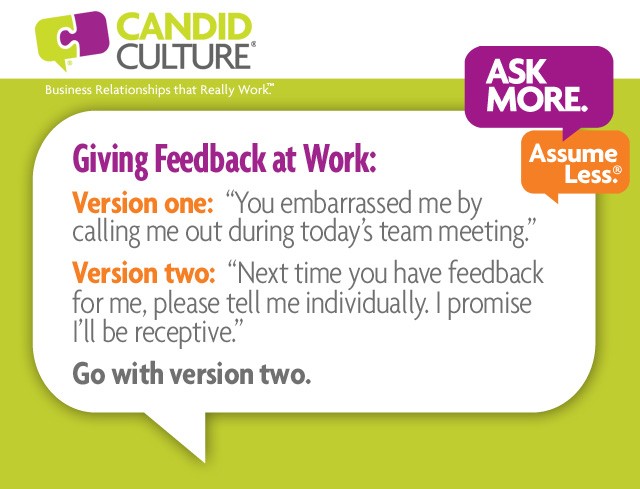
When you feel you’ve been wronged, it’s natural to lay into the offending person, give negative feedback, and tell him exactly what you think. The problem with doing this is that as soon as a person feels accused, he becomes defensive. And when people are put on the defensive and feel threatened, they stop listening. And you’ve potentially damaged your workplace relationship.
When someone does somethingfor the first time that violates your expectations, use the lowest level of intervention necessary. Allow the person to save face, and ask for what you want, without giving an abundance of negative feedback and pointing out all the things he’s done wrong.
Likewise, when you cut your finger while cooking, you put a Band-Aid on your finger. You don’t cut off the finger. This is true with business communication too.
When you’re facilitating a meeting, you can ask the two people who are side talking to stop, or you can go third grade on them and ask, “Is there something you want to share with the rest of us?” Both methods will stop the behavior. But one embarrasses the side talkers a lot, the other only a little.
Likewise, when one of your coworkers takes credit for your work, you can give feedback and say, “I noticed you told Mike that you worked on that project, when we both know that you didn’t. Why did you do that?” Or you can skip the accusation and ask a question instead, saying, “I noticed you told Mike you worked on that project. Can I ask why you did that?” From there you can have a discussion, give feedback if you need to, and negotiate.
When your boss doesn’t make time to meet with you, rather than saying, “You don’t make time for me. That makes it hard for me to do my job and makes me feel unimportant.” Instead consider saying, “I know how busy you are. Your input is really important in helping me move forward with projects. How can we find 30 minutes a week to connect so I can get your input and stay on track?”
In each of the situations above, you’d be justified in calling the person out and giving negative feedback. And it might feel good in the moment. But being right doesn’t get you closer to what you want, and it can damage your workplace relationships.
Practice good business communication –say as little as you have to, to get what you want. If this method doesn’t work, then escalate, communicate more directly, and give feedback. The point is to get what you want, not to make the other person look bad. The better the ‘offender’ feels after the conversation, the more likely you are to get what you want in the future.
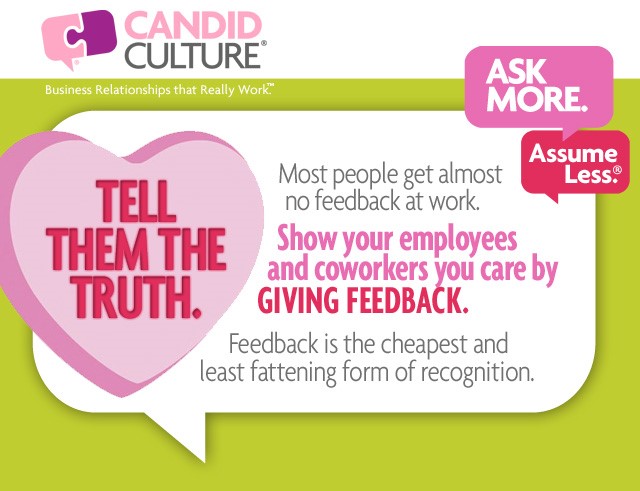
Many organizations spend more money than they have to on employee recognition gifts and appreciation programs that often involve bonuses, paid time off, contests, gifts, and other expensive forms of compensation. What employees want most is to know they’re doing a good job.
Giving feedback in the workplace is the cheapest, most effective, and often overlooked form of employee recognition. Employees want to know how they’re performing, and most employees get little to no positive or negative feedback at work. They may not want to hear negative feedback, but employees want to know if they aren’t meeting expectations.
In several of Candid Culture’s training programs, I give participants a box of questions to help coworkers set expectations and improve workplace communication. Some of the questions include:
Do you prefer to receive information via email, voicemail, or text message?
Are you a big picture or a detail-oriented person?
What are your pet peeves at work?
What type of work do you like to do the most? What type of work do you like to do the least?
What do you wish I would start, stop, and continue doing?
Participants use the questions during the training, and I am consistently amazed at how often training participants ask what their coworkers wish they would start, stop and continue doing. I assume employees will be hesitant to ask for feedback in front of a group of peers. But training participants consistently tell me that they get almost no feedback at work, and they’re desperate for the information.
Here’s How to Celebrate Valentine’s Day at Work Without Spending Money:
Give clear, specific, and timely positive and negative feedback. Employees want to know how they’re performing.
Ask what type of work employees really want to do, and let them do that work most of the time.
Ask what skills employees want to learn, and give them a chance to attain those skills.
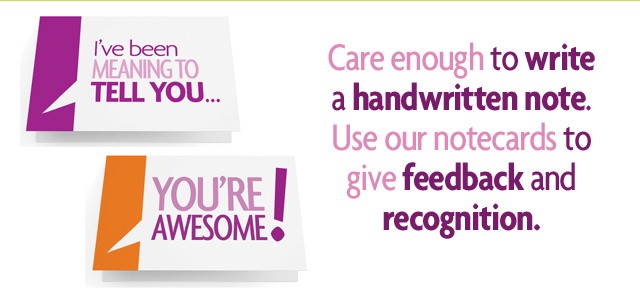
Write handwritten notes of appreciation.
Employees at Candid Culture get their birthdays off paid. We often buy employees lunch, give bonuses, and have a generous time-off policy. Those perks are important and do help retain employees. But monetary rewards never replace or supersede the value of being aware of employees’ performance and caring enough to tell employees the truth.
Today I’m having lunch with people I worked with twenty years ago. Twenty years. I have long forgotten the projects we worked on, the deadlines, and deliverables that were important at the time. What I do remember, are Jim and Siobhan. Some of my closest friends and the people most important to me in the world, are the people I’ve worked with.
It makes sense that we make friends at work, it’s where we spend a lot of time. And the people we work with make work fun or miserable.
There is a considerable amount of research citing the connection between having good business relationships and employee engagement, retention, and performance. When we feel we belong and have good relationships at work, we are happier and do better work. It makes perfect sense.
As I’m writing this, I’m thinking about my coworkers who I traveled with for weeks on end, who endured a CEO who made us practice and re-write presentations until 1:00 am for a meeting the next morning, and the coworkers I worked with at the World Trade Center. As much as I appreciated and cared about the people I worked with, I’m not sure how often I told them that they made my work world better.
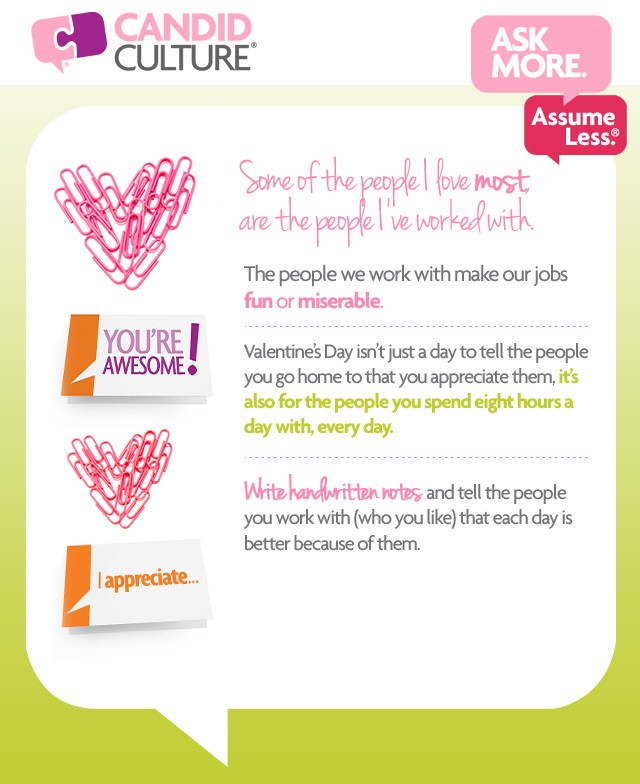
Valentine’s Day is a day we express appreciation for the people closest to us. Don’t limit your appreciation to your loved ones at home; include your coworkers who make your work fun and who help you get things done. Of course, I hope you’ll express appreciation more than once a year, but Valentine’s Day is an occasion not to miss.
Write the people you work with, who matter most to you, a handwritten note that they’ll keep for a long, long time. You can see our assortment of greeting cards for the workplace here. I’ll admit that I collect stationery and love giving and receiving handwritten notes. I suspect the people you work with will appreciate receiving a handwritten note too.