Last week I had lunch with a client. When I returned from lunch I saw a friend who told me I had something stuck in my teeth. I was embarrassed and wondered why my client hadn’t told me.
It’s quite possible he hadn’t noticed. In fact, knowing this guy and how much work I’ve done with his firm on being candid, it’s probable he hadn’t noticed. But we all know people who notice and say nothing. We could walk around all day with toilet paper on our shoe, lipstick on our teeth, or our fly down, and the people around us won’t tell us.
If you read my blog weekly, you already know that people have been trained not to tell you the truth.
But I think there is more preventing people from telling us the truth. Complete this sentence: “If you have nothing nice to say, _________________________________. Who told you that? Your mother!!!
I do think there’s something to this. We’re raised to believe that it’s not nice to say something to another person that isn’t positive. And in the past, when we did speak up, it’s likely the other person got defensive. So it’s no wonder that we don’t readily give people bad news.
Here are five tips for getting feedback from the people around you:
Establish a core team of people who will always tell you the truth. These can be friends, coworkers, clients, vendors, your boss, etc.
Give people permission, to be honest with you. “Let’s make a deal. I always want you to tell me the truth. If I have something stuck in my teeth, or I’m inappropriately dressed for a meeting, or I’m doing something that damages my reputation, I want you to tell me.”
Make it easy to tell you the truth. “I promise no matter what you tell me and how hard it is to hear, I will say thank you. I won’t get defensive. And if I do, I’ll apologize and try to do better next time.”
Offer to do the same for them. “And if you want me to do the same thing for you, I’m happy to do it.”
Periodically check in with people and ask for feedback. “A few months ago I asked you to tell me anything I said, did, or wore that got in the way of my success. Is there anything you’ve seen that you want to tell me?”
Every time you ask for feedback and take it graciously, you train the person to give you more feedback. On the contrary, every time you get defensive, you make it hard for people to give you feedback, making it likely they won’t do it again.
If you don’t want to walk around looking silly all day, create a safe environment where co-workers can tell the truth.
There is one job interview question recruiters and hiring managers must ask. And the answer should be a deal-breaker.
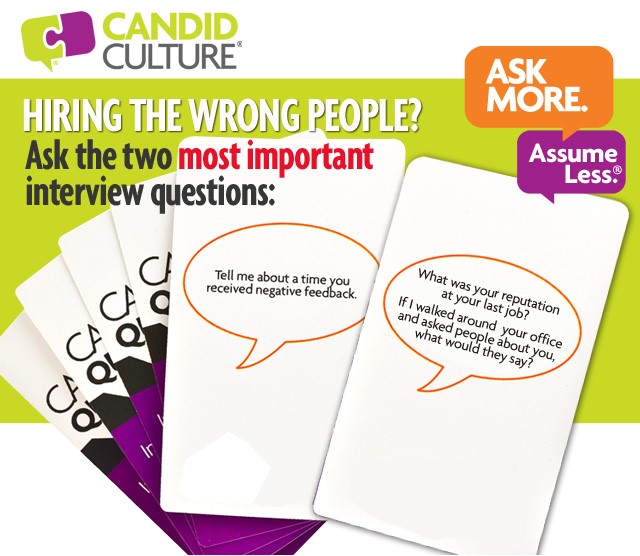
The most important job interview question for any role and level, in every organization: Tell me about a time you received negative feedback.
This is NOT the same question as tell me about a weakness. Or tell me about a time you made a mistake at work. Those are also important job interview questions to ask. But they’re not the most important question.
Let’s assume everyone you interview is age sixteen and older. Unless your candidates live in a cave, never speaking to anyone, it’s not possible to arrive at age 16 without having received negative feedback. The feedback can come from a friend, teacher, or parent. It doesn’t need to be work-related.
The point of the question is to discover whether the candidate is open to feedback. People who are not open to feedback are extraordinarily difficult to work with. They aren’t coachable. Any type of feedback they receive will result in resistance and defensiveness.
Employees who aren’t open to feedback won’t change or improve their behavior, regardless of how effective a manager is. Instead of listening to feedback and taking corrective action, employees who are not open to feedback will tell managers why s/he is wrong.
Everyone you interview has received negative feedback at some point. The question is whether or not candidates were open enough to listen to the feedback. People who aren’t open to feedback won’t be able to answer your question.
If candidates can’t tell you about a time they received negative feedback, ask a follow-up question. Your job as the interviewer is to give candidates every possible opportunity to be successful. If you don’t get the answer you’re looking for, ask the interview question in two different ways, until you’re certain the candidate can’t or won’t answer the question.
If candidates can’t tell you about a time they received negative feedback, ask what their reputation is at their current job or was at a previous job. Candidates probably won’t be able to answer this question either. Most people don’t know their reputation at work.
Even if a candidate doesn’t know with certainty his reputation at work, the answer he provides will give you a sense of how self-aware he is. People who are self-aware are more open to feedback and are easier to coach and manage than people who are not self-aware.
I really do eliminate candidates who demonstrate that they aren’t open to feedback –whether I’m hiring for Candid Culture or for one of my clients. I don’t care how credentialed or experienced the candidate is.
Posted under Uncategorized on January 13, 2020 by Shari Harley. 2 Comments
My four-year-old son and I were waiting for a flight, playing in one of those airport, kids’ play areas, when he spit on a play structure. I’m not sure why he did that. I’d never seen him do it before, and, needless to say, it was gross. There was a mom sitting nearby who had been loudly and firmly reprimanding her kids for not listening well, etc. etc., so I felt the need to do the same. I reprimanded my son more loudly than I needed to.
Even in the moment, I knew the message wasn’t for him, it was for the parents nearby. I wanted them to know that I was taking action. My son’s reaction wasn’t what I expected, he said in an embarrassed tone, “Everyone is looking at me.” I helped him wipe down the play structure with the anti-bacterial wipes that all tightly-wound parents carry and hurried him out of the play area. The lesson of the day was really for me. Correct quietly and privately, saying only what needs to be said to get the desired actions.
I wish I’d whispered in his ear that spitting on play equipment is unsanitary, given him a chance to clean the equipment, and left.
Speak quietly so no one else could hear. Don’t over-talk or over scold. Let the kid save face. The other parents didn’t need to know how I handled it. It’s none of their business.
The purpose of feedback isn’t to teach people a lesson, it’s to elicit certain behavior. At work, we call these behaviors “performance”. Talking to kids is just like talking with adults. People are people. We have the same needs whether we’re four or forty.
Below are six strategies for giving helpful and succinct upgrade
feedback:
Write down your message. Save it as a draft. Re-read it later, when you’re not emotional, then cut the words in half. Shorter is better.
Remove emotion. Examples are helpful, emotion is not. Emotion: You embarrassed me. Example: You raised your voice at me in front of others.
Remove judgments. Vague words are judgmental. Judgment: Your behavior was unacceptable. Specific: You rolled your eyes at a coworker.
When you can deliver your message in about a minute, without emotion or judgment, you’re ready to speak.
Deliver all upgrade feedback in a private setting, behind a closed door.
Then, in the spirit of the Disney film Frozen, let it go. When the conversation is over, it’s over. Don’t stay angry or remind the person of the situation. If the behavior is repeated, discuss it then.
Be a feedback minimalist. Say only what you need to. Deliver messages privately. Protect the ego, which is fragile. Let people save face.
Many year-end performance reviews include whatever the manager and direct report can remember happening during the last six to twelve weeks of the year. For the most part, managers and direct reports sit in front of blank performance appraisals and self-appraisal forms and try to remember everything that happened during the year. The result: A vague, incomplete performance review that leaves employees feeling disappointed, if not discounted.
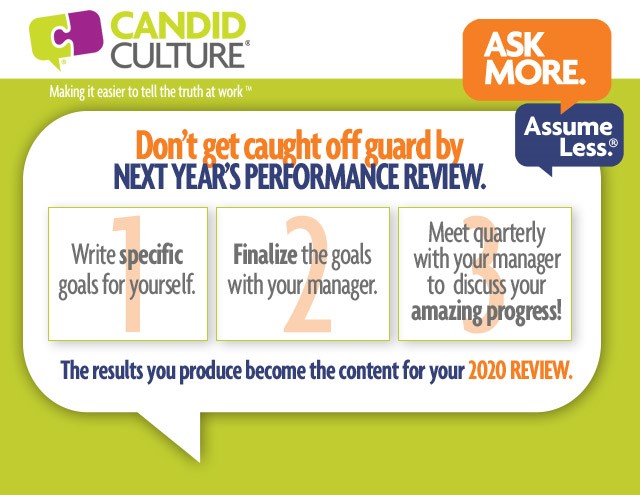
If you were disappointed by your performance review this year, don’t let it happen again next year. Take charge of your career by writing your own goals.
One of the first companies I worked for did the goal process so well, I learned early in my career how powerful well-written goals could be. Each employee set five to seven goals. Experienced employees wrote their own goals and then discussed those goals with their manager. Less experienced employees wrote their goals with their manager. Managers wrote goals for inexperienced employees. The goals were so specific and clear that there could be no debate at the end of the year whether or not the goal had been achieved. It was obvious. Either employees had done what they said they would, or they hadn’t. This made writing performance appraisals very easy. Very little on the appraisal was subjective. And this gave employees a feeling of control over their year and performance.
It’s great if you work for an organization or manager who works with you to write goals. If you don’t, write your own goals and present them to your manager for discussion and approval. Managers will be impressed you took the initiative to write goals and will be thankful for the work it takes off of them.
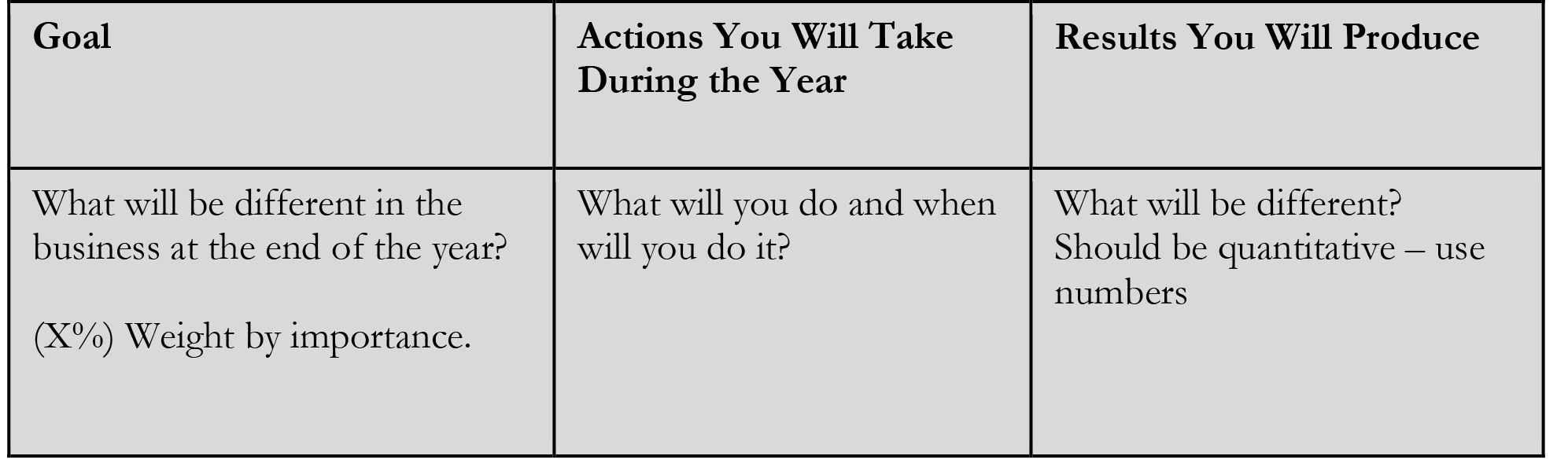
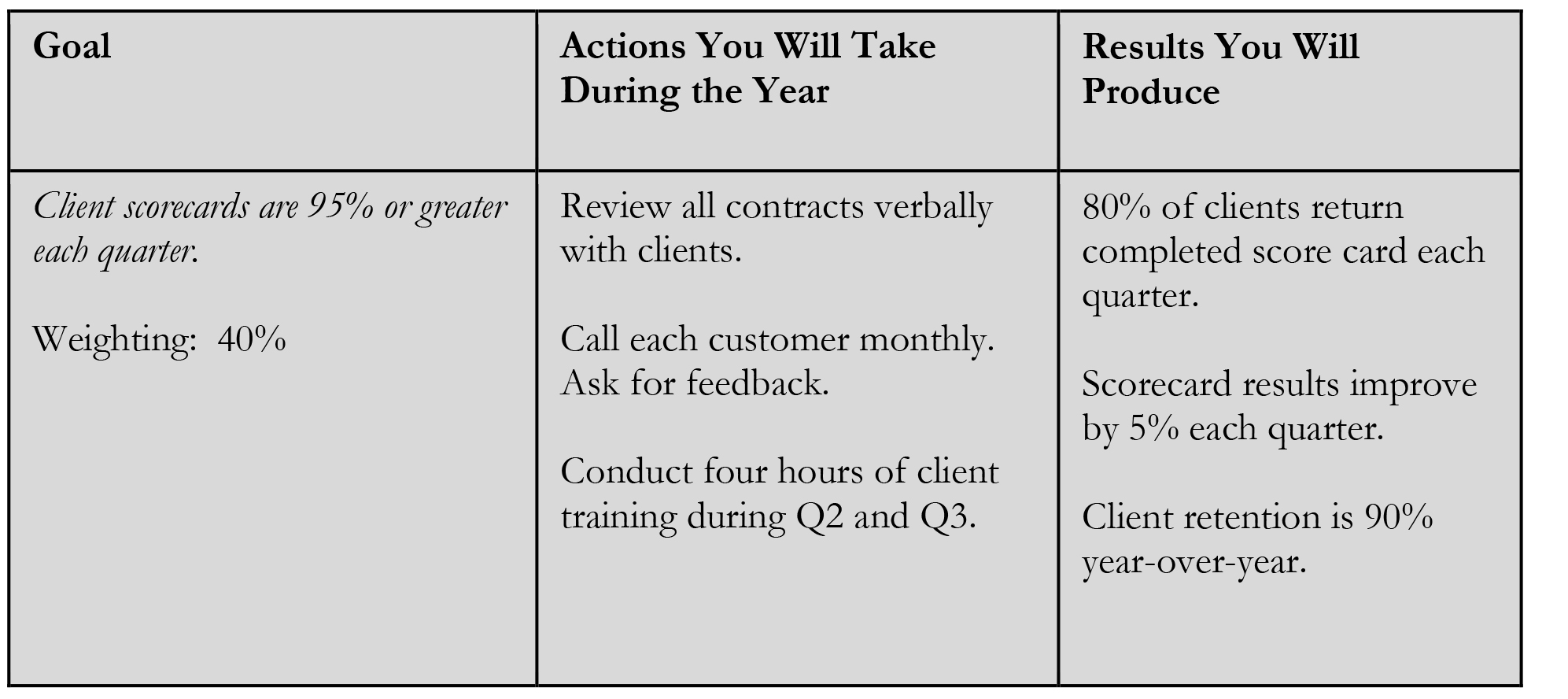
Goals should be simple and clear. It must be obvious whether you achieved the goal or not. There should be little if any room for debate. Sample goals are below.
Desired Outcome (goal):
• Improve client feedback – too vague • Get better-written reviews from clients – better • 80% of clients respond to surveys and respond with an average rating of 4.5 or above – best
Actions you will take to achieve the goal:
• Ask clients for feedback throughout project — too vague • Ask clients for feedback weekly – better • Visit client site weekly. Talk with site manager. Ask for feedback — best
Goal template:
Completed sample goal:
How to approach your manager with written goals:
Try using this language with your manager: “I want to be sure I’m working on the things that are most important to you and the organization. I’ve written some goals for 2020 to ensure I’m focused on the right things. Can we review the goals and I’ll edit them based on your input? And what do you think of using the agreed-upon goals to measure my performance in 2020?”
You have nothing to lose by writing goals and presenting them to your manager. You will gain respect from your manager, clarity of your 2020 priorities, and more control of your year-end-performance review. Give it a try, and let me know how it goes.
Sign Up
Career tips you won't get elsewhere. Sign up to get a free tip card.