Employees are often afraid of the most senior people in organizations, simply because of their titles. The better the title, the scarier people are. And if employees are scared of organizational leaders, they’re not going to give those leaders negative feedback. The most senior people in an organization get the least information of anyone.
No one likes to be told that he is wrong. Negative feedback tells the person he did something wrong. But there is more than one way to give feedback. Asking questions can be equally as effective as giving direct feedback.
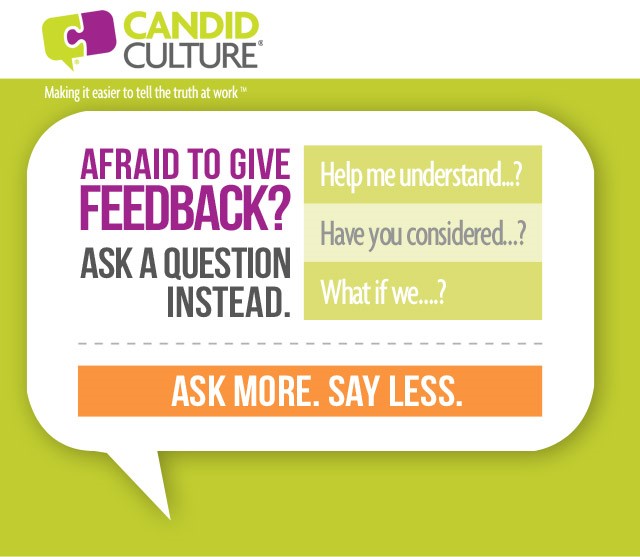
If you want to give a senior person negative feedback, but you’re afraid of the consequences, manage up by asking more and saying less.
Here are some ways to manage up by asking questions:
Rather than saying, “I disagree, I think you’re wrong, or this is a mistake,” consider managing up by asking questions like:
We’ve chosen to invest a lot in this software. I wasn’t here when the software was chosen. What’s the history of this initiative?
What were the criteria for selection?
What are you concerned about?
What are you satisfied with?
What else have we tried?
What are your thoughts about…?
What if we tried…?
Asking questions gets the person involved in a discussion, during which you can eventually express your point of view. When you ask questions, you say very little, and definitely don’t call the person’s decision-making into question.
Human beings are wired for survival. Receiving negative feedback kicks the need to defend oneself into gear, hence why people become defensive when they receive negative feedback. Negative feedback calls survival into question. If you don’t want people to become defensive, don’t require them to defend themselves. A discussion, during which you ask questions, is much less threatening than overtly disagreeing with someone’s point of view.
Asking questions takes more time and more patience than giving direct feedback. But it also takes less courage, and the quality of your relationship doesn’t have to be as good. You need a pretty good relationship to give direct feedback. If you don’t have that relationship, manage up by asking questions instead of being so direct.
If you do choose to ask questions, watch your tone. If you can safely add the words “you dummy” to a question, you aren’t really asking a question, you’re giving feedback, which is likely to evoke the defensive response you’re seeking to avoid.
It’s important to be able to express your point-of-view at work. Staying in a job or organization in which you can’t speak up, doesn’t feel great and doesn’t leverage the best of what you have to offer. But if you’re concerned about giving direct feedback, manage up by asking questions. Say less. Ask more.
Changing a damaged reputation is challenging. My number one piece of advice: Be very overt about the changes you’re making.
Here are eight steps to discover and repair your professional reputation:
Step one to repair your professional reputation: Make a list of people who observe your performance and who can impact your career. If you’re not sure who these people are, ask your boss and peers. They know.
Step two to repair your professional reputation: Ask for specific, candid feedback at least twice a year, and tell people why you’re asking for the information.
Asking, “How am I doing?” is not specific. Instead, say something like, “I want to learn more about my reputation in the office and want to eliminate my blind spots. I’d be grateful for any input you can provide on my reputation and what people say about me when I’m not there.” Then schedule a specific time in the near future to discuss the feedback, so you don’t catch people off guard. You’ll get better feedback when people have had a chance to observe your behavior and think about what they’d like to say.
Step three to repair your professional reputation: Listen to the feedback and no matter how hard the feedback is to hear, say, “Thank you for telling me that.” Don’t defend yourself. Instead, leave the conversation, think about what the person has said, and then go back to him a few days later with questions, if you need to.
Step four to repair your professional reputation: If the feedback you receive doesn’t feel accurate, tell others who you trust about the feedback and ask them to provide input.
Step five to repair your professional reputation: Sit with the feedback before taking action. Let yourself be emotional. You might feel angry, sad, or betrayed. All of those are normal responses to feedback.
Step six to repair your professional reputation: Take action. Make changes that feedback providers suggested.
Step seven to repair your professional reputation: Tell people who provided input and who are impacted by your behavior about the changes you’ve made. You could say, “I recently received feedback that I’m not careful enough and that my work often has errors. I’m really working on this. Will you pay attention to the accuracy of what you receive from me and let me know if you see changes? I’d really appreciate your input.”
Step seven is very important and something people rarely do. Don’t assume people will notice the changes you’ve made. Instead, assume they won’t. Without being told what to look for, the decisions people have already made about you will supersede changes you’ve made. It takes a lot of effort to see people differently. Validating what we already know and think about someone is much easier and more likely than noticing changes.
Step eight to repair your professional reputation: Continue to ask for feedback. Receiving feedback is not a one-time event. It’s an ongoing process. Don’t ask for feedback weekly, rather check in once a quarter, tell people the changes you’ve made, and ask for specific input.
You can change your reputation if you want to. Doing so will require courage, openness, and effort on your part. Work on one or two things at a time, not ten. And then reward yourself for the changes you’ve made with a pint of Ben & Jerry’s because too often we’re hard on ourselves and forget to celebrate wins.
When leaving a job, the late nights and all-consuming projects quickly become history. What we take with us, are the people we worked with and the friendships we formed.
Much of what contributes to job satisfaction or dissatisfaction are our workplace relationships. “I just can’t work with this person. We don’t see eye to eye. We can’t get along,” are the types of challenges that often motivate people to job hunt.
I’m a believer that suffering at work is optional. You deserve and can have a job doing work you love, with people you enjoy. If your workplace relationships are strained, there are several things you can do to improve them.
Four steps to improve workplace relationships:
1. Make a list of the people you need a good working relationship with.
2. If you’re not sure who you need to work well with, ask your boss, peers, and internal customers. They know.
3. Ensure you know what your internal customers are expecting from you. Ask what a good job looks like, how they’re evaluating your results, and how they like to communicate.
4. Tell people you’re struggling with, “I think we both know this relationship is strained. I’d really like a good working relationship with you. Would you be willing to have coffee or lunch with me, and we can talk about what has gone on, and perhaps start in a different way?”
Fixing a broken relationship needs to be a phone or in-person conversation. Sending someone an email, telling him you want a good working relationship, won’t do the job.
Damaged workplace relationships can be fixed. We often don’t know what the other person is really upset about. We may think we know or assume, but may be surprised when we have the conversation.
You spend way too much time at work not to enjoy the people you work with. Don’t assume strained relationships will remain strained. Identify who is most important to your success, tell those people you want a good working relationship, and then ask questions to learn what they are expecting from you. Good relationships don’t just happen.
You have more influence over your relationships than you may think. Don’t accept the status quo. Suffering is optional.
Click here to take advantage of our holiday special. Get everyone in your organization a copy of How to Say Anything to Anyone, and get more peace at work. Buy five books. Get one free. No limit on quantities.
Sign Up
Career tips you won't get elsewhere. Sign up to get a free tip card.