Archive for February, 2019
At the end of presentations, attendees often approach me and say something like, “People tell me my communication style is really direct and that it can be off putting. I don’t know what to do about this.” Or they say, “People say I’m really quiet and hard to read. They have a difficult time getting to know me.” 
If you’ve been given the same feedback repeatedly, or know you create a first impression that may be challenging to others, set expectations and tell people about your communication style when you begin working with them. Don’t wait until they feel offended, confused, or frustrated. Simply tell people when you meet them, “I’ve been told that I’m too direct and how I provide feedback can be off putting. Anything I say is to be helpful. If I ever offend you or provide too much information, I hope you’ll tell me.” Or you could say something like, “I’m told that I’m quiet and it’s hard to get to know me. I’m more open than I may appear. If you want to know anything about me, feel free to ask.”
People will make decisions about and judge you. There is nothing you can do about this. But you can practice what I call, ‘get there first.’ Set people’s expectations about your communication style and what you’re like to work with, and then ask people to speak freely when they aren’t getting something they need.
The root of frustration and upset is violated expectations. People may not be aware of their expectations of you or be able to articulate them, but if they didn’t have certain expectations, they wouldn’t be upset when you acted differently than how they (possibly unconsciously) expected.
I’m a proponent of anticipating challenges and talking about them before problems arise. If you know something about your behavior is off putting to others, why not be upfront about it.
When people interview to work for me, I set clear expectations about my communication style and what I’m like to work with. I tell them all the things I think they’ll like about working for me and all the things I suspect they won’t. I tell them the feedback I’ve received from past employees and things I’m working alter. People often nod their heads and say, “no problem,” which, of course, may not be true. They won’t know how my style will impact them until they begin working with me. But when I do the things I warned them would likely be annoying, we can more easily talk about those behaviors, than if I had said nothing.
Talk about your communication style when projects and relationships begin. Replace judgment and damaged relationships with dialogue.

Most of what comes through our phones is probably not all that compelling – emails we don’t really want to read, advertisements for things we won’t buy, and social media updates we don’t really care about. And yet those little devices are so seductive. It’s hard not to check your email, texts, and social media updates constantly. Being so connected electronically and thus so continuously distracted has its benefits but it also has real costs. 
Most of you know I have a small child and I’m committed to being a present and involved mom. I spend a lot of time with my son. But the best times are when I leave my phone behind. Without my phone I’m fully present with him, in the moment, enjoying him. When I have my phone, I’m distracted, often stressed, and typically torn. Can’t I read this email and reply quickly? What’s the harm? It will only take a second.
And each time I take a minute to read my email, I’m gone. I’m focused on my phone. And then I feel guilty and sad for not being as engaged as I want to be. Then I recommit to being fully present. And then read my email again. It’s a vicious cycle.
There is a huge cost to being distracted most of the time. Our relationships suffer. Car fatalities have increased tenfold. People are consistently tired.
Every productivity expert will tell you to check your messages three times a day, respond, and to not be constantly reading email. It’s fantastic advice. And I suspect no one, including productivity experts, follows it. It’s just too hard. We’re lured by our phones, tablets and laptops. Not checking them regularly makes us antsy, uncomfortable, and nervous.
What would happen if we set defined periods of time for each thing we did? I.e., Spend from 1:00 pm – 4:00 pm with your children. At 4:00 p.m., check your phone. Take the weekend off and check your messages at 7:00 p.m. on Sunday. Work on a project without interruption from 9:00 a.m. to 10:00 a.m. I suspect we’d get way more done and feel less stressed. But we have to give ourselves permission to put the phone away.
Here are three ways to be more focused and productive, and hopefully, happy:
1. Schedule work and personal activities for realistic, defined periods of time, and stick to them.
2. Agree on no cell phones or other electronics during personal meals and outings. I like the game people are playing in restaurants by putting cell phones face down in a pile on the table. The first person who touches their cell phone pays the entire bill.
3. Agree on no cell phones during group or one-on-one meetings. Your meetings will be shorter, easier to manage, and more productive. Meeting attendees are dying to tell their peers to put away their phones. Strong facilitators who set and hold to this expectation earn others’ respect and get more done.
In a nut shell, give yourself permission to focus. Do one thing at a time for a short period of time. Allow similar chunks of time to read and reply to messages and read Facebook updates you don’t care about. Then put the phone down and walk away. Your family and friends miss you.
Want to improve your relationships? Read How to Say Anything to Anyone.
 Chances are, at some point in your career, you’ve worked with someone you wished would go away. Maybe the person repeatedly threw you under the bus, took credit for your work, or didn’t keep his commitments. And at some point, you wrote the person off, and have been merely tolerating him ever since.
Damaged relationships can be repaired, if you’re willing to do some work.
The first step in repairing a damaged relationship is to decide that you really want to do so. Managing conflict in the workplace isn’t easy. It will take effort and will likely be uncomfortable. So before you take action, decide if you really want to work on the relationship.
How to know if you should even try resolving conflict in the workplace: Ask yourself how much you need the relationship. This probably sounds political, and it is. If you work on projects together, need to give or receive information, or have to work together regularly, then it’s likely worth working on the relationship. If you don’t need to work together regularly, then perhaps don’t work on the relationship.
If you decide to attempt to strengthen a relationship, plan what you’re going to say. Never trust the first thing that comes out of your mouth during a difficult conversation.
Step one for resolving conflict in the workplace: Like any feedback conversation, start with the end in mind. Consider what you want to have happen as a result of the conversation.
Step two for resolving conflict in the workplace: Plan what you’re going to say by taking notes and practicing out loud. What you say in your head is usually not what comes out of your mouth.
Step three for resolving conflict in the workplace: Ask the person for time on his calendar. People don’t like surprises. You’ll have a better outcome if the person has blocked time to talk with you. Have the conversation in-person whenever possible. If you can’t speak in-person, talk on the phone. Do not attempt to fix your relationship via email. 1. Email is wimpy. 2. It will not work.
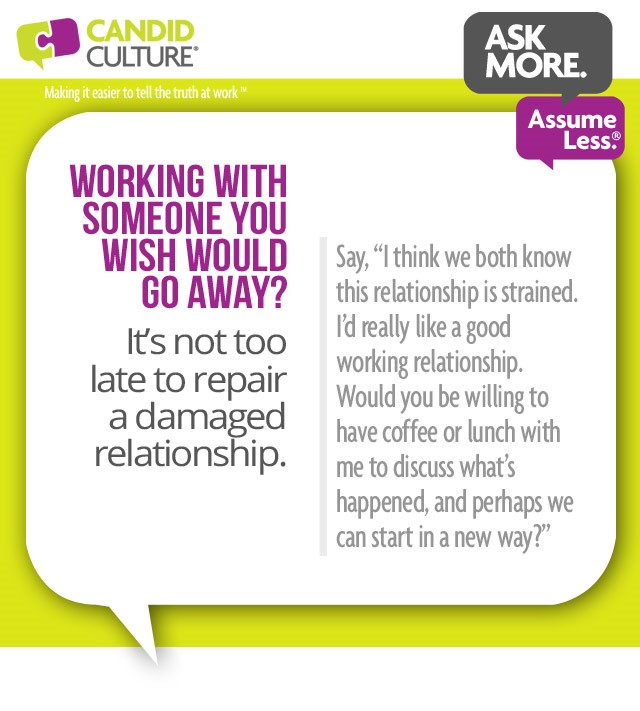
Tell the person, “Our relationship is strained. I don’t think I’m saying anything we’re not both aware of. I’d really like a good working relationship. Would you be willing to have coffee or lunch with me, and we can talk about what has happened and perhaps start in a new way?”
Step four for resolving conflict in the workplace: Ask for a meeting to work on the relationship up to three times. If, after the third time, the person hasn’t made time, stop asking. You can’t work with someone who won’t work with you. If the person doesn’t make time to meet, be polite, professional, and inclusive, but stop trying to nurture the relationship. Inclusive means: cc’ing him on necessary emails, inviting him to appropriate meetings, and providing necessary data.
Step five for resolving conflict in the workplace: If the person makes time to meet, speak candidly, be yourself, and be vulnerable. I don’t mean set yourself up to be killed. I do mean be authentic.
How to Manage Difficult Conversations:
- Tell the person what you want.
- Ask for feedback about how you’ve damaged the relationship.
- Listen to what you hear, and resist the urge to defend yourself.
- Ask for permission to tell him how he’s damaged the relationship.
- Give small amounts of feedback, with a few specific examples.
- Make agreements of what each of you will do differently in the future.
- Thank the person for the conversation and schedule another meeting.
Step six for resolving conflict in the workplace: Build in follow-up. Most people have one conversation and expect things to be fixed, forever. Relationships don’t work that way. Agree to meet monthly, for the first few months, until you’ve rebuilt trust and learned how to communicate and work together. During the monthly meetings, give each other permission to give candid feedback about how you’re working together. I call these Relationship Inventory Meetings™.
During monthly Relationship Inventory Meetings™ ask:
- What’s working about how we work together?
- What’s not working?
- What working agreements did we keep?
- What working agreements did we break?
- Which working agreements are helpful?
- What working agreements need to change?
You might be thinking, “I don’t like this person. I don’t want to work with him. And I definitely don’t want to have these uncomfortable conversations.”
- If the nature of your relationship is impacting your ability to do your job, your professional reputation, or your happiness, all of those consequences are far worse and more long-lasting than any conversation will be.
- The conversations won’t be as bad as you think. No one will tell you anything you can’t handle, because for the most part, they’re afraid of your reaction and they know they’ll be next.
Conflict in the workplace and damaged relationships keep people up at night, reduce job satisfaction, and often motivate people to leave jobs. If you’re experiencing any of these things, all of them are worse than any conversation will be. The anticipation of the conversation is far worse than the conversation itself.
- Decide if you want to strengthen the relationship.
- Plan the conversation.
- Ask for time to meet.
- Have the conversation. Speak honestly, but responsibly.
- Plan to have another conversation before ending this conversation.
- Congratulate yourself for being courageous and picking happiness over anxiety and frustration. Suffering is optional.