Archive for January, 2019

Last week I had some really, really terrible moments. Our office WIFI went out during a webinar. Not even the phone worked. I missed the deadline to speak at a conference that’s almost in my backyard and an event that I really want to participate in, I double booked myself and had to cancel a few appointments, and I hit my son’s teacher’s car, leaving her side mirror dangling like a Christmas tree ornament.
Some days are going to be terrible. On those terrible days, it’s so easy to feel like we’re screwing things up and that we are indeed a screw up. Instead, give yourself a break. The thing to know and remember, in the moment, is that you’re not terrible. You’re a human being, doing the best you can.
Here is a list of ways to give yourself a break and as a result, do your best work. I’ll admit, I’m working on doing these things too. Every day I’m annoyed that I’m not perfect. I want to be a combination of Mary Poppins, Super Woman, and Kate Middleton, but I’m not. I’m a business owner, working mom, who hasn’t seen the inside of a gym since my son was born, who recommits to better self-care every day, only to break that commitment in eleven different ways by 10:00 am.
Here are Nine Way to Give Yourself a Break:
- Set realistic deadlines so you’re not constantly running against time and overestimate how long everything will take to do. Set yourself up to win.
- Before agreeing to a new commitment, ask yourself, “Do I really want to do this?” Try not to commit yourself to things you know, at your core, you don’t want to do. You’ll just resent that commitment when it rolls around and aren’t likely to do your best work.
- Turn off the alerts on your phone and laptop when you’re working. You’ll be more focused and get more work done.
- Ask for help. If there is someone who can help with a project (and it won’t make you look bad) let them.
- Go to bed earlier than you think you need to and leave your phone in the kitchen.
- Take a day off. Your company offers vacation time for a reason. People do better work when they take time to relax and rejuvenate.
- Take time for yourself, even if it’s 30 minutes.
- Drink more water and make sure you eat breakfast and lunch. I’m starting to sound like your mom.
- Say “thank you” more and “I’m sorry” less. “Thank you for letting me know” is more empowering than “I’m sorry I missed that.” I’m guilty of apologizing for everything, so much so that one of my employees and I play a game that whoever says she’s sorry first has to throw a dollar in a communal collection pot. Whatever you put attention on will improve.
-
Some of these things are business focused, some are personal. You bring yourself – your whole self – to work. It’s why you’re good at what you do. People want to work with real people. And real people over commit, make mistakes, and spend too much time on Facebook at 11:30 pm. Give yourself a break.
 Several years ago I hired a vendor that wasn’t a good fit. Try as we might to work together, we didn’t communicate well. Everything was a struggle. After a frustrating few weeks, the owner of the business offered to refund my money and amicably part ways. His company had already done work on our behalf and I didn’t want to lose momentum. I turned him down. That was a mistake. When a small business owner, who needs your business (money), tells you to go elsewhere, listen. We parted ways a few months later in a much more costly and less amicable way.
You don’t want to work with people who don’t want to work with you. The same is true for friends and romantic relationships. Don’t chase people. If they don’t want you, move on. There are lots of other people who will see your value.
There are differing schools of thought on whether or not you should try to retain unhappy employees who quit. I’d be interested in seeing statistics on how long employees who quit but are then retained, stay with an organization and how well they perform. I’d let them go. Again, you don’t want people who don’t want you.
The challenge is that most people are afraid to speak up in organizations and relationships (of all kinds) when they’re unhappy. Unhappy employees typically quit versus make requests and give feedback.
The antidote is to create a culture in which employees, vendors, and customers openly make requests and talk about what is and isn’t working. Create a climate of candor in which feedback is exchanged regularly versus just during exit interviews, which is too late.
How to know when to cut bait with unhappy employees and vendors:
- You’ve had several open discussions and can’t meet each others’ needs. If you don’t have a job the employee wants, that’s a good reason to part ways.
- It’s not a good culture fit. You talk and talk but don’t communicate. Issues don’t get resolved. Frustration is the norm. This is also a good reason to end a working (or personal) relationship.
Five steps to create a more candid culture:
- Discuss employees’, customers’, and vendors’ needs and requests at the beginning of working relationships. Agree upon what success and a good job looks like. Ask lots and lots of questions, and listen closely to the answers.
- Ask for feedback regularly. Conduct a weekly plus/delta (a discussion of what is and isn’t working) during which all parties are invited and expected to speak freely. The more you have these discussions, the easier they will be and the more candid people will become.
- Address challenges as they come up.
- Discuss challenges that can’t be fixed.
- If a relationship isn’t working, end it sooner rather than later. Be slow to hire and quick to fire.
There are lots of talented vendors and employees. Find employees and suppliers who are easy to work with (for you) and who can meet your needs, and vice versa. If you can’t meet each others’ needs or the relationship is a constant struggle, those are good reasons to move on. Don’t chase.

Giving feedback upwards is hard. Giving feedback downward is hard. Giving feedback to peers can be the hardest of all. We work closely with our peers. They’re often our friends. And still, we need to be able to speak freely when our coworkers violate our expectations.
The key to being able to give peers feedback (to give anyone feedback) is to agree that doing so is not only acceptable but expected. Before agreeing to give and receive feedback, peers need to set clear expectations of how they’ll work together and treat each other.
Telling people how you want them to behave is always easier than correcting a behavior. But it often just doesn’t occur to us to tell our peers what we want and need from them. We’re busy. They’re busy. And don’t they already know what courteous workplace behavior looks like? Return all emails within a day or two, keep your workspace quiet so others can focus, turn off your personal cell phone alerts at work, take personal calls away from your desk, and don’t wear anything scented at work. Aren’t all of these behaviors fairly obvious? Do I really need to people these are my expectations? Uh….yes, you do.
If you don’t want employees dumping these challenges at their managers’ doors, help employees talk to each other.
Here are seven steps to help people who work closely together set expectations and hold each other accountable:
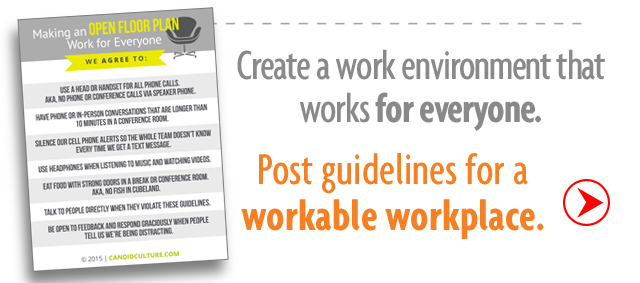
- Schedule a meeting during which people working together can discuss the working environment they need to be satisfied and productive. Then facilitate a discussion during which the group creates 5 – 7 behavior guidelines each person agrees to follow.
- Post the list of agreed-upon behaviors on a poster that is large enough to be read from any place in the work environment, or virtually. Leave the guidelines posted indefinitely.
- Give each person in the group permission to talk to individuals who violate the guidelines. This is very, very important. For the most part, employees won’t tell a peer s/he is missing deadlines, gossiping, talking too loudly, has too many visitors at her desk, listens to music or videos without headphones, or is distracted with personal calls/texts. People will suffer in silence and avoid the offender rather than speak up about the behaviors that frustrate them.
Ask the group to grant each other permission to speak up when guidelines are violated. Giving each other permission to speak up will make future conversations possible – difficult but possible. Without permission and these agreed-upon behaviors in place, people will suffer in silence or talk about each other, not to each other.
- Ask everyone in the work group to take feedback graciously, responding with “thank you for telling me,” rather than with defensiveness.
- Two weeks after making the list of guidelines, get the group together to review the list and make any necessary changes to it. Discuss behaviors that were omitted, aren’t realistic, and are realistic but aren’t being followed.
- Then follow up by facilitating a monthly conversation during which group members give honest feedback about which guidelines are being followed and which are not, and problem solve as a group. These conversations aren’t a chance to embarrass or call people out in front of a large group. If one person is violating a guideline, that conversation should happen individually. Group conversations keep the lines of communication open – which is essential to making working with others work.
- You will need a strong facilitator for the group discussions. The facilitator must tease out people’s thoughts, while making sure no one gets blasted in front of the group. Don’t let concerns, that you know exist, be brushed under the rug. Group members must openly and regularly discuss what is and isn’t working about their work environment, or frustrations will build, and unhappiness and dissension will ensue.
It’s not too late to put these practices in place, even with a group that has been working together for a long time. Just schedule the conversation and explain why you’re having it. People will be relieved and grateful.
 Tis’ the season to over commit.
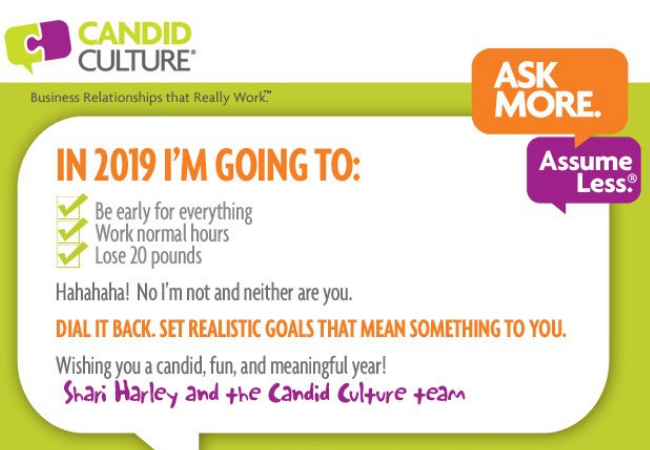
It’s the start of a new year, when many of us begin thinking about New Year’s Resolutions. We vow to lose 20 pounds, save 10% of our income, get promoted at work, take an exotic vacation, be a better partner, etc. etc. Also known as “how to set yourself up to fail” in five easy steps. The reality is, we might do one or two of those things, if that.
Why not set yourself up to win instead? Instead of setting huge goals that are unlikely to happen, why not set more realistic goals that you can and will likely do?
If you manage people, perhaps you’re thinking about how you can be a better manager in 2019. Or you may be thinking about how you can accelerate your career. You may decide to meet with your employees more frequently, or ask your boss for more feedback, or ask for new and different work. You may think that doing these things will help you strengthen your relationships with your employees and your reputation, and advance your career. Doing any of these things might help you strengthen your business relationships and help you get ahead. But they might not, if those things are not important to your employees, your boss and/or your organization.
In 2019, put energy and resources into the things that truly matter to the people you work with, rather than the things you think they think are important. And the only way to know what the people around you really want and need, is to ask them. Don’t assume you know what is important to your boss, direct reports and coworkers, ask them. Ask more. Assume less.
There are countless examples of managers who went to great lengths to make their employees happy. They gave bonuses, cool projects, and time off. And their employees quit anyway. Or, trying to make a manager happy, employees stayed late, beat deadlines, and took on additional work, and still got a mediocre review. Rather than doing what you think others want, ask them!
How about this for a New Year’s resolution — ask your boss, direct reports and key customers these questions as you begin the New Year:
- What’s the most important work I did in the past 12 months?
- What’s an area, in 2018, I exceeded your expectations?
- How did I let you down?
- If I could do one thing differently this year that would make the biggest difference for you and/or the organization, what would it be?
- Where do you think I should focus my energy in 2019?
It may be intimidating to ask for feedback from your peers and direct reports. But you won’t know what to do more, better, or differently if you don’t ask.
The right answer to feedback is always “thank you,” regardless of what you really want to say. Saying “thank you” makes you a safe person to whom to tell the truth and makes it more likely you’ll get more information in the future. So bite your tongue and respond to all feedback with, “Thank you for telling me that. I’m going to think about what you’ve said and may come back to you to discuss further.” They’ll be relieved, and you’ll strengthen your professional image.
It’s easy to assume what others want and are expecting from us. The problem is, we’re not always correct. Thus we expend energy doing things that others don’t find valuable or important, otherwise known as wasting time and resources.
Your time and budget dollars are valuable. Use your time and money for things that others actually want, versus what you think they want. In 2019, dial it back. Make realistic, attainable goals that are aligned with what the people around want and need. And in return, you too will get what you want and need.