Archive for October, 2018
Most of us grapple with whether or not we should give feedback when someone else does or says something frustrating.
Here are a few criteria to help you decide whether or not you should give feedback or say nothing:
- Do you have a relationship with the person? Do you know each other well enough to share your opinion? Aka, have you earned the right?
- Has the other person requested your opinion? Unsolicited feedback often goes on deaf ears.
- If the other person has not requested your opinion, does he appear open to hearing feedback?
- Are you trying to make a difference for the other person or just make him look or feel badly?
- Do you want to strengthen the relationship?
Before you give feedback, do something I call, ‘check your motives at the door.’ If your motives are pure – you want to strengthen the person or the relationship, and you have a good enough relationship that you’ve earned the right to speak up — then do it.
People are more open to feedback when they trust our motives. If we have a good relationship with the person and he knows we’re speaking up to make a difference for him or for the relationship, you’ll be able to say way more than if your motives are questionable – aka you want to be right.
Saying no is hard. We don’t want to disappoint or let people down. And yet, you can’t say yes to everything. You can say no and still sound like a responsible, easy-to-work-with, accommodating professional.
Here are four techniques for how to say no:
Thank the person for asking. “Thank you for asking me.”
1. Saying “thank you” acknowledges the other person and buys you time to think about his request.
2. Tell the person you need some time to think about his request. Ask, “Can I have a few days to think about it? I’ll get back to you by Friday.”
You don’t need to reply in the moment. I often regret things I agree to without thinking through the request thoroughly.
3. Consider what you really want and are willing to do. It’s much worse to over commit and under deliver than to simply say no or renegotiate requests.
4. Get back to the person in a timely way (when you said you would) and tell him what you’re willing to do.
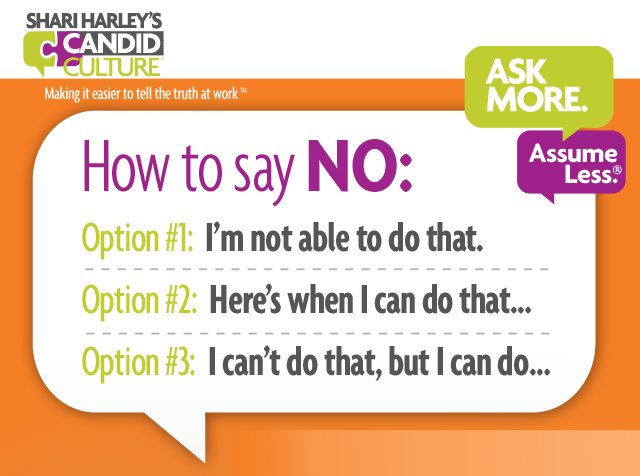
How to Say No Option One: Simply say no.
Example: “I really appreciate you asking me to write the proposal for the __________ RFP. I’m not able to do that. Can I recommend someone else who has the expertise and will do a great job?”
Don’t give a bunch of reasons for saying no. People aren’t interested in why we can or can’t do something. They just want to know if we will do it.
How to Say No Option Two: Agree and negotiate the time frame.
Example: “I’d be happy to do that. I can’t do it before the last week of the month. Would that work for you?” If the answer is no, negotiate further. Ask, “When do you really need it? I can certainly do pieces by then, but not the whole thing. Given that I can’t meet your timeline, who else can work on this in tandem or instead of me?”
How to Say No Option Three: Say no to the request but say what you can do.
Example: “I can’t do _______. But I can do ________. How would that work?”
A review of how to say no:
- Acknowledge the request by getting back to the requestor within 24 hours.
- Give yourself time to think about and respond to requests.
- Negotiate requests to your and the requestor’s satisfaction.
- Agree on what you can and are willing to do.
- Keep your commitments.
Saying no is always hard. But it’s always better to say no than to ignore requests, or to say yes and do nothing.

I had a colleague at my last job, prior to starting Candid Culture, who was a peer and a friend. We were at a similar level and would periodically sit in one of our offices, with the door closed, engaging in office gossip, talking about the bad decisions our company’s senior leaders made. One day I realized that these conversations were exhausting to me. They were negative and didn’t make me feel better. In fact, they made me feel worse.
Some people distinguish between office gossip and venting, asserting that venting is cathartic and makes people feel better. It doesn’t. Venting and office gossip are one in the same and both will make you tired and feel worse about your job and organization.
I’ll use an analogy I read in one of Deepak Chopra’s books. When you put a plant in the closet and don’t give it light or water, it withers and dies. When you put a plant in the sunlight and water it, it grows. And the same is true for people. Wherever you put your attention will get bigger and stronger. Whatever you deprive attention will become smaller.
In addition to draining you of energy and ensuring you focus on the things that frustrate you, office gossip kills organizations’ cultures. If employees can’t trust that their peers won’t talk about them when they’re not there, there is no trust in the organization. And this lack of trust feels terrible. It makes employees nervous and paranoid. A lack of trust sucks the enjoyment out of working because we feel we have to continuously watch our back.
Office gossip isn’t going anywhere. It’s a human phenomenon and is here to stay. But you can reduce office gossip.
Here are five steps to reduce the office gossip in your workplace:
Reducing gossip in the workplace step one: Address the gossip head on.
Tell your employees, “I’ve been hearing a lot of gossip, which is not good for our culture.”
Reducing gossip in the workplace step two: Hold regular town hall meetings, and give employees more information than you think you need to about initiatives, organizational changes, profitability, etc. Employees want to know how the organization is doing and what they can do to contribute. In the absence of knowledge, people make stuff up, not because they’re malicious, but because they have a need to know. Employees don’t have to fill in the gaps with office gossip when you inform them.
Reducing gossip in the workplace step three: Create a no-gossip-in-the-workplace policy.
Tell your employees, “We want people talking directly to each other, rather than about each other. As a result, we’re putting a no-gossip policy in place.”
Reducing gossip in the workplace step four: Draw attention to gossip.
Perhaps suggest, “Every time you hear gossip, wave two fingers in the air (or something else that’s equally visual).” This will draw attention to office gossip without calling anyone out.
Also, ask your peers and friends not to gossip with you. End conversations that contain gossip. This will be hard to do, but if everyone does it, it will become much easier.”
Reducing gossip in the workplace step five: Have an agreed-upon consequence for gossip.
Tell employees, “Every time we hear gossip in the workplace, the gossiper owes a dollar. Every quarter the gossipers will buy the office lunch from the office gossip jar.”
The keys to reducing office gossip are to draw attention to the gossip, have a consequence for gossiping, and over communicate so your employees don’t have to fill in the gaps themselves.
Venting and office gossip are the same. If you’re talking about someone else, unless you’re planning a conversation with a coworker or friend to address a challenge or problem, you’re gossiping. And talking about what frustrates you will only make you more frustrated.
My advice: Do something about the things you can impact and let the other stuff go. Talk about the things that matter to you. Resist the temptation to speak negatively about the people around you. And know that anyone who will gossip about someone to you, will also gossip about you.

Organizations are working hard at retaining employees. Employees are watching how their organization’s leaders and managers work, and often make career decisions based on the hours the most senior people keep. Not a recipe for retaining employees.
Many employees pay particular attention to how often managers and senior leaders take vacations and whether or not leaders attend meetings and respond to emails while they’re ‘off.’ Employees observe the late nights leaders and managers put in and the emails sent at 11:00 pm and on the weekends. I’ve heard lots of employees say, “If I need to work like my boss works to get ahead in this organization, I’m not interested.”

Managers, the key to retaining employees is to communicate expectations. If you’re available while you’re on vacation, but don’t expect your employees to do the same, set that expectation. If you send an email outside of regular business hours but don’t expect employees to respond until the next business day, tell them so. They don’t know. Many employees assume that if you email them at night, you expect a reply.
Instead of allowing employees to make assumptions about what managers do and don’t expect, set clear expectations. Be overt and clear. Tell employees, “I work most evenings and weekends, but don’t expect you to do so. And I work these hours because I enjoy it, not because I have to. If I email you outside of regular business hours, I am not expecting you to reply.” Retaining good employees begins during the interview process, when initial expectations are first set.
Managers, if you expect employees to check and respond to emails outside of regular business hours and to be available while on vacation, tell them. If working long hours is a criteria for promotion, set that expectation preferably during the interview process. It’s completely fine to expect long hours and for employees to be accessible outside of regular business hours. There is nothing wrong with either expectation. There is only a problem if employees don’t know that’s the expectation.
Employees, if your manager emails you outside of regular business hours and she doesn’t tell you whether or not she expects you to reply, ask. Simply say, “I often receive emails outside of regular business hours. How will I know when you need me to reply?” Likewise, if you notice your manager emails you on vacation, you can say, “I typically hear from you when you’re on vacation. Are you expecting me to check in while I’m off?”
The need to ask questions and set expectations goes both ways. Don’t wait to be told. Ask.
Managers and employees, ask these Candor Questions about working style preferences to aid in retaining employees:
- How do you feel about being contacted outside of regular business hours?
- If I need to reach you over a weekend or in the evening, what method is best?
- Would you prefer I text you so you don’t have to check your email outside of business hours?
- What time is too early and too late to call, text, and/or email?
Ask more. Assume less and make retaining employees easier.