Archive for August, 2018
L ots of organizations send out employee engagement surveys with the desire of improving employee engagement and retention; unfortunately they often damage both in the process.
There are a few employee engagement survey pitfalls that are luckily easy to avoid.
Here are three practices to follow when sending out employee engagement surveys:
- Shorter is better. I hate to say this, but no one wants to fill out your employee engagement survey. It’s time consuming, employees doubt the survey will yield results, and employees worry that their feedback isn’t really confidential.
Make your employee engagement survey easy to fill out by making it short. And by short, I mean 10 questions or fewer. You’ll get a better response rate to a 10-question survey than a 65-question one. And do you really need more information than the answers to ten well-written questions?
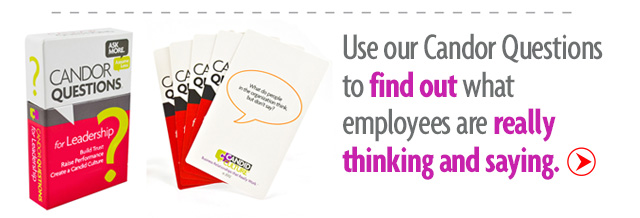
- Provide employees with survey results quickly. Most organizations ask for too much information. Leaders are overwhelmed by the survey information, so they spend months and months reviewing it, while employees comment on yet another employee survey with no communication.
Send out a communication sharing the top few learnings – the good and the not-so-good — within a few weeks of sending out the survey. You don’t need to take action at the same time. Simply keep employees in the loop by communicating a quick summary of what you learned. If you wait too long to share the feedback, it often never gets communicated. And the next time you send out a survey, employees will remember the absence of information and be hesitant to fill it out.
- Within 90-days, tell employees what you will and won’t be changing, based on the survey feedback, and tell them why. Employees don’t need or expect all of their input to be utilized. Closing the loop with clear communication about what you are and aren’t changing, and why, is often sufficient.
All of that being said, I’m going to recommend you send out fewer surveys. Employee engagement surveys are a good way to quickly collect lots of information. Engagement surveys are not a good way of building trust and relationships with employees, which is what leads to employee engagement and retention. Employees don’t feel closer to an organization’s leadership team after filling out an employee engagement survey. Trust isn’t built. Instead of sending out so many surveys, I’d suggest cutting the number in half and have leaders and managers hold roundtable discussions with groups of 6-8 employees a few times a year instead. Roundtable discussions achieve several goals at once—they give leaders visibility, which builds trust, they help leaders build rapport and relationships, and gather the same data that a written survey provides.
When leaders participate in our Be a Best Place to Work program, we teach the five things leaders need to do to engage and retain employees. Holding roundtable discussions and asking these questions is a key recommendation of the training. Sending out written surveys is not. Engage and retain employees by talking with employees. Ask employees for their input. Listen. And watch your employee engagement survey scores sky rocket.
 You probably have coworkers, customers and employees you rarely, if ever, see in person. You might even work for or with someone you’ve never met. While all feedback conversations can be hard, conversations with people we work with remotely seem even more challenging.
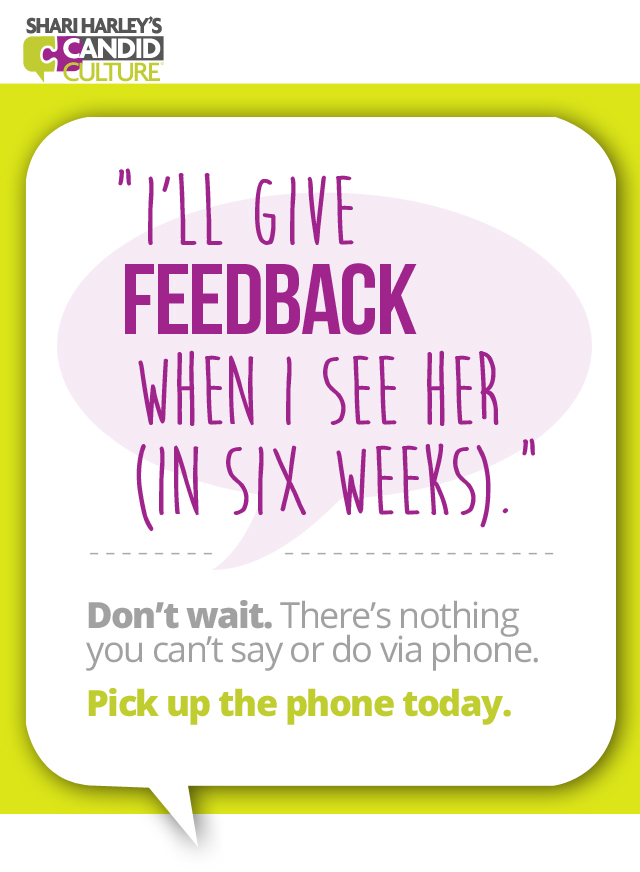
If I got a new pair of shoes every time someone said to me, “I’ve got this person and she isn’t (fill in the blank with anything that would trouble you). I’m going to see her in six weeks, so I’ll just have the conversation then.” Waiting six weeks to give feedback is unhelpful and wimpy.
There is nothing you can’t say or do over the phone. I used to think you couldn’t lay someone off via phone, but I’ve done it, so now I know it can be done.
Here are eight tips for remote management of employees and all types of working relationships:
Remote management tip number one: Know that any conversation you can have in person, you can have via phone.
Remote management tip number two: Schedule the same meetings you have with local employees, coworkers, and customers with those who live/work remotely. When you talk with people regularly, giving feedback is (hopefully) a part of your regular conversations. Having a feedback conversation with someone you rarely talk with will probably be more difficult.
Remote management tip number three: Set clear expectations for how often you want to meet and the purpose of the meetings. Tell people that you will discuss the same things via phone as you would in person and invite them to do the same.
Remote management tip number four: Work hard not to cancel meetings and reschedule all cancelled meetings as soon as possible. Time goes by so fast. By the time you know it, a month will have passed and you still won’t have had ‘that’ conversation.
Remote management tip number five: If you’re not a phone person, force yourself to have the conversations. If you’d prefer to use video conferencing, skype or Facetime, do that. Although for remote employees that will require not wearing pajamas, and they might not like that.
Remote management tip number six: Keep phone meetings shorter than in-person meetings. It’s easy to become distracted via phone. Keep meetings focused and short.
Remote management tip number seven: Give feedback verbally. Don’t rely on email to deliver hard messages. It’s easy to send feedback via email with people you work with remotely. You can’t manage the tone of written feedback the way you can during a live conversation.
Remote management tip number eight: Use whatever form of communication remote coworkers and customers prefer to schedule meetings. If they’re texters, text. If they like email, use that. You’ll get better participation and responses from people when you use their preferred method of communication.
One of our vendors isn’t a phone person. Her ringer is typically off. So if I call without warning, I get voicemail. So I text her, tell her a need to talk with her, and ask when is a good time. Then my calls get answered. You may be thinking, “Vendors work for you. You shouldn’t have to do that.” Maybe. But I try hard to live in the world of what works versus what’s right. When I communicate with people how they like to communicate, I get a better response, and you will too.
Approach remote business relationships just as you would in-person relationships. Schedule regular meetings. Pick up the phone to deal with tough issues, don’t fall back on email to give feedback. And don’t wait. The time to have any challenging conversation is now. You can do it. Pick up the phone.
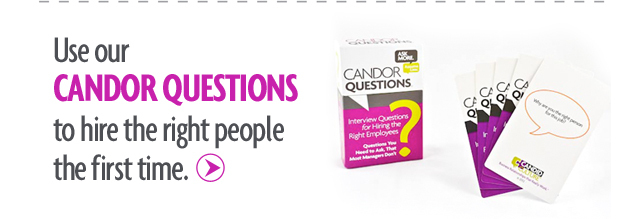
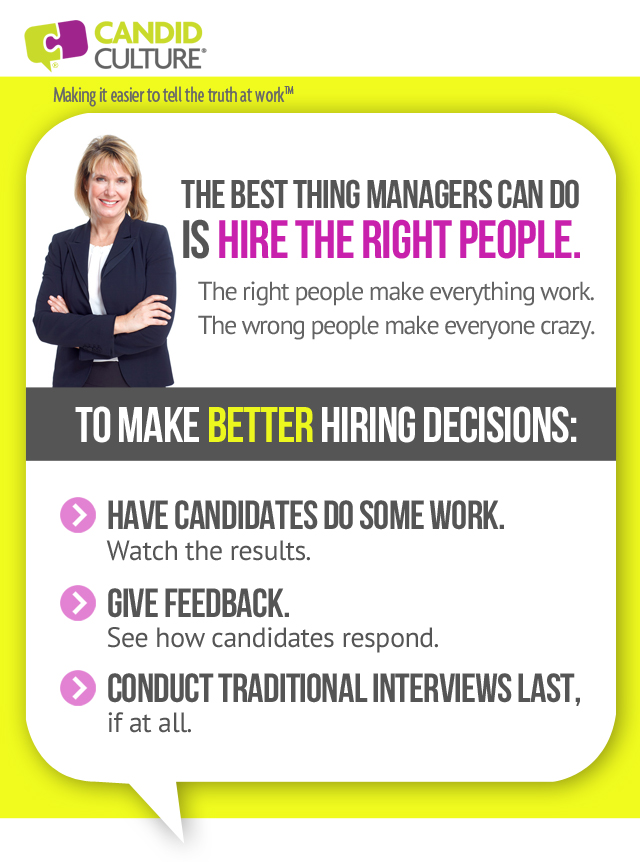 Want to spend less time managing performance issues? Hire the right people. The right people make everything work. The wrong people drain your time, patience, and resources.
Instead of spending 60-90 minutes doing in-person interviews, which tell you little, give candidates a chance to experience the job, and see how they do. I used to conduct thorough, in-person interviews. I’d ask a lot of questions, and I still hired the wrong people. And as a result, we’ve changed our hiring practices at Candid Culture. We no longer do traditional, in-person interviews after phone screens. Instead, we watch candidates do parts of the job. Then we decide if we want to talk with them further.
Too many companies spend too much time interviewing candidates they won’t hire. You might have multiple employees interview a candidate. It’s not uncommon for candidates to meet six or seven people and spend an entire day interviewing. The ultimate decision maker(s) often interviews the person last, cuts the candidate, and thus wasted her employees’ and the candidate’s time. If you want your employees to be involved in the hiring process, have them interview only the candidates the decision maker(s) would be willing to hire. Why waste everyone’s time?
Here Are Seven Interviewing Techniques to Make Better Hiring Decisions:
Interviewing Techniques Number One: Consider hiring a recruiting firm to source and screen candidates. Reading 100 resumes is likely not how you want to spend your time.
Interviewing Techniques Number Two: If you choose not to outsource recruiting, create a few steps for candidates to follow when applying for a job with your company to weed out the people who aren’t serious. It’s better to see 20 resumes from serious candidates than 100 resumes from candidates who potentially aren’t really interested in your company.
Interviewing Techniques Number Three: If you’re sourcing and screening your own candidates, conduct thorough phone screens. Assess culture fit and candidates’ ability to do the job, and eliminate candidates who don’t meet your criteria.
Interviewing Techniques Number Four: Schedule in-person interviews with the candidates you’re interested in. Tell candidates they’ll be participating in a practical interview during which they’ll get to do parts of the job, so they can see if they’ll enjoy the work.
Interviewing Techniques Number Five: Have candidates do some of the work, observe them and/or the work they produce, and provide some positive and improvement feedback. If, after observing candidates do some work, you think they can do the job, and the candidate accepted your feedback without becoming defensive, conduct an in-person interview. If you don’t think they can do the job, end the interview.
During interviews, I screen for a candidate’s willingness to accept coaching and feedback. People who aren’t coachable or open to feedback are exhausting and difficult to work with.
Interviewing Techniques Number Six: If you’re interested in a candidate after both the practical and in-person interview, conduct detailed reference checks. Never, ever skip the reference check.
Interviewing Techniques Number Seven: Lastly, if you’re going to extend an offer, ask your finalists to spend a day or half a day job shadowing. Candidates and employers are on their best behavior during an interview and become more relaxed outside of the traditional interview. You want candidates to get a feeling for what it’s really like to work in your organization. Culture fit is the hardest thing for candidates and hiring managers to predict. Job shadowing helps.
Slow down your interviewing, be more thorough, and make better hiring decisions.