Archive for May, 2018
Every time I ignore the red flags I see when interviewing a candidate, or when I feel an employee is struggling, or a project is off track, I pay the price. Every single time. 
You interview a candidate whose commute will be 75-minutes each each way, but she says she likes to drive. Sure, until it snows. Move on. You haven’t gotten an update from a project team in over a month, but this group is typically reliable, so things are probably fine. Check in. Even the most diligent employees need accountability and attention.
They call them red flags for a reason. If you suspect a problem, there likely is one. Don’t just wait and ‘see how things go.’ Make a hard decision, get more information, or get involved. Wait and see is often a recipe for disaster.
Sometimes we don’t get involved because we don’t have the time or want to focus on other things. Other times we just don’t trust or listen to our gut.
Trust yourself.
I usually know what I want and need to do, both personally and professionally. Yet I tend to ask LOTS of people for their opinions of what I should do. I solicit advice from friends and colleagues, and in the end, I usually do whatever I want. Why not just trust that I know the right thing to do and just do it? Dad, are you reading this? See, I listen. My dad tells me all the time to stop soliciting opinions, I often ignore anyway, and just act.
Here are a six steps you can take to help listen to yourself and ensure you don’t overlook or ignore red flags:
1. Become very clear about your desired outcome. Decide what you want.
2. Eliminate distractions. Get quiet, aka, still your mind.
3. Think about the situation at hand. Weigh the facts and your options.
4. Decide without belaboring.
5. Act on your decision.
6. Don’t look back. Your initial decision is usually the right one.
Trusting and listening to ourselves can be hard. Perhaps it’s the fear of making a mistake or being wrong. Chances are you’re right. So pay attention to the red flags, trust yourself, and listen to your gut.

I think Instacart is a brilliant idea. I make a grocery list online, someone else goes shopping for me, and drops my groceries on my porch. What a  great way to save time, unless I want a certain brand of canned tomatoes with no rosemary, and two green bananas and three that are almost ripe and one that is ripe right now. Meaning, if I want my groceries a certain way, I need to go shopping myself. No one else will pick precisely what I would. And delegating work and managing people is the same.
No one will do something just like you will. They might do it better or worse, but either way, work won’t be done just as you would do it. If you want something done precisely your way, you’re likely going to need to do it yourself.
There is little more demoralizing than working hard on a document and having your manager red line it with edits that aren’t wrong, they’re just not her way. This kind of feedback makes employees wonder why they bothered doing the work in the first place. Employees find themselves thinking and possibly saying, “If you’re going to change my work to be more your way, you should just do it yourself.”
This isn’t to say that if you have a vision for how work should be done that you shouldn’t delegate. Managers need to delegate work or they will be focused on the wrong things, exhausted, and resentful, and employees won’t grow, develop, and be properly utilized.
Managers need to set clear expectations, follow up to review work, provide regular feedback as the work is in process, and then expect and accept that completed projects won’t look just like what they would have done. Employees might produce great work, but it likely won’t be a mirror image of what the manager would have done herself.
If getting work that is slightly askew from what you would have done works for you, delegate the work. If work produced must be a certain way, you should likely do it yourself, or risk both you and your employees’ frustration.
Here are six steps on how to delegate, a skill I think most managers can strengthen:
How to delegate step one: Provide clear instructions to the person to whom you’re delegating. If you have an image of what something should look like, provide a sample document.
How to delegate step two: Ask the person to whom you delegated to tell you what you’re expecting. Don’t ask, “Do you have any questions?” The right answer to that question is, “No,” and gives you no insight about the person’s understanding of your expectations. Instead, ask, “So I know I’ve been clear, what am I asking you to do?” Or you could ask, “Based on what I’ve said, what do you think I’m looking for?” There are lots of ways to assess a person’s understanding. You simply need to get the person talking.
How to delegate step three: Don’t assume people know what to do. We have all left someone’s office with a new project thinking, “I have no idea where to start.” And then that project goes on the bottom of the pile.
Ask the person, “What are you going to do first?” If they give you an answer that tells you they know what to do, step back. They’ve earned some freedom. If they give you an answer that will not lead to the results you want, step in and offer help.
How to delegate step four: Ask to see work as the work is completed versus reviewing all of the work when the project is done. Giving a lot of upgrade feedback after work is completed is demoralizing to employees and wastes a lot of time. Tell employees, “I’d like to see your progress every Friday (or whatever interval is appropriate depending on the length and complexity of the project). This isn’t to micromanage you, it’s to ensure you don’t do a bunch of work that I will want changed. I don’t want you to waste your time.”
How to delegate step five: Give candid feedback when you review work. Don’t say something is fine if it’s not. Make changes while the work is in its early stages versus when it’s almost complete.
How to delegate step six: Resist the temptation to edit work or give feedback on work that is correct but wasn’t done your way. Remember, if you want something done your way, sometimes it makes sense to do it yourself.
When it makes sense to do something yourself: When you must have something a certain way and you’re the only person who can and will do it that way. If you’re ok with things not having the same words, formatting or flavor you’d put on them, delegate. If you need your bananas to look a certain way, go pick them up yourself. And both options are right answers. It’s ok to want what you want.

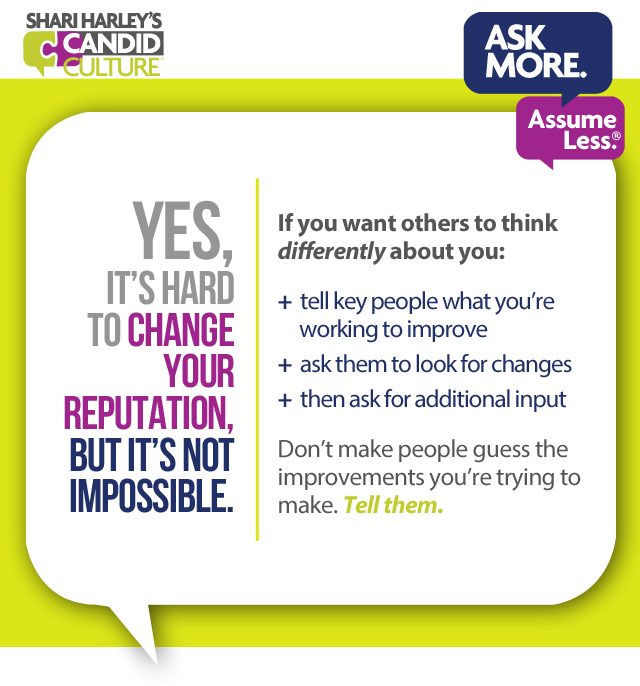 We know impressions are made quickly and are hard to change. But it’s not impossible to repair your reputation. If you want to change how people see you, I’d suggest being very overt about the changes you’ve made. Don’t simply alter your behavior and wait for people to notice. They likely won’t.
Once people have formed an opinion about you, that’s often their opinion for as long as they know you. For example, if you have a tendency to be late, even if you periodically show up on time, your friends and coworkers will think of you as the person who is always late. If you work with someone who tends to miss deadlines, even if she periodically turns work in on time, you’ll think of her as someone who misses deadlines.
Once people make a decision about us, that’s often how they’ll see us for the duration our relationship. So if you want to repair your reputation, you’re going to have to do it overtly. Making changes and hoping people notice, won’t produce the desired result.
Here Are Eight Steps to Repair Your Reputation:
- Ask people who can impact your reputation and whose judgment you trust for feedback.
- Work hard to manage yourself and not get defensive. Respond to all feedback, no matter how hard it is to hear or how invalid it may feel with, “Thank you for telling me that. I’m going to think about what you said. I may come back to talk more later.”
- Once you’ve absorbed the feedback, decide what, if any, changes you will make.
- Change your behavior for a period of weeks.
- Return to the people who gave you feedback, tell them about the behavior changes you’ve made, and ask them to observe your behavior.
- Tell the people who gave you feedback that you’ll ask them for feedback again in a few weeks, and you want to know what they see.
- Return to the people who gave you feedback and ask what changes they have or haven’t noticed.
- Repeat steps 3 through 7 at least quarterly. Everyone periodically does things that can damage their reputation.
Overtly pointing out the behavior changes you’ve made, asking people who are important to you to pay attention, and give you additional feedback, is key to altering your reputation. Most people working to change their reputation don’t do this. They make behavior changes and hope others notice. If you want to alter your reputation and how others see you, you need to do so overtly. Tell people the changes you’ve made; don’t make them guess. Ask people to observe your behavior, and then ask for more feedback. And no matter how hard the feedback is to hear, don’t get defensive. Becoming defensive will ensure you don’t get feedback the next time you ask.

Hire people using whatever (legal) criteria you like. Compensate employees however you like. Charge for your products and services however you like. Run your business however you like. But be transparent about your practices. People want to work with those they trust. Transparency builds leadership trust.
A few weeks ago one of our vendors gave me a bill that was higher than what I expected, so I asked for an itemized invoice. I never heard from the company again. Poof; they disappeared. Not a great way to build leadership trust nor a reputation.
Another vendor was very delayed in filling our product orders. When I asked questions about how such a thing could happen, I got a vague answer. “I guess we have communication issues and you got lost in the shuffle.” It was an insufficient and thus bad answer that didn’t instill confidence in the company. Instead, it created doubt that they could reliably meet our needs and we’re going to replace them.
One of my friends recently got turned down for an internal job. She was told, “She just wasn’t the right fit.” An unhelpful and yet typical way to decline an internal candidate.
You don’t owe your employees or customers answers, but if you want people to want to work with you, have confidence in you, and trust you, you’ll provide more information than you think you need to.
Employees and customers can handle the truth. And while you may not think you need to provide it, people want to work with those they trust. We trust people who give us the whole truth. Or at least more of it than, “I guess you got lost in the shuffle.”
Increase business trust: Outline how you derive your pricing. Be clear and transparent about your pricing.
Increase corporate trust: Tell employees how and why you make the hiring decisions you do. They’ll refer friends to work for you, even when you decline them.
Increase leadership trust: Tell employees how the organization makes money, the feedback you’re getting from prospects and customers, and why you’re making the business decisions you’re making. Employees will feel more connected and thus committed to the organization.
Knowledge makes people feel comfortable. The people who work for and with you want to understand how and why decisions are made. If you want your customers and employees to trust you, give them a little more truth than you might think necessary.