Archive for March, 2018
The normal, natural reaction to negative feedb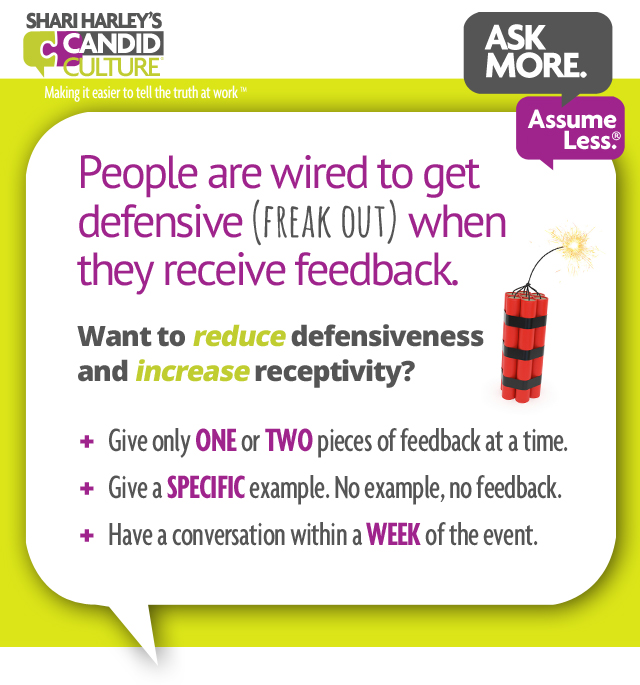 ack is to become defensive, a response I’ve labeled as The Freak Out.
Everyone, even the people you think do little work, wants to be seen as good – competent, hardworking, and adding value. When anyone calls our competence into question, we get defensive. Becoming defensive is an automatic response that we have to train out of ourselves.
Until the people you work with train themselves not to become visibly defensive when receiving feedback, just expect it. And be happy when you get a defensive response. It means the person is breathing and cares enough about what you’re saying to get upset.
While you can’t get rid of a defensive response to feedback, you can reduce it by following a few employee feedback practices. Practice these methods of giving feedback and your input will be heard and acted on, more often than not.
Employee feedback practice one: Don’t wait. Give feedback shortly after something happens. But do wait until you’re not upset. Practice the 24-hour guideline and the one week rule. If you’re upset, wait at least 24-hours to give feedback, but not longer than a week. If the feedback recipient can’t remember the situation you’re talking about, you waited too long to give feedback, and you will appear to be someone who holds a grudge.
Employee feedback practice two: Be specific. Provide examples. If you don’t have an example, you’re not ready to give feedback.
Employee feedback practice three: Praise in public. Criticize in private. Have all negative feedback discussions behind a closed door.
Employee feedback practice four: Effective feedback discussions are a dialogue; both people talk. When the feedback recipient responds defensively, don’t be thwarted by his/her reaction. Listen to what s/he has to say and keep talking. Don’t get distracted.
Employee feedback practice five: Give small amounts of feedback at a time – one or two strengths and areas for improvement during a conversation. People cannot focus on more than one or two things at a time.
Employee feedback practice six: Give feedback on the recipient’s schedule and in his/her workspace, if s/he has a door. It will give the other person a sense of control and s/he will be more receptive.
Employee feedback practice seven: Talk with people – either in person or via phone. Don’t send an email or voicemail. Email is for wimps and will only damage your relationships.
Employee feedback practice eight: Prepare. Make notes of what you plan to say and practice out loud. Articulating a message and thinking about it in your head are not the same thing.
Employee feedback practice nine: Avoid The Empathy Sandwich – positive feedback before and after negative feedback. Separate the delivery of positive and negative feedback, so your message is clear.
Employee feedback practice ten: Offer an alternative. Suggest other ways to approach challenges. If people knew another way to do something, they would do it that way.
You can deal with whatever reaction to negative feedback you get. The other person’s response will not kill you. It might make you uncomfortable, but that’s ok. You’ll survive. Try to practice the guidelines above, and if you don’t, and you ‘do it all wrong,’ at least you said something. Just opening your mouth is half the battle. When you come from a good place of truly wanting to make a difference for the other person, and you have both the trust and permission to give feedback, you really can’t go wrong.

Running effective meetings is hard. It takes courage. Who wants to tell their boss, peers, and customers to put away their phones, stop side talking, and laser their communication? No one. But if you don’t manage ‘bad’ meeting behavior, you look bad and you won’t get the results you want. 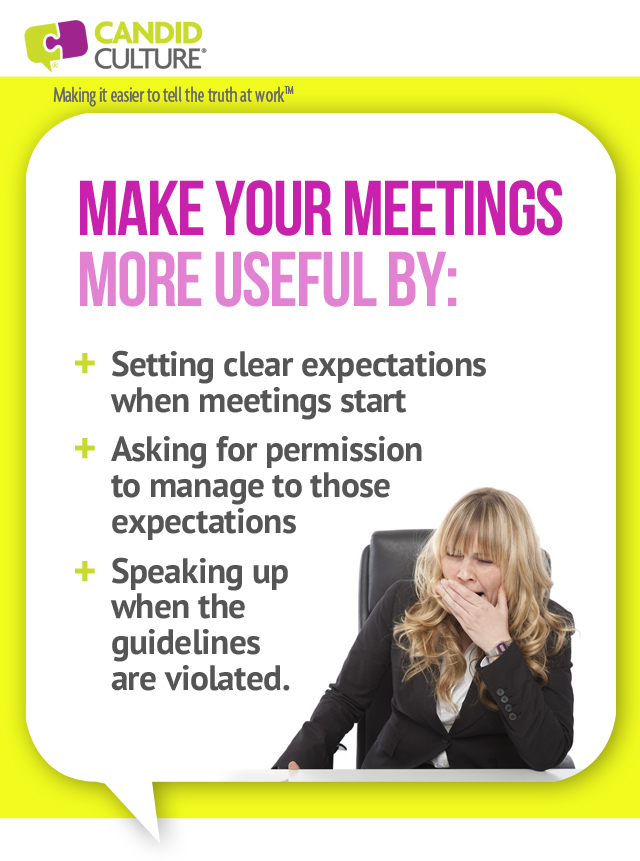
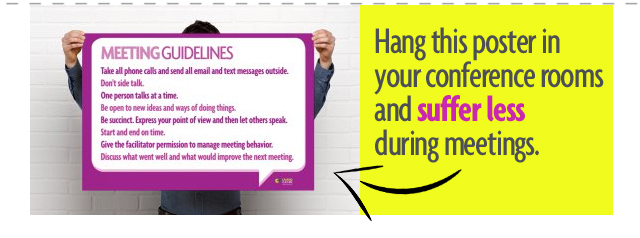
If you run meetings, work with the meeting participants to set expectations everyone agrees to follow. Standard meeting guidelines for running effective meetings include not side talking, putting away or silencing electronics, tabling tangents, not interrupting others, speaking succinctly, etc. You can set any behavior guidelines you like as long as the meeting participants agree to those expectations. Ask meeting participants what behavior guidelines they want to follow. The more control you give people, the more buy in you’ll get.
Possibly even more frustrating than running a meeting in which participants break all the ‘rules’, is participating in inefficient meetings when you aren’t the facilitator. It’s difficult to sit through a poorly run meeting feeling there isn’t anything you can do to make it better.
Luckily, there are things you can do to improve the meetings you don’t run. None of my suggestions will be comfortable. But think of all the time you’ll save.
Conversation one – running effective meetings: If you want to impact the meetings you attend, approach the facilitator(s), empathize about what a challenging meeting it is to run, tell the person you want to be supportive, and ask if s/he wants to discuss some different ways to manage the meeting. That conversation could sound something like, “Wednesday’s staff meeting is tough to run. I empathize with you. Would you be interested in talking through some different ways to manage participant behavior? I have some ideas and would be happy to discuss. I’d like to be supportive.”
Conversation two – running effective meetings: If you want to be more direct, you could say something like, “Can we talk about Wednesday’s staff meeting? It can’t be an easy meeting to run. I empathize with you. Key decision makers are missing meetings and a few people tend to take over the conversation and take us off track. Can I make a few suggestions that might help? What do you think of working with the group to set some expectations people agree to be managed to and then holding people to those agreements? We can share the facilitation responsibilities by assigning jobs during the meeting – back up facilitator, note taker, time keeper, etc. – so all of the responsibility doesn’t fall to you. What do you think?”
The person running the meetings knows they’re not going well. They just don’t know what to do about it. Offer support. Don’t judge. Be helpful and possibly they’ll be receptive.
The key to running an effective meeting is to set clear expectations people agree to follow and be managed to, hang up and review those expectations at the beginning of every meeting, and speak up when the expectations are violated. All of these things take courage. But meeting participants will be grateful to you for being strong.
You’re talking with someone. He asks a question demonstrating he didn’t understand or hear what you said. You let out an exasperated silent or audible sigh and say, “Like I just said…” Saying “like I just said” or “as I just explained” tells the person that you  think he’s stupid or doesn’t listen. Both might be true, but saying so won’t help your relationship.
I consider myself reasonably smart. And for the most part, I listen. If I ask a question about something you said, consider the possibility that your explanation wasn’t clear and find a way to rephrase what you said the first time. Resist the temptation to tell me and the people you work with that we’re stupid.
Letting people save face is an art that takes patience, good communication, and the desire to have good relationships.
Here are five good communication tips that will strengthen you relationships versus alienate you from others:
Good communication tip number one: Give people the benefit of the doubt. Assume good. People are doing what they know to do.
Good communication tip number two: If someone doesn’t understand what you said, take responsibility for delivering unclear information. It’s easier to change your communication style than alter someone else’s style.
Good communication tip number three: Put your desire to have good business relationships above the desire to be right.
Good communication tip number four: Consider that you may not explain things in the way others learn. Vary your communication methods. Most people don’t learn solely by hearing. Make your explanations hands on and/or visual, and you’ll reach more people.
Good communication tip number five: Bring your patience to work.
It’s tempting to tell people where they’re lacking, but it won’t get you very far. Say what you need to in order to get your point across. And if people are unclear, know the easiest thing is to alter your message. Take the path of least resistance; let people save face.

Working in a matrix management structure often means being accountable to several people/having multiple bosses, and having lots of accountability without much authority – both challenging. The key to making a matrix management structure work is lots and lots of good communication.
It’s not uncommon for people working in a matrix management structure to be frustrated. People with dotted line employees or managers often say they’re unsure of who they really work for, who to go to with challenges and needs, and that they don’t have the authori ty to lead people or processes. All of these frustrations are avoidable and manageable.
If you work in a matrix management environment and are thus accountable to multiple people, take charge of the management structure by asking the questions:
- Who is my ultimate boss?
- Who has input on my performance feedback and review?
- Who writes my performance review?
- Who decides on raises and promotion opportunities?
- Who do I go to when I need help?
Request:
- Quarterly (at a minimum) joint meetings with all the managers you answer to
- That all the managers you’re accountable to provide input on your performance appraisal
- That all the managers your report to participate in your performance discussion(s)
Follow the same practices for people who dotted line report to you. If you’re accountable for someone’s results, but you’re not his/her direct supervisor, ask for quarterly meetings with the employees’ boss. Ask to participate in the appraisal process, and keep the lines of communication between you, the employee, and the direct supervisor transparent and open. Talk regularly. Agree on who sets expectations and gives feedback. Be sure you know your role and the direct supervisor’s role.
The key to making a matrix management structure work is:
- Everyone knows who does what and who has what authority
- Joint meetings happen regularly
- Expectations are clear
Ask more. Assume less.

Nothing will help you with time management more than having a baby. Since having my son, deciding what to say yes and no to has be come very easy. I do just what I have to and really, really want to, and say no to everything else. Work that wasn’t where I should be spending my time is now done by someone else. Social events that I didn’t really want to attend get declined.
Time is the only thing in life you can’t get back. You can make friends and lose friends. You can make money and lose money. You can gain weight and lose weight. But you never ever get back your time.
So where is your time going? What are you doing that you know someone else should be doing? What are you doing out of obligation that is devoid of enjoyment? Where do you invest more time than you need to, requiring you to give short shrift to another priority?
It may seem odd that a communications expert is writing about time management. I don’t speak or train on time management. But I am knowledgeable and passionate about people loving the work they do, where they do it. And it’s hard to love what you and do your best work when you don’t allocate your time well.
Here are five time management questions:
Time management question one: What are you doing that you know someone else could or should do?
Time management question two: If you invested a few hours training someone, what could you give up to create room for something new?
Time management question three: What personal relationships do you invest time in because you think you’re supposed to?
Time management question four: Which family events are you attending out of obligation?
Time management question five: What do you give 110% percent to that 70% would be more than sufficient, leaving more of your time and energy for something more important?
You only have so much time and energy. Where are you going to put it – on the things that matter most or on distractions that seem important?
I’m not suggesting you skip every family event you don’t want to go to. But perhaps go for less time or skip every third event. I’m not advocating cutting corners or doing mediocre work. But sometimes we spend much more time on things than we need to, when investing less time would deliver the same result.
Here are a few examples of what I mean by 70% being more than enough:
- You spend 25 hours on the formatting of a presentation when the content is what’s really important. You create gorgeous tables and graphs when five bullets were what the client really wanted.
- You host a party and make hand painted table tents describing each food, when your guests will have a great time with typed descriptions or no descriptions at all.
- You maintain friendships you know should have ended long ago because it seems like the right thing to do.
- You avoid calling friends if you don’t have an hour to talk instead of calling and saying, I only have ten minutes but really want to talk with you.
Invest your time in what produces the greatest results and maximizes your enjoyment. Work hard, do great work, invest in your family and friends, and know when “no thank you” is the right answer.