Archive for November, 2016
I’ve always thought it was weird to sit next to someone on a plane and not say hello. I don’t mean a long chat, “Where are you going? Do you live there? What do you do for work,” merely a hello. Or to pass someone on the street or at the gym who pretends not to see me. It’s downright weird. And it’s even worse at work.
Passing someone in the hallway at work who you may or may not know and not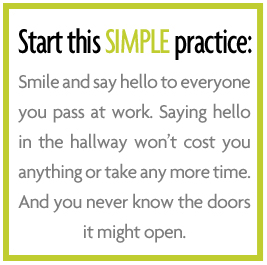 saying hello can be off putting to many people. Admittedly, some people don’t care. But more do.
Many of the people you work with are affronted if you pass them in the hallway and don’t smile and/or say hello. They’ll never tell you they’re put off by the lack of social graces, they’ll just make decisions and assume they’re right. They’ll tell themselves, “We sit in multiple meetings together, and that guy doesn’t even know who I am.” Or, “I’ve walked past this woman every day for five years and it’s like she’s never seen me before.” Or, “Bob never says hello when he sees me in the hallway. I wonder why he doesn’t like me?”
Chances are you’re not thinking any of these things about the people you work with. You’re busy and focused on other things, and your mind is not on making small talk when you pass people in the hallway. But know that not saying hello can have an impact on the people around you and your corporate culture.
Start this simple practice: Smile and say hello to everyone you pass at work. Saying hello in the hallway won’t cost you anything or take any more time. And you never know the doors it might open. Maybe the person in accounts payable who’s been kicking back your expense reports will cut you a reimbursement check even when you fill out the wrong form. Or maybe IT will come to your desk first versus eighth when your laptop decides it’s taking a vacation day.
Get more simple ways to strengthen your corporate culture with a signed copy of How to Say Anything to Anyone. The book is on sale for $15 to celebrate our 4th printing. It’s the perfect holiday gift. Get your copy now! Offer ends 12/31/16.
Most of what comes through our phones is probably not all that compelling – emails we don’t really want to read, advertisements for things we won’t buy, and social media updates we don’t really care about. And yet those little devices are so seductive. It’s hard not to check your email, texts, and social media updates constantly. Being so connected electronically and thus so continuously distracted has its benefits but it also has real costs. 
Most of you know I had my first child last year. And I’m committed to being a present and involved mom. I spend a lot of time with my son. But the best times are when I leave my phone behind. Without my phone I’m fully present with him, in the moment, enjoying him. When I have my phone, I’m distracted, often stressed, and typically torn. Can’t I read this email and reply quickly? What’s the harm? It will only take a second.
And each time I take a minute to read my email, I’m gone. I’m focused on my phone. And then I feel guilty and sad for not being as engaged as I want to be. Then I recommit to being fully present. And then read my email again. It’s a vicious cycle.
There is a huge cost to being distracted most of the time. Our relationships suffer. Car accidents have increased. People are tired.
Every productivity expert will tell you to check your messages three times a day, respond, and to not be constantly reading email. It’s fantastic advice. And I suspect no one, including productivity experts, follows it. It’s just too hard. We’re lured by our phones, tablets and laptops. Not checking them regularly makes us antsy, uncomfortable, and nervous.
What would happen if we set defined periods of time for each thing we did? I.e., Spend from 1:00 pm – 4:00 pm with your children. At 4:00 p.m., check your phone. Take the weekend off and check your messages at 7:00 p.m. on Sunday. Work on a project without interruption from 9:00 a.m. to 10:00 a.m. I suspect we’d get way more done and feel less stressed. But we have to give ourselves permission to put the phone away.
Here are three ways to be more focused and productive, and hopefully, happy:
1. Schedule work and personal activities for realistic, defined periods of time, and stick to them.
2. Agree on no cell phones or other electronics during personal meals and outings. I like the game people are playing in restaurants by putting cell phones face down in a pile on the table. The first person who touches their cell phone pays the entire bill.
3. Agree on no cell phones during group or one-on-one meetings. Your meetings will be shorter, easier to manage, and more productive. Meeting attendees are dying to tell their peers to put away their phones. Strong facilitators who set and hold to this expectation earn others’ respect and get more done.
In a nut shell, give yourself permission to focus. Do one thing at a time for a short period of time. Allow similar chunks of time to read and reply to messages and read Facebook updates you don’t care about. Then put the phone down and walk away. Your family and friends miss you.
Want to improve your relationships? Read How to Say Anything to Anyone. The book is on sale for $15 to celebrate our 4th printing. It’s the perfect holiday gift. Get your copies now! Offer ends 12/31/16.
Hire people using whatever (legal) criteria you like. Compensate employees however you like. Charge for your products and services however you like. Run your business however you like. But be transparent about your practices. People want to work with those they trust. Transparency builds leadership trust.
A few weeks ago one of our vendors gave me a bill that was higher than what I expected, so I asked for an itemized invoice. I never heard from the company again. Poof; they disappeared. Not a great way to build leadership trust nor a reputation.
Another vendor was very delayed in filling our product orders. When I asked questions about how such a thing could happen, I got a vague answer. “I guess we have communication issues and you got lost in the shuffle.” It was an insufficient and thus bad answer that didn’t instill confidence in the company. Instead, it created doubt that they could reliably meet our needs and we’re going to replace them.
One of my friends recently got turned down for an internal job. She was told, “She just wasn’t the right fit.” An unhelpful and yet typical way to decline an internal candidate.
You don’t owe your employees or customers answers, but if you want people to want to work with you, have confidence in you, and trust you, you’ll provide more information than you think you need to.
Employees and customers can handle the truth. And while you may not think you need to provide it, people want to work with those they trust. We trust people who give us the whole truth. Or at least more of it than, “I guess you got lost in the shuffle.”
Increase business trust: Outline how you derive your pricing. Be clear and transparent about your pricing.
Increase corporate trust: Tell employees how and why you make the hiring decisions you do. They’ll refer friends to work for you, even when you decline them.
Increase leadership trust: Tell employees how the organization makes money, the feedback you’re getting from prospects and customers, and why you’re making the business decisions you’re making. Employees will feel more connected and thus committed to the organization.
Knowledge makes people feel comfortable. The people who work for and with you want to understand how and why decisions are made. If you want your customers and employees to trust you, give them a little more truth than you might think necessary.