Archive for July, 2016
Breakdowns happen. There will be days people won’t give you what you need to complete projects. Things will break. And you will look bad. When breakdowns happen, I always ask myself, “What could I have done to prevent this situation?” or “What did I do to help create this situation?” I see myself as accountable for whatever breakdowns occur.
It may sound odd that I always look at myself when breakdowns occur, even when it’s someone else who didn’t do her job, but it’s just easier. I can’t control anyone else. But I can control me (admittedly, some days I do a better job at this than others). When I can identify something I could have done to make a situation go differently, I feel more in control – aka better.
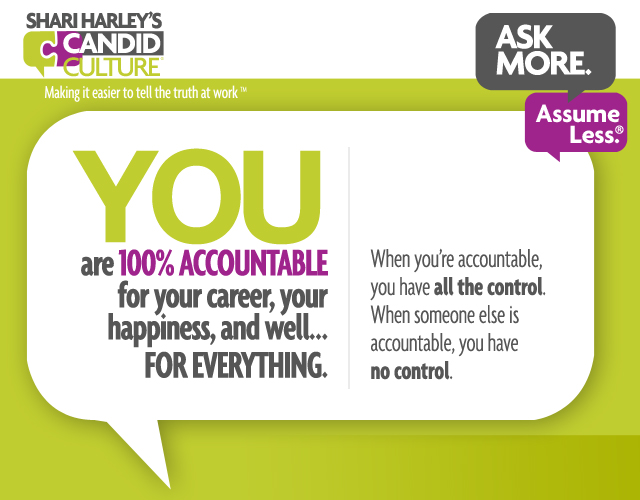
It’s like getting off a highway versus sit in bumper-to-bumper traffic. The alternate route may take longer, but at least I’m moving. I feel like I’m doing something and thus have more control. Taking responsibility for everything that happens to you is similar. When you’re accountable, you can do something to improve your situation. When someone else is accountable, you’re at the mercy of other people and have very little control.
There are, of course, exceptions to the practice that “we’re always accountable.” Terrible acts of violence, crime, and illness happen to people, about which they have no control. But in general, in our day-to-day lives, there is typically something we did to contribute to a bad situation or something we can do to improve it.
Here are four practices for improving difficult situations, even when you didn’t create the mess (alone).
1) Increasing accountability in the workplace: Ask more questions. If you’re not clear about what someone is expecting from you, ask. You’re responsible for doing good work, regardless of the type of direction you receive.
2) Increasing accountability in the workplace: Tell people what you think they’re expecting and what you’re planning to do, to ensure everyone’s expectations are aligned. Clarifying expectations beats doing several weeks worth of work, only to discover what you created isn’t what someone else had it mind.
3) Increasing accountability in the workplace: Ask for specific feedback as projects progress. Don’t wait until the end of a project to find out how you performed.
4) Increasing accountability in the workplace: Say “thank you” to whatever feedback you receive versus defending yourself. People will be pleasantly surprised and their upset will dissipate more quickly. That could sound like, “That’s good feedback. I’m sorry that was your experience. Thank you for telling me.”
5) Increasing accountability in the workplace: Admit when you make a mistake or when you wish you had done something differently. Don’t wait for someone to tell you. Saying, “I’m sorry. How can I make this right with you?” goes a long way.
I am always asking the following questions:
“What could I have done differently?”
“What did I do to contribute to this situation?”
“What can I do now to make this situation better?”
I encourage you to ask these questions, even when someone else drops the ball. You can’t control others, but you can control you. And your happiness and success is your responsibility.


There are two purposes of giving feedback and only two purposes – to encourage people to either replicate or change a behavior. Providing input for any other reason doesn’t actually qualify as feedback and only serves to damage relationships.
Sometimes we provide input because we’re frustrated or simply don’t like someone. Consider the purpose of your comments before you make them. If your intentions are pure – to help someone replicate or alter a behavior, then ask for permission and give feedback once given the green light. If you’re ‘just talking’ to talk or vent, say nothing.
Here are five criteria for when to give feedback and when to say nothing:
Giving feedback criteria one: You have the relationship to do so. You’ve built trust. The recipient will know your motives are pure – to add value and help.
Giving feedback criteria two: You’ve asked for permission to give feedback. Even if your title grants you the permission to give feedback, asking if the person is open to the feedback can increase receptivity.
Giving feedback criteria three: You’re not upset. Wait to give feedback until you’re calm, but don’t wait longer than a week (max two).
Giving feedback criteria four: Four months haven’t passed since the incident happened that you want to address. If the purpose of feedback is to encourage someone to replicate or change a behavior, the feedback needs to be given shortly after the event occurred. If you wait, the feedback is unhelpful and creates suspicion of other things you haven’t said.
Giving feedback criteria five: You have a specific example to provide. No example, no feedback. Feedback is supposed to be helpful. Telling someone they’re “doing a great job” is nice to hear but isn’t specific enough to be helpful or sincere. Likewise, telling someone their work isn’t “detailed oriented,” isn’t helpful without a specific example or two.
Evaluate your motives before you speak. Are you attempting to encourage someone to alter or replicate a behavior, or are you just sharing your unsolicited opinion? Give feedback for the right reasons, and retain your relationships.

I think Instacart is a brilliant idea. I make a grocery list online, someone else goes shopping for me, and drops my groceries on my porch. What a  great way to save time, unless I want a certain brand of canned tomatoes with no rosemary, and two green bananas and three that are almost ripe and one that is ripe right now. Meaning, if I want my groceries a certain way, I need to go shopping myself. No one else will pick precisely what I would. And delegating work and managing people is the same.
No one will do something just like you will. They might do it better or worse, but either way, work won’t be done just as you would do it. If you want something done precisely your way, you’re likely going to need to do it yourself.
There is little more demoralizing than working hard on a document and having your manager red line it with edits that aren’t wrong, they’re just not her way. This kind of feedback makes employees wonder why they bothered doing the work in the first place. Employees find themselves thinking and possibly saying, “If you’re going to change my work to be more your way, you should just do it yourself.”
This isn’t to say that if you have a vision for how work should be done that you shouldn’t delegate. Managers need to delegate work or they will be focused on the wrong things, exhausted, and resentful, and employees won’t grow, develop, and be properly utilized.
Managers need to set clear expectations, follow up to review work, provide regular feedback as the work is in process, and then expect and accept that completed projects won’t look just like what they would have done. Employees might produce great work, but it likely won’t be a mirror image of what the manager would have done herself.
If getting work that is slightly askew from what you would have done works for you, delegate the work. If work produced must be a certain way, you should likely do it yourself, or risk both you and your employees’ frustration.
Here are six steps on how to delegate, a skill I think most managers can strengthen:
How to delegate step one: Provide clear instructions to the person to whom you’re delegating. If you have an image of what something should look like, provide a sample document.
How to delegate step two: Ask the person to whom you delegated to tell you what you’re expecting. Don’t ask, “Do you have any questions?” The right answer to that question is, “No,” and gives you no insight about the person’s understanding of your expectations. Instead, ask, “So I know I’ve been clear, what am I asking you to do?” Or you could ask, “Based on what I’ve said, what do you think I’m looking for?” There are lots of ways to assess a person’s understanding. You simply need to get the person talking.
How to delegate step three: Don’t assume people know what to do. We have all left someone’s office with a new project thinking, “I have no idea where to start.” And then that project goes on the bottom of the pile.
Ask the person, “What are you going to do first?” If they give you an answer that tells you they know what to do, step back. They’ve earned some freedom. If they give you an answer that will not lead to the results you want, step in and offer help.
How to delegate step four: Ask to see work as the work is completed versus reviewing all of the work when the project is done. Giving a lot of upgrade feedback after work is completed is demoralizing to employees and wastes a lot of time. Tell employees, “I’d like to see your progress every Friday (or whatever interval is appropriate depending on the length and complexity of the project). This isn’t to micromanage you, it’s to ensure you don’t do a bunch of work that I will want changed. I don’t want you to waste your time.”
How to delegate step five: Give candid feedback when you review work. Don’t say something is fine if it’s not. Make changes while the work is in its early stages versus when it’s almost complete.
How to delegate step six: Resist the temptation to edit work or give feedback on work that is correct but wasn’t done your way. Remember, if you want something done your way, sometimes it makes sense to do it yourself.
When it makes sense to do something yourself: When you must have something a certain way and you’re the only person who can and will do it that way. If you’re ok with things not having the same words, formatting or flavor you’d put on them, delegate. If you need your bananas to look a certain way, go pick them up yourself. And both options are right answers. It’s ok to want what you want.


I had a colleague at my last job, prior to starting Candid Culture, who was a peer and a friend. We were at a similar level and would periodically sit in one of our offices, with the door closed, engaging in office gossip, talking about the bad decisions our company’s senior leaders made. One day I realized that these conversations were exhausting to me. They were negative and didn’t make me feel better. In fact, they made me feel worse.
Some people distinguish between office gossip and venting, asserting that venting is cathartic and makes people feel better. It doesn’t. Venting and office gossip are one in the same and both will make you tired and feel worse about your job and organization.
I’ll use an analogy I read in one of Deepak Chopra’s books. When you put a plant in the closet and don’t give it light or water, it withers and dies. When you put a plant in the sunlight and water it, it grows. And the same is true for people. Wherever you put your attention will get bigger and stronger. Whatever you deprive attention will become smaller.
In addition to draining you of energy and ensuring you focus on the things that frustrate you, office gossip kills organizations’ cultures. If employees can’t trust that their peers won’t talk about them when they’re not there, there is no trust in the organization. And this lack of trust feels terrible. It makes employees nervous and paranoid. A lack of trust sucks the enjoyment out of working because we feel we have to continuously watch our back.
Office gossip isn’t going anywhere. It’s a human phenomenon and is here to stay. But you can reduce office gossip.
Here are five steps to reduce the office gossip in your workplace:
Reducing gossip in the workplace step one: Address the gossip head on.
Tell your employees, “I’ve been hearing a lot of gossip, which is not good for our culture.”
Reducing gossip in the workplace step two: Hold regular town hall meetings, and give employees more information than you think you need to about initiatives, organizational changes, profitability, etc. Employees want to know how the organization is doing and what they can do to contribute. In the absence of knowledge, people make stuff up, not because they’re malicious, but because they have a need to know. Employees don’t have to fill in the gaps with office gossip when you inform them.
Reducing gossip in the workplace step three: Create a no-gossip-in-the-workplace policy.
Tell your employees, “We want people talking directly to each other, rather than about each other. As a result, we’re putting a no-gossip policy in place.”
Reducing gossip in the workplace step four: Draw attention to gossip.
Perhaps suggest, “Every time you hear gossip, wave two fingers in the air (or something else that’s equally visual).” This will draw attention to office gossip without calling anyone out.
Also, ask your peers and friends not to gossip with you. End conversations that contain gossip. This will be hard to do, but if everyone does it, it will become much easier.”
Reducing gossip in the workplace step five: Have an agreed-upon consequence for gossip.
Tell employees, “Every time we hear gossip in the workplace, the gossiper owes a dollar. Every quarter the gossipers will buy the office lunch from the office gossip jar.”
The keys to reducing office gossip are to draw attention to the gossip, have a consequence for gossiping, and over communicate so your employees don’t have to fill in the gaps themselves.
Venting and office gossip are the same. If you’re talking about someone else, unless you’re planning a conversation with a coworker or friend to address a challenge or problem, you’re gossiping. And talking about what frustrates you will only make you more frustrated.
My advice: Do something about the things you can impact and let the other stuff go. Talk about the things that matter to you. Resist the temptation to speak negatively about the people around you. And know that anyone who will gossip about someone to you, will also gossip about you.