Many people worry about giving feedback because they fear they don’t have the ‘right’ words. They’re concerned they’ll say ‘it’ wrong and damage their relationships.
Feedback is hard enough to give without worrying about saying everything perfectly. Worry less about having all the right words and more about whether or not people trust your motives.
When people trust your motives – why you’re giving feedback – you can say almost anything. When they don’t trust your motives you can say almost nothing.
Getting negative feedback is hard. It’s easier to listen to feedback when we trust the person who’s giving us the feedback – we know their intentions are to help versus to judge or hurt us.
Speak from the heart, be authentic, and worry less. Be yourself. If you’re nervous to say what you want to say, tell the other person you’re nervous. If you’re struggling to find the right words, say so. If you’re worried you’ll damage the relationship or that it isn’t your role to give the feedback, say that. Authenticity goes a long way.
How’s how to give feedback you’re apprehensive about:
How to give feedback phrase one: Consider saying, “There’s something I need to talk with you about but I’m concerned that I won’t use the right words and will damage our relationship.”
How to give feedback phrase two: “There’s something I want to talk with you about, but I’m concerned how it will come across. Is it ok if I say what I need to say?”
How to give feedback phrase three: “I want to give you my thoughts on something but I’m concerned that it’s not my place to do so. Is it ok if I share my ideas about _________?”
Other people aren’t expecting you to be perfect. But they do want to know they’re working with a human being. And human beings are fallible. We have fears. We make mistakes. And sometimes we don’t say things perfectly.
You don’t have to be perfect, you just have to be real.
Who have you fired lately? The person who cuts your hair or lawn? A doctor, accountant, or restaurant where you had a bad experience? Did you call any of those providers and tell them why you were replacing them? My hunch is no. There’s little incentive to do so. Why risk their defensiveness? It’s easier to just replace them. And the same is true for you.
There’s little incentive for the people you work with to tell you when you frustrate them. The perceived cost seems too high. The people you work (and live) with have experienced others’ defensive responses to negative feedback (which is no fun) and they don’t want to experience your reaction. As a result, when you disappoint or frustrate others, it’s easier to say nothing than tell you the truth.
The tendency for others to tell you things are fine when they’re not will prevent you from managing your career and relationships. People will go missing and/or you’ll be passed over for professional opportunities and never know why.
To make it more likely that people will tell you when you disappoint or frustrate them, make it easy to tell you the truth.
Here are a seven practices for receiving feedback:
Receiving Feedback Practice #1: When you begin new relationships, tell people you want their feedback.
Receiving Feedback Practice #2: Promise that no matter what people say, you’ll respond with “thank you.” This is very hard to do.
Receiving Feedback Practice #3: Tell people you already have relationships with that if you haven’t said it in the past, you really want their feedback and promise to respond graciously with “thank you.”
Receiving Feedback Practice #4: Ask people who matter to you for feedback regularly.
Receiving Feedback Practice #5: Resist the urge to get defensive.
Receiving Feedback Practice #6: Catch yourself when you start to become defensive and apologize. Say something like, “I’m getting defensive. I’m sorry. Tell me again. I’ll do a better job of listening.”
Receiving Feedback Practice #7: Take a break from conversations during which you find yourself responding defensively. Say something like, “I’m not responding as well as I’d like. How about we take a break? Give me a few minutes (hours or days) and I’ll come back to you to talk more. I really want to hear what you have to say.”
The aforementioned list provides recommendations for asking for and receiving feedback you want, not feedback you don’t. You are not a dumping ground. Don’t ask for feedback you don’t want. And when you do ask for feedback, qualify what type of feedback you’re looking for. Telling people “I want your feedback” doesn’t mean they’re welcome to say whatever they want.
The purpose of asking for feedback and making it safe to tell the truth is to give you more control over your career and relationships. It’s ok to be passed over for opportunities and relationships, but it’s unhelpful not to know why.
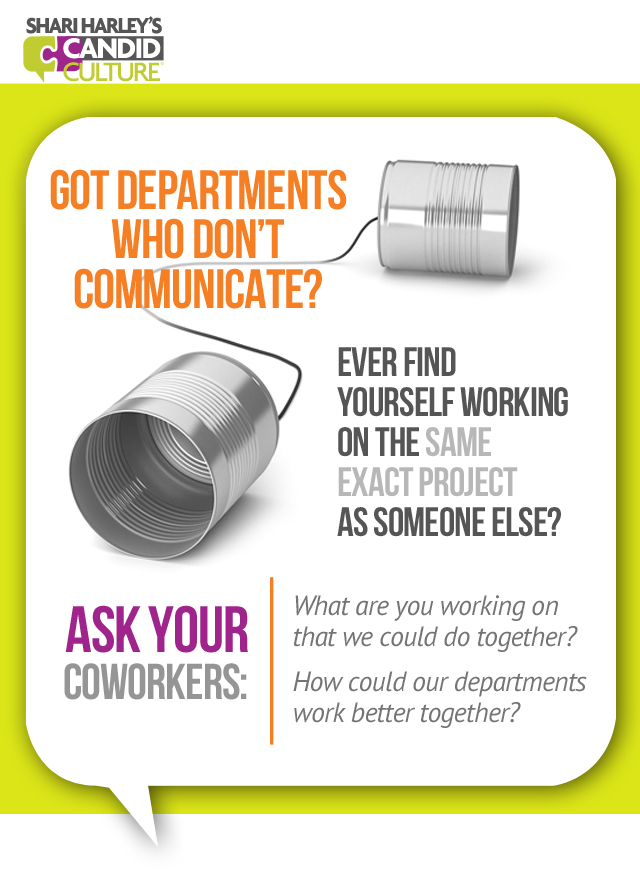
I’ll never forget sitting in a meeting with other department leaders, at my last job, and hearing that another department was working on the very thing that my department had been working on for months. We were a lean organization. No one had time for unnecessarily redundant work. And yet there were two departments working on the same project without knowing it.
As crazy as it sounds, this isn’t uncommon. People often know very little about what others across their organization do. Sometimes people on the same team don’t even know what type of work fellow team members are doing. This lack of knowledge can lead to conflict (i.e. get off my turf), wasted resources, and stale ideas. If you know two departments are working to solve similar challenges, sharing ideas is likely to generate better solutions.
Friday is National Swap Ideas Day. This sounds like a cheesy, invented holiday, but we’ve all been frustrated or constrained by a lack of sharing of ideas in our workplaces. So in honor of this invented holiday, here are five ways to find out what others in your organization are doing in the hopes of sharing more ideas and resources.
Workplace Communication Tip #1: This will sound basic, but be sure to let the people and departments impacted by your work know what you’re doing. I.e., if you’re advertising a new product, let the folks in fulfillment know they need to staff up the day the advertisement hits prospects’ and clients’ offices or they may not have enough people to fulfill orders. I’m embarrassed to admit we’ve made this mistake at Candid Culture. Oops.
Workplace Communication Tip #2: Create opportunities for departments who impact each other to communicate on a regular basis. Either literally get teams together quarterly to discuss what they’re working on, or if that’s not feasible, select liaisons from each department to meet regularly and discuss current and upcoming projects.
During the discussions, ask these questions:
What are you working on?
What challenges are you having?
What are you trying to change?
How can we help you?
What are you working on that we could do together?
How could our departments work better together?
Workplace Communication Tip #3: Widen your net and ask people you typically don’t have a lot (or any) contact with for their ideas on something you’re working on. Someone doesn’t necessarily need deep knowledge or expertise to offer a suggestion, they just need to think differently than you do.
Workplace Communication Tip #4: Be open to help, new ideas, and sharing projects. It’s easy to feel threatened and territorial at work, thinking that if someone else can do what you do, that you become extraneous. It’s not easy to find employees who are hardworking, reliable, effective, and low drama. Bring all of those qualities to work, and you have nothing to worry about. So start sharing.
Workplace Communication Tip #5: Keep up whatever idea-sharing practice you start. It’s common to try one of the ideas suggested above and then let the practice lapse when things get busy. Put processes in place to make sharing ideas the normal way that you work.
You likely have enough to do. You don’t need to be working on projects that someone else is working on. And sometimes hearing how a coworker would approach a problem will give you a solution you need. Share ideas. Work together across teams and departments and maybe you’ll end working less.
Sign Up
Career tips you won't get elsewhere. Sign up to get a free tip card.




 . And the same is true for you.