Archive for August, 2015
Having a good manager is key to a happy life. A good manager can make your job (and life) a happy experience. A bad manager can make your job (and life) hell. If you’ve worked long enough to have both good and bad boss’s, you already know this. Having a good manager is worth a lot.
If you’re lucky enough to have a good manager, say “thank you” on National Hug Your Boss Day, this Friday. Don’t physically hug her, of course. She isn’t likely to appreciate that. But there are lots of other ways to say “thank you.”
I don’t think it’s appropriate for employees to buy managers gifts. But there are lots of ways to show appreciation without spending money. Think about what’s meaningful to you. I’m sure an email containing positive feedback, a handwritten note, or a positive verbal comment all feel good to you, and they’ll feel good to your boss as well.

Here are six ways to show your boss you appreciate her on hug your boss day:
Hug your boss day idea #1: Send your boss an email, telling her some of the things she does that make you feel valued and that make your organization a good place to work. Be as specific as you can. Specific feedback is more meaningful, authentic, and helpful than vague generalities. For example, rather than saying, “You’re such a great boss! I really appreciate you,” considering saying something like, “I really appreciate the time you take teaching me about our business. I’ve learned a lotl in the past six months.” When you give specific feedback your boss will know what she does that’s meaningful to you, making it more likely that she’ll replicate that behavior in the future. If you provide specific feedback, you’ll both get something out of the recognition you provide.
Hug your boss day idea #2: Write her a handwritten note. A handwritten note is more impactful than an email. It’s so rare for anyone to get a handwritten note, let alone from a direct report, it’s something your boss will appreciate and keep for a long time. Like the suggestion above, be sure to provide specific feedback about what your boss does that you appreciate.
Hug your boss day idea #3: Equally impactful to a handwritten note is to talk to your boss in person. Giving verbal feedback may feel a little weird if it’s not something you do often, but she’ll appreciate the risk you took in being honest and vulnerable to make her feel appreciated.
Hug your boss day idea #4: Have your team write and act out a skit for your manager. This may sound corny, but skits are a fun and unique way to thank your boss, and something she likely hasn’t experienced before. During the skit, demonstrate some of the things your boss does that team members appreciate. Ham it up. It’ll be fun and she’ll learn a lot about what’s important to the team.
Hug your boss day idea #5: Write a song that tells your boss what you appreciate about her and have your team perform it. Like skits, this is a fun team activity that will be memorable for everyone. Have whomever on your team loves stuff like this spearhead the effort versus the person who is tortured by it.
I realize that skits and songs may not sound fun. In fact, some of you might now feel physically ill. In my experience, people typically roll their eyes at first and then end up having a great time. Try it! Teams that post a picture of themselves performing a skit or a song for their boss on our Facebook page will be entered in a contest to receive free Candor Bars (very delicious chocolate bars) How’s that for an incentive?!
Hug your boss day idea #6: Have a pot luck lunch. This is a good opportunity for the team to spend time together. Just make sure you pick food she likes. If my team brought in Mexican food (I’m not a fan. I know I’m weird), I’d know that they really didn’t like me. Are you guys reading this???
Don’t take a good boss for granted. Find a way to say “thank you” this Friday that will be meaningful to her.
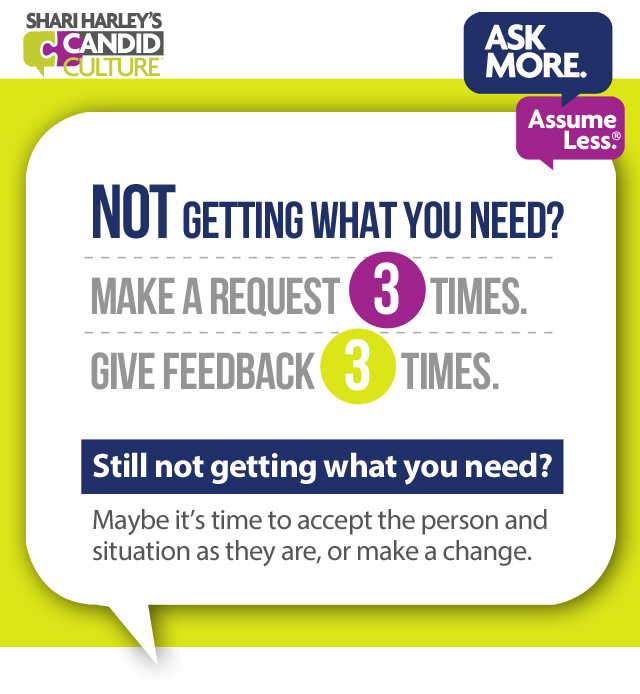 Unless you never interact with other people, there’s probably someone in your life who repeatedly engages in a behavior that annoys you. You’ve probably made requests about what you’d like to the person to do differently, and hopefully you’ve given feedback. But the behavior hasn’t changed.
At some point, we have to accept that people are who and how they are. People can and will change certain behaviors, if their motivation is high enough. But other behaviors won’t change. They are what they are. And if you want to have the person in your personal or professional life, you have to accept the behavior and the person as they are. And doing this can be very difficult, at least it is for me. I admit, I often have this conversation myself, “Why won’t he…? I don’t get it. It’s not that hard. How many times do I have to ask?”
Here are five strategies for working with difficult people:
Working with difficult people strategy one: Become very clear on the behavior(s) you expect.
Working with difficult people strategy two: Make a request and ask the person to do what you want. Be sure you are being explicitly clear in your request. For example, “Please include me in meetings” is too vague. Instead, try, “Please invite me to all client meetings so I can stay connected to the clients and projects.”
Working with difficult people strategy three: Make requests at least three times. With each successive request (nicely) remind the person that you’ve made this request in the past and it still isn’t happening. For example, “We’ve talked about this in the past and it isn’t happening. Help me understand what’s happening?”
Working with difficult people strategy four: If you’ve made a request at least three times, give feedback as to what isn’t happening and why that causes challenges. For example, “We’ve talked about inviting me to client meetings a few times. It’s still not happening. I’m getting calls from clients with questions I can’t answer because I’m not included in the meetings. Can you help me understand why I’m not being invited to meetings?” Read chapters nine through eleven and chapter thirteen of How to Say Anything to Anyone to get more examples of how to give clear and specific feedback.
Working with difficult people strategy five: Know when to give up and accept the person and behavior as they are. If you’ve made a request and have given feedback three times, you likely aren’t going to get what you want. The person either can’t do what you’re asking or doesn’t want to. Now you have a decision to make.
Decide how important this behavior is. Is it a deal breaker? If it’s a deal breaker, you can’t work or live with the person. If it’s not a deal breaker stop expecting the behavior to happen and accept that it won’t. When you accept that you won’t get what you want from someone you’ll suffer less.
Strategy five is really the crux of this blog. Knowing when to stop expecting something and coming to peace with that decision will give you great freedom. In order to let go of the expectation you have to decide that it’s really ok for you not to get what you want. Ask yourself, “Can I live with this behavior as it is?” If you can’t, you have a hard decision to make. If you can, then stop expecting and asking for the behavior. Truly let it go. You’ll feel better.
I’m honored to have been quoted in Fast Company’s article on how to give negative feedback. Check it out.
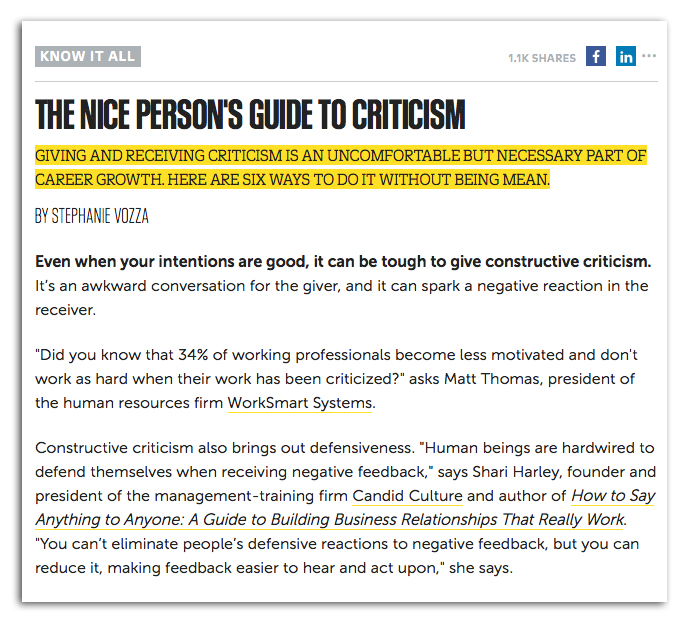 EVEN WHEN YOUR INTENTIONS ARE GOOD, IT CAN BE TOUGH TO GIVE CONSTRUCTIVE CRITICISM.
Constructive criticism also brings out defensiveness. “Human beings are hardwired to defend themselves when receiving negative feedback,” says Shari Harley, founder and president of the management-training firm Candid Culture and author of How to Say Anything to Anyone: A Guide to Building Business Relationships That Really Work. “You can’t eliminate people’s defensive reactions to negative feedback, but you can reduce it, making feedback easier to hear and act upon,” she says.
4. Don’t “save up” your negative feedback
People often hoard feedback until a situation becomes so frustrating that they can’t help but speak up, says Harley. “Because they waited too long to say what they think, many more words come tumbling out than is either necessary or helpful.”
Instead, make it a practice to give small amounts of feedback at a time—one or two strengths and areas for improvement during a conversation. People cannot focus on more than one or two things at a time, says Harley.
5. Be timely but not immediate
Give feedback close to the time of an event, but not when you’re upset, says Harley.
“The time to fix a problem is when no one is upset,” she says. “I call this practice the 24-hour guideline and the one-week rule: Wait 24 hours to give feedback if you’re upset, but not longer than a week after an event occurs.”
6. Finally, be discreet
“Praise in public, criticize in private,” says Harley. Make sure all negative feedback discussions happen behind a closed door.
Click here to read the entire article at FastCompany.com.
Posted under
Uncategorized on August 9, 2015 by Shari Harley. Comments
 It’s not easy to admit when we’re overwhelmed and need help. In fact, it’s such a hard thing to say that instead of asking for help, most of us either work harder or longer or job hunt.
Admitting work overload isn’t a weakness and it isn’t bad. It’s all in how you handle it.
If you find yourself with work overload and you aren’t sure what to do, consider taking these four steps.
Eliminate work overload step one: Every time you find yourself doing something that someone else could and should do, write it down, including how much time the task took. Doing this will create awareness of how much time you spend doing things that may not be the best use of your skills and experience. Then work with whomever you need to in your organization to align that work where it belongs. This practice isn’t to make you sound like an entitled prima donna. It’s an entrepreneurial way to approach your work.
The highest and best use of my time at Candid Culture is talking to current or future clients, writing new material, and delivering keynote presentations or training programs. I really shouldn’t do anything else. I can do a lot of things – like talk to vendors, count inventory, order supplies, and pack product orders – but none of those things add value to the business the way speaking, training, writing and spending time with clients does.
The business owner’s mantra is, “If I can pay someone less than I get paid to do something, I should do that.” Consider how you can apply that practice to your workplace, without appearing to be someone who won’t ‘wash windows.’ Meaning, you don’t want to be or appear to be someone who isn’t willing to do grunt work. Every job has it. But those lower level tasks shouldn’t be where you spend most of your time, unless your job description and annual goals say so.
Eliminate work overload step two: Watch out for and eliminate time suckers. This includes people, problems, and processes. If you find yourself in meetings all day long, consider which meetings you can skip or send someone else on your team. If someone in your office swings by daily to have personal conversations, tell the person, “I’d love to talk with you and I’m working under a deadline. Can we catch up later?”
Lots of people are at work longer than they need to be because of time spent talking with coworkers they don’t know how to ask to go away. You’re doing everyone a favor when you end conversations that are distracting. If you really want to talk about what’s happening with your coworkers’ kids, mother-in-law, and home renovation, go to lunch or happy hour.
Eliminate work overload step three: Sometimes doing 110% percent isn’t important. Notice when you’re doing more than you need to and when that additional work doesn’t add significant value. I.e., you put together a PowerPoint presentation and then spent five more hours printing and stuffing folders to put the presentation in. Next time, focus on the content and worry less about the aesthetics.
Eliminate work overload step four: Lastly, know when and how to ask for help. The last organization where I worked, before starting Candid Culture, was very fast paced and lean. I worked all the time and consistently felt overwhelmed. I eventually went to my boss to ask for help. I made a list of everything I was working on and asked him to rate each item based on how important he saw the project/task. He put an “A” next to the things that needed to get done first, a “B” next to the things that came next, and a “C” next to the things that were the least important. He told me to do the A’s first, then the B’s, and if I got to the C’s, great, if not, no problem.
The meeting was eye opening for me. I assumed he thought everything on my list was an “A” and that left me stressed with an inability to prioritize. Hearing how he perceived my workload reduced my anxiety and gave me permission to ease up on projects I’d previously considered timely.
Don’t suffer in silence. But do approach reducing work overload in a positive way. Rather than whining to your boss and coworkers, end conversations that you know are a time drain, limit work that doesn’t add significant value, and ask for help prioritizing when you can’t do it for yourself.

 If you took my advice last week and asked your boss who impacts the decisions made about you at work and what those people think of you, you probably got some feedback. The question is, what should you do with the feedback?
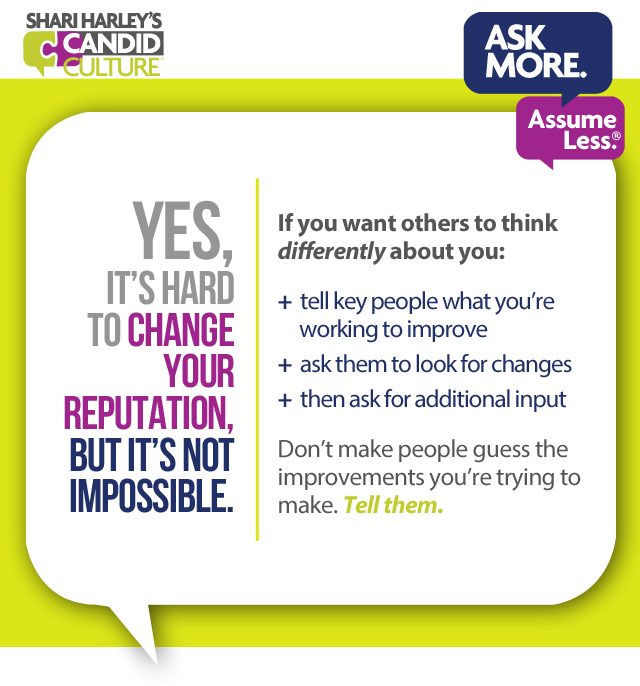
We know impressions are made quickly and are hard to change. But it’s not impossible to repair your reputation. If you want to change how people see you, I’d suggest being very overt about the changes you’ve made. Don’t simply alter your behavior and wait for people to notice. They likely won’t.
Once people have formed an opinion about you, that’s often their opinion for as long as they know you. For example, if you have a tendency to be late, even if you periodically show up on time, your friends and coworkers will think of you as the person who is always late. If you work with someone who tends to miss deadlines, even if she periodically turns work in on time, you’ll think of her as someone who misses deadlines.
Once people make a decision about us, that’s often how they’ll see us for the duration our relationship. So if you want to repair your reputation, you’re going to have to do it overtly. Making changes and hoping people notice, won’t produce the desired result.
Here Are Eight Steps to Repair Your Reputation:
- Ask people who can impact your reputation and whose judgment you trust for feedback.
- Work hard to manage yourself and not get defensive. Respond to all feedback, no matter how hard it is to hear or how invalid it may feel with, “Thank you for telling me that. I’m going to think about what you said. I may come back to talk more later.”
- Once you’ve absorbed the feedback, decide what, if any, changes you will make.
- Change your behavior for a period of weeks.
- Return to the people who gave you feedback, tell them about the behavior changes you’ve made, and ask them to observe your behavior.
- Tell the people who gave you feedback that you’ll ask them for feedback again in a few weeks, and you want to know what they see.
- Return to the people who gave you feedback and ask what changes they have or haven’t noticed.
- Repeat steps 3 through 7 at least quarterly. Everyone periodically does things that can damage their reputation.
Overtly pointing out the behavior changes you’ve made, asking people who are important to you to pay attention, and give you additional feedback, is key to altering your reputation. Most people working to change their reputation don’t do this. They make behavior changes and hope others notice. If you want to alter your reputation and how others see you, you need to do so overtly. Tell people the changes you’ve made; don’t make them guess. Ask people to observe your behavior, and then ask for more feedback. And no matter how hard the feedback is to hear, don’t get defensive. Becoming defensive will ensure you don’t get feedback the next time you ask.