Archive for August, 2014
I always try to do the right thing. I try to remember and send cards for special occasions. Apologize for mistakes, or better yet, don’t make any. Listen more than I talk. Be a great boss. Keep in touch with friends near and far. Always take the high road. Never lose my temper or patience. Eat healthy. Get fewer parking tickets. I could go on and on and on. In short, I want to be perfect. And I’m annoyed that I’m not.
Lately I’ve begun to realize that my desire to be perfect is causing me stress, diminishing my happiness, and preventing me from pursuing things I really want. So here’s to overcoming perfectionism. I hope the steps here help all of us who are frustrated that we’re not perfect.
Overcoming perfectionism tip number one: When you make a choice, go with it. Don’t second guess yourself.
If you decide to skip a party, networking event, or class at the gym, you have a good reason. Don’t question yourself or say, “I should have.”
Overcoming perfectionism tip number two: Stop thinking that life has to look a certain way.
Maybe you’re in a job that doesn’t challenge you 100%, or you wish you were saving more money. Be careful not to buy into others’ views of how life should be lived. You’re living your life in the way it works for you.
Overcoming perfectionism tip number three: Don’t compare yourself to others.
Comparing ourselves to other people is normal and natural, and it’s the booby prize. There will also be people who are more successful, more fit, and more attractive than us. Those seemingly perfect folks have challenges and disappointments we will never know about.
Overcoming perfectionism tip number four: If you make a mistake, apologize once and move on.
I often feel badly for ‘mistakes’ long after they’re over. The other person is likely to have forgotten about the incident long after I’m still feeling guilty.
Overcoming perfectionism tip number five: Worry less what people think.
Human beings are wired for survival. Most people are so worried about themselves; they’re not preoccupied with you. So do your thing and assume the rest of the world is not watching.
Overcoming perfectionism tip number six: Try new things and be willing to make mistakes.
We won’t have anything different if we don’t do anything different. Learn a new skill, try a new way to solve a problem, and be willing to look silly and fail.
I’m hoping the tips above provide both me and my striving-to-be-perfect comrades some freedom. By suggesting you live your desired life, I’m not saying ignore responsibilities, be rude, or put yourself first all the time. I am saying that living life the way you think it should be lived, versus how you really want to live it, will diminish your personal happiness and satisfaction. And as far as we know, we only go around once.
Organizations are working hard at retaining employees. Employees are watching how their organization’s leaders and managers work, and often make career decisions based on the hours the most senior people keep. Not a recipe for retaining employees.
Many employees pay particular attention to how often managers and senior leaders take vacations and whether or not leaders attend meetings and respond to emails while they’re ‘off.’ Employees observe the late nights leaders and managers put in and the emails sent at 11:00 pm and on the weekends. I’ve heard lots of employees say, “If I need to work like my boss works to get ahead in this organization, I’m not interested.”

Managers, the key to retaining employees is to communicate expectations. If you’re available while you’re on vacation, but don’t expect your employees to do the same, set that expectation. If you send an email outside of regular business hours but don’t expect employees to respond until the next business day, tell them so. They don’t know. Many employees assume that if you email them at night, you expect a reply.
Instead of allowing employees to make assumptions about what managers do and don’t expect, set clear expectations. Be overt and clear. Tell employees, “I work most evenings and weekends, but don’t expect you to do so. And I work these hours because I enjoy it, not because I have to. If I email you outside of regular business hours, I am not expecting you to reply.” Retaining good employees begins during the interview process, when initial expectations are first set.
Managers, if you expect employees to check and respond to emails outside of regular business hours and to be available while on vacation, tell them. If working long hours is a criteria for promotion, set that expectation preferably during the interview process. It’s completely fine to expect long hours and for employees to be accessible outside of regular business hours. There is nothing wrong with either expectation. There is only a problem if employees don’t know that’s the expectation.
Employees, if your manager emails you outside of regular business hours and she doesn’t tell you whether or not she expects you to reply, ask. Simply say, “I often receive emails outside of regular business hours. How will I know when you need me to reply?” Likewise, if you notice your manager emails you on vacation, you can say, “I typically hear from you when you’re on vacation. Are you expecting me to check in while I’m off?”
The need to ask questions and set expectations goes both ways. Don’t wait to be told. Ask.
Managers and employees, ask these Candor Questions about working style preferences to aid in retaining employees:
- How do you feel about being contacted outside of regular business hours?
- If I need to reach you over a weekend or in the evening, what method is best?
- Would you prefer I text you so you don’t have to check your email outside of business hours?
- What time is too early and too late to call, text, and/or email?
Ask more. Assume less and make retaining employees easier.
When I led leadership development training for a large mutual fund company we offered a lot of training focused on helping people have hard conversations. Over time I realized that despite that I’d bought and offered the best training programs I could find, the training wasn’t helping. Managers didn’t give enough feedback and when they did give feedback, employees were often left confused, wondering what they needed to do differently.
I decided that what was missing was the conversation before the crucial conversation. It wasn’t that managers didn’t know what they wanted to say, many managers felt they couldn’t say what they wanted to say. There wasn’t sufficient safety or permission for giving feedback, so managers said little or delivered messages that were so vague, employees were left wondering if there was a problem. This is when the idea for Candid Culture was born.
 If you’re struggling with giving feedback, I doubt it’s the message that’s the challenge. The distinction between being able to tell the truth (as you see it) and saying nothing, is the quality of your relationship.
Think about the people – personal and professional – who can say anything to you. These are the people who can tell you that the person you’re dating is wrong for you, that a piece of clothing is not flattering, that you disappointed them, or dropped the ball. You may not enjoy getting the feedback, but you’re able to hear what they have to say and take it in, because you know they care about you and have your best interests at heart. You trust their motives. When you trust people’s motives, they can say anything to you. When you don’t trust people’s motives, there is little they can say.
If you’re struggling to give feedback, evaluate your relationship by asking these three questions:
- Does this person know that I have her back under any circumstances?
- Does this person trust me?
- Does this person know that I accept her just as she is?
If the answer to any of the questions above is no, it’s not giving feedback you’re struggling with, it’s the quality of your relationship. Work on building trust with this person and you’ll be able to say whatever you feel you need to say.
Here are five steps to building trusting relationships:
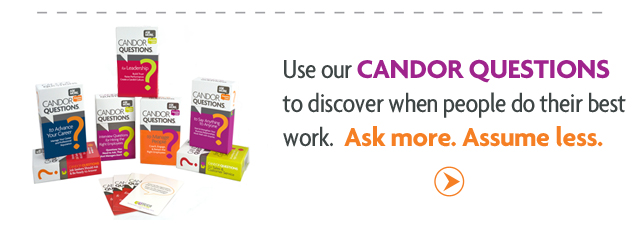
- Get to know people better than you know them now. Download free conversation-starting Candor Questions to have these conversations.
- Tell people you want them to succeed and demonstrate that by being supportive of their efforts.
- Don’t be judgy. No one likes to be told that she is wrong.
- Set the expectation that you will give both positive and negative feedback when appropriate, because you want the person to win. And if you remain silent, you are of no help to the other person.
- When you deliver feedback, be extremely specific. Feedback that is specific will be received much better than vague feedback, which is typically judgmental.
When people know that you respect and want good things for them, you have a great deal of freedom to speak up. When people don’t trust your motives, giving feedback is almost impossible. The recipient will become defensive and dismiss whatever you say, rationalizing that you don’t like her and never have.
Worry less about giving feedback –for now. Instead, build trust. Get to know people better, then work on giving feedback.
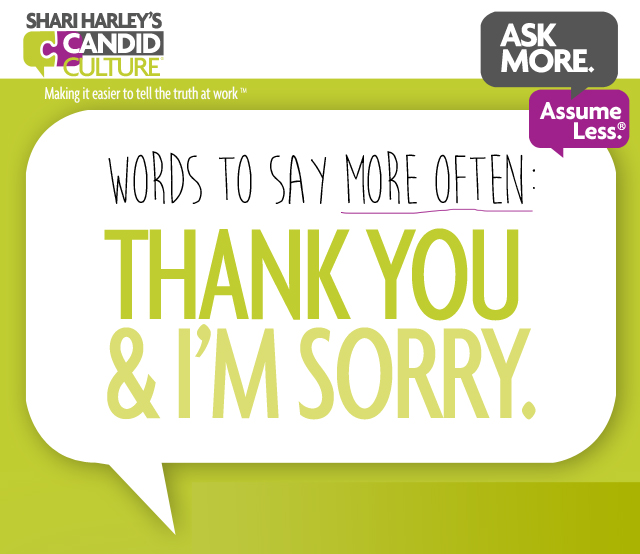 If a friend asked you to do something, you did it, and she didn’t say thank you, you’d probably think twice the next time she asked you for something. The people you work with are not different.
If you don’t say thank you to employees, they too will stop doing things you think are important. Human beings thrive on recognition and relationships. We need both to survive. And when we don’t feel connected or appreciated, we find appreciation elsewhere.
If you think saying “thank you” to the people you work with is unnecessary, consider this example. An overwhelmed employee feels strapped for time. She produces a 30-page report every month that takes hours of her time. No one has ever talked with her about how the report is used and why it’s important. So when she is overwhelmed and decides that something needs to go, she stops doing work that appears not to add value—the 30-page report. It turns out the report reflects her department’s results and is reviewed by the CEO, CIO, CFO, and COO. Oops.
There are managers who think that a paycheck is enough of a thank you to employees (old school) and that any other thank you to employees is unnecessary (this doesn’t work). Human beings want to make a difference.We don’t like doing tasks we perceive as not being impactful. So tell the people you work with that their work matters by saying thank you, and how you say thank you matters. Saying, “Thanks for doing such a great job on that project” doesn’t go nearly as far as saying, “Thank you for taking over the Briggs proposal. You shepherded the proposal from beginning to end and made sure no detail was overlooked. You made all of us look good and we would not have won the business without you.” Like all feedback, specific feedback is meaningful and drives future behavior. Vague feedback feels inauthentic and doesn’t tell the recipient what to replicate in the future.
Onto why it’s important to say “I’m sorry.” Some people think that saying you’re sorry puts you in a weak position and that you will lose employees’ respect. This couldn’t be further from the truth. Strong people admit when they’re wrong. Weak people can’t admit mistakes.Admitting fault ingratiates you to other people. Refusing to take responsibility alienates you.
It’s very frustrating to work hard and never be told “thank you.” Likewise, it’s upsetting when people don’t apologize for dropping the ball and making mistakes. It’s so easy to say “thank you” and “I’m sorry,” and it costs nothing. The more you demonstrate appreciation for the people you work with and take responsibility for your mistakes, the harder people will work on your behalf.