Archive for May, 2014
 When I landed my first ‘real’ job after graduating from college I was so scared, I almost turned the job down. It took me five years to finish my first book, How to Say Anything to Anyone, in part because I was afraid no one would like it.
It seems anything worth doing is worth fearing.
I’m not talking about taking risks for the sake of risk –driving as fast as your car can take you, not paying your bills to see what will happen, or offering a counter point of view at work for the sake of doing so. I’m talking about pursuing the things you really want, that speak to your true purpose.
Being afraid doesn’t mean you can’t do something, nor does it mean that you shouldn’t. Feeling some fear just means what you want is outside of what you know you can do. But it’s the edge and the unknown that is juicy and rich.
During the past two years I’ve been pursuing things I’m terrified of, that I don’t know I can do. Yet I want these things, so I pursue them in the face of fear. And I have to admit, that as I get closer to getting what I want, the fear doesn’t dissipate, it actually gets worse . As I can almost taste having what I want, I get more scared. And sometimes I pull back, thinking, maybe I don’t really won’t those things. Maybe I was wrong. Then I remember why I want what I want and step back into the pursuit, despite the fear.
Don’t misinterpret fear as a reason not to do something.
A few suggestions for how to face your fears at work:
1. Write your desires down and/or tell people what you want.
- You’re more likely to get what you talk about having.
2. Take one step towards having what you want.
- Talk to someone who either has what you want or can help you get what you want.
3. Put yourself in the place of most potential, where you can get what you want.
- If you want to work in a certain department, express interest in working on a project that serves that department.
- Tell your boss and people in leadership in your desired work area of your interest.
- Apply for a job in that area.
4. Be positive and persistent.
- No one wants to give a complainer an opportunity, and takes time to make a shift.
The key is to take one step, then another, then another. And when you feel fear, don’t let it stop you. Fearing the next job or opportunity doesn’t mean you can’t do it well, it just means you haven’t done it yet.
When you need encouragement to face your fears, hang our inspiring magnets at your desk. You have to believe in yourself just as much as the people around you believe in you.

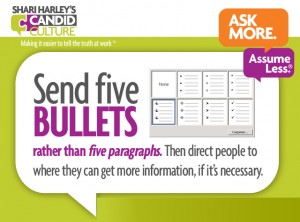 People are drowning in data, more specifically in email. If you want people to read your communications, send short emails and fewer of them.
How often do you open an email, see its daunting length, close the email promising you’ll get back to it later, but don’t. Then you bump into the sender a week later and he asks, in an annoyed tone, “Did you get my email?” And you attempt to conjure up the email, distinguishing it from the 1500 you’ve received since.
Some people like receiving lots of information, others don’t. Ask your internal and external customers how much information they want to receive, in what format, how frequently, and with how much detail. And when you can, accommodate their preferences.
I’m a big picture person. For me, more information is not necessarily better. I’ll read five bullets. I won’t read five paragraphs. I’m frequently guilty of opening a long email, becoming overwhelmed, deciding I don’t have time to read the entire message, promising to read it later, and by the time I go back to the message, I’ve typically missed a deadline.
You can say it’s my problem that I don’t read long emails, not the sender’s problem. And you’d be right. I should read every email I get in full. But when I don’t give the sender something she needs, because I was overwhelmed by the length of her email, it becomes her problem too. If you want people to respond and do what you’re asking, communicate how they like to communicate, whenever possible.
I’d like to say that people are so used to reading short text messages and Facebook and Twitter updates that they’ve been trained not to read anything longer than a few sentences. And there may be something to that. But the truth, is there are detail people who like a lot of data and there are big picture people who don’t. If you provide a high level summary – just what recipients need to know – followed by more details or information on where more details can be found, you accommodate both the detail and the big picture people.
When you write your next email or any other type of communication, consider, could this be said with fewer words? Do the recipients want or need this level of detail? Then, shorten your communications and accommodate both the big picture and the detail people. And you’ll be amazed at how quickly you receive the things you’re asking for.
And if that’s not working, go old school and use our greeting cards to write a note, because no one can resist and handwritten note.

How many times do you walk by something in your house or office and think, “I have to clean that up?” Or get in your car and think, “I really need to wash this thing.” Every day we put up with things that drain our energy and attention, but we often do nothing.
What you’re tolerating may be small –a disorganized drawer or desk. But it may also be bigger –an unsatisfying relationship, a job you’ve outgrown, or a policy with which you disagree.
I took a time management class years ago and the trainer helped us organize our Word files so things were easier to find. She asked the question, “What are you tolerating?” I thought it was a funny question in relation to my laptop’s hard drive. But after my files were organized and I could access things without searching for 20 minutes, I realized how much time I’d been wasting and what I was indeed tolerating.
What frustrates you, but you’re so used to it, you no longer even notice? Perhaps you’re tired of responding to emails late at night or on the weekends? Or frustrated by people who don’t keep their word? We train people to treat us as they treat us.
Here a few suggestions for how to say no at work:
Start cleaning up the small things that make you cringe each time you look at them. Perhaps start with your desk or a drawer you’re afraid to open. Then consider when you’ve said yes, when you meant no. These situations are harder than cleaning out a drawer because they involve other people.
If you’ve agreed to something you don’t want to do, you can often renegotiate. Saying no at work could sound something like this, “I said I really wanted to lead X project and realized that I don’t have the time to do the project justice. I think I need to replace myself. I’m sorry to suggest a change so late in the game. I shouldn’t have offered to take it on in the first place. It was too ambitious. Who do you think would be a good fit?” Retracting yourself is better than doing a poor job.
Or, “I realized I said I’d plan our next family reunion. I’d love to do it and don’t feel I have the time to do the event justice. Who do you think would take it on?”
If you’ve committed to something you really don’t want to do, it will likely show. You’ll resent it and might not do the best job. Both of which are bad for your relationships and reputation. So start speaking up and saying no at work. And if that feels too big, go wash your car. You’ve got to start somewhere.
Seven years ago today I left my corporate job and started what’s now Candid Culture. Thank you for your support and for working towards having a more candid workplace. Please enjoy 20% off all of our resources through Friday May 16th. Use code: 7YEARSOFCANDOR.
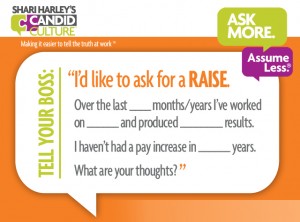 The time to ask for a raise isn’t at the end of the year. In fact, the end of the year, when compensation decisions have likely already been made and you’re competing with everyone else in your organization for a finite pool of money, is the worst time to ask for a raise. The time to ask for a raise is at the beginning of the year, and it could sound like this:
How to ask for a raise:
“Next year I’d like to take on more responsibility and be earning _____. What would it take to get me there? I’ve written a few goals. Can we review the goals together and talk about if this is the right course of action to help me get to the next level?”
Set yourself and your boss up for success in giving you a raise. Significant pay increases need to be justified and approved by others in the organization. And results justify raises.
A few steps to take to get the pay increase you want:
- At the beginning of the year, you and your boss should agree upon goals that are important to the organization.
- Agree that at the end of the year, goal achievement will position you for more responsibility and more money.
No manager will promise a raise a year out, but ensure your career path is a conversation that will be had.
Given that you may want to ask for a raise now, here are some techniques for asking for more money in the middle of the year:
- Schedule time to talk with your boss, so you’re sure to have her undivided attention.
- Bring a list of accomplishments from the past months or years. Be sure to document those accomplishments in whatever format and level of detail your organization’s decision makers’ like to get information. You’ll know that by watching how the leaders communicate.
- Give your boss a copy of the list.
- Be bold. Use words like, “I’d like to talk with you about my career. It’s been _____ months/years since I’ve had a raise. I’ve generated __________ results. Can we discuss what it would take to get me to the next level?”
- Don’t say, “This is awkward and I’m uncomfortable asking, but I’d like to talk about my compensation.” That’s not a powerful way to ask for anything.
The worst you will get is a no. You won’t get fired or ‘in trouble’ for asking. And if you get a no, ask, “What do I need to do to position myself for a significant pay increase in the next year?”
When asking for money, time, or resources, it’s easier to say no than it is to say yes. So give your manager something that’s easy to say yes to.
When asking for a raise, say:
- “I’d like to position myself for more responsibility and more money.
- What do I need to do to do that?
- What’s a reasonable time frame to make that happen?
- Whose support do I need in addition to yours?
- What can I do to ensure the leaders who will also impact the decision are knowledgeable about my contributions?”
You will not get what you don’t ask for. So be bold, but also be deliberate, planful, and smart about how you ask.